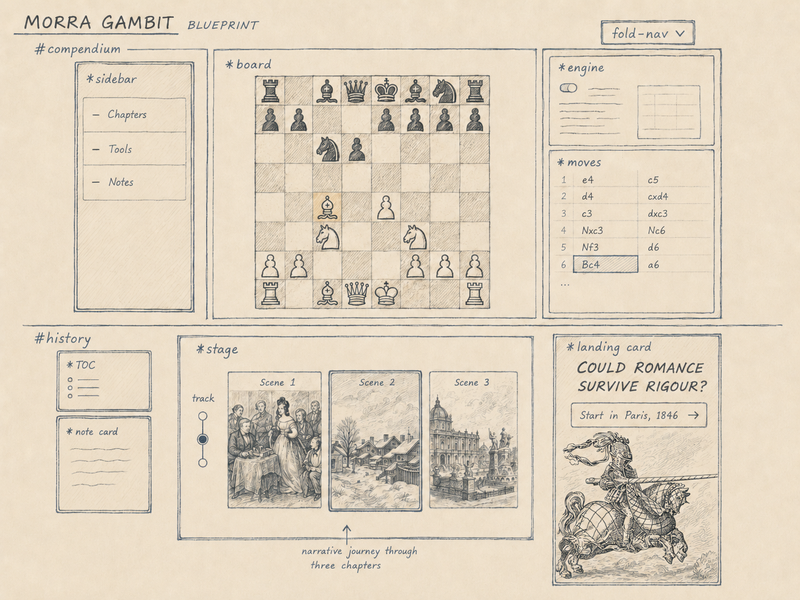
Morra Gambit: A History
Could romance survive rigour?I. Romantic Rudiments
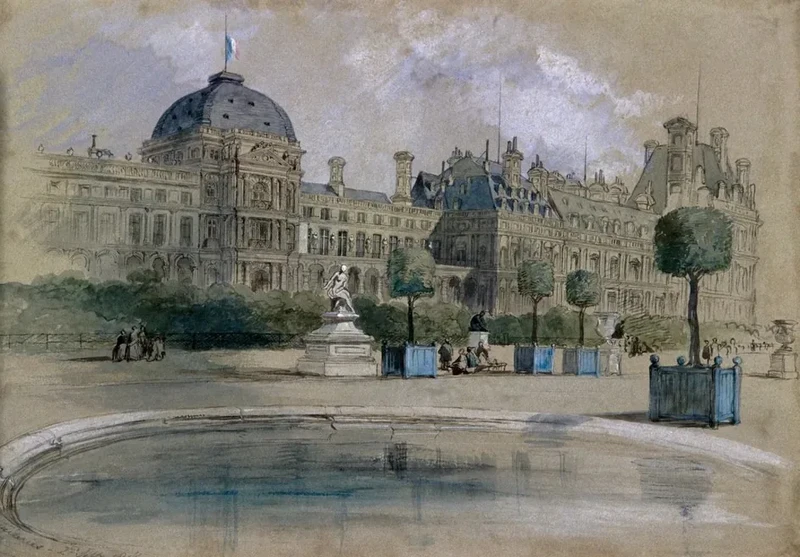
The Morra Gambit was born in the Romantic era. Kieseritzky–Vitzthum, Paris 1846 is considered the earliest recorded game. Lionel Kieseritzky (1806–1853) is remembered chiefly for his defeat in the "Immortal Game". Here, he is the victor.
The game is typical Romantic chess[1]: open position, pseudo sacrifices[2], and bold attacks that modern masters would file under reckless. Both sides err early, but the missteps are instructive, for they demonstrate how quickly the position might turn unfamiliar once the pawn is taken. That, in microcosm, is the entire argument of the Morra: the gambiteer does not purchase an advantage with the offered pawn; he purchases turbulence and attacking chances.
A century then elapsed, largely in silence.
Pierre Morra (1900–1969) founded l'Échiquier Niçois in 1946, which under his stewardship became the top club of Nice and the seventh in France. Around 1950 he published a booklet and a scattering of articles on the gambit, and the opening took his name because he was among the first to commit it to print. However, none of Morra's games in the gambit has been found — an oddity few openings can boast of their eponym.
II. Faith & Fiasco
Kenneth Ray Smith (1930–1999), founder of Chess Digest, came to chess by accident. An injury put him in a hospital bed in the late 1940s. Someone brought him chess books and he never recovered. The story goes that within six months he was of master strength.
The gambit bears his name[3] for his zealous devotion: Smith produced nine books and forty-nine articles on the Morra over thirty years. He was also a formidable poker player, who held that the two disciplines trained the same nerve: the gambler and the gambiteer are both in the business of calculated risk.
In 1972, San Antonio hosted an international round robin, setting American players against the best of Europe and the Soviet Union. Smith had his invitation, his theory, and world-class opposition seated across the board. He essayed the gambit three times. He lost three times.
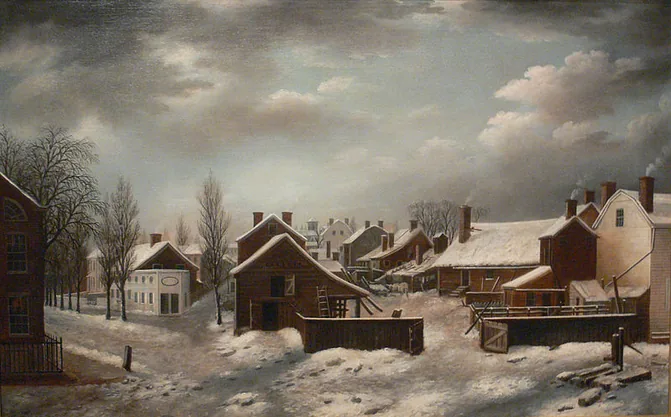
It is only fair to note the disparity in class: Smith was an FM in a field of grandmasters. But the result appeared to confirm the consensus that, against serious defence, the initiative quickly dissipates while the material deficit remains. Romance, it seemed, could not survive rigour.[4]
Annotating a game in which Smith's opponent had answered 1.e4 with the French Defence, Bent Larsen wrote, "1...e6? Stronger is 1...c5, which wins a pawn." The truth hurts.
III. Practical Potential
Vindication arrived from an unexpected quarter. Modern engines, cast as the Morra's executioner, became its champion instead: exhaustive calculation unearthed resources in positions human judgement had long since written off. Armed with silicon, the gambiteers found novelties that had eluded the pioneers.
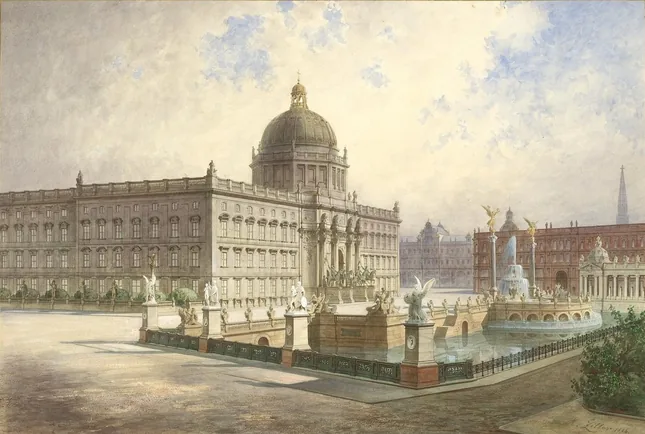
Foremost among them was Marc Esserman. At the 2011 U.S. Open, he defeated Loek van Wely within 25 moves. It was less a game than a demonstration. Esserman's opening preparation ran deep: its centrepiece the sacrifice 11.Nd5, its victim a 2700-rated grandmaster.
The following year Esserman published Mayhem in the Morra, to which Van Wely contributed a foreword — a gracious act from the book's principal exhibit.
The Morra's practical value exceeds its theoretical reputation. Engines confirm that with "best defence", Black is better. What engines do not capture is that best defence must be found over the board. Between objective evaluation and human play lies a chasm: clock, nerve, and fallibility.
Objectively, declining is a respectable answer. Yet to decline is to stand in the surf while insisting one is dry. By refusing the pawn, the decliner settles for a quieter game. By offering the pawn, the gambiteer invites an open clash and keeps faith with the Romantic era: daring, dynamic, uncompromising.
Notes
[1] Romantic School of Chess
In the Romantic era, players prized quick tactical play over long-term strategic planning. They favoured open games and gambits, chief among them the King's and the Evans. Pawns and pieces alike were jettisoned to keep the attack in motion, which often ended with the enemy king hunted down in the open.
As the game matured, it was subjected to more rigorous critique. The era is conventionally held to have ended with Wilhelm Steinitz (1836–1900), whose positional play and closed games ushered in what became known as the Modern school.
[2] Types of Sacrifice
Sacrifices fall into two categories.
Pseudo, or sham, sacrifices are merely part of a tactical combination. The benefit is usually plain and arrives within a few moves: the sacrificing player soon regains material of equal or greater value, or else forces mate.
Real sacrifices are rarer and more speculative. The player often plays on with less material for a long time, compensated by dynamic or positional advantages which he must capitalise on — or lose to the material deficit.
Kasparov–Topalov, 1999 contains both in consecutive moves: 24.Rxd4 is a real sacrifice, 25.Re7+ a pseudo one.
[3] Naming Conventions
The split between "Morra" and "Smith-Morra" is not a unique case.
Some classical openings carry more than one name:
| English | European |
|---|---|
| Ruy Lopez | Spanish Game |
| Petrov's Defence | Russian Game |
| Benko Gambit | Volga Gambit |
[4] Romance and Rigour
For a century the verdict seemed settled. What no one foresaw was that rigour, pursued far enough, would circle back: the engines meant to end romance for good have instead found grounds for it in positions no human would have dared to enter.
The tension is not peculiar to chess. In any pursuit that demands both, convention sets them in opposition — one living on novelty and spontaneity, the other on discipline and structure.
Yet the opposition rarely holds up in practice. Spontaneity alone exhausts itself soon enough; the discipline supposed to smother romance more often turns out to be the frame that holds it upright.
Links
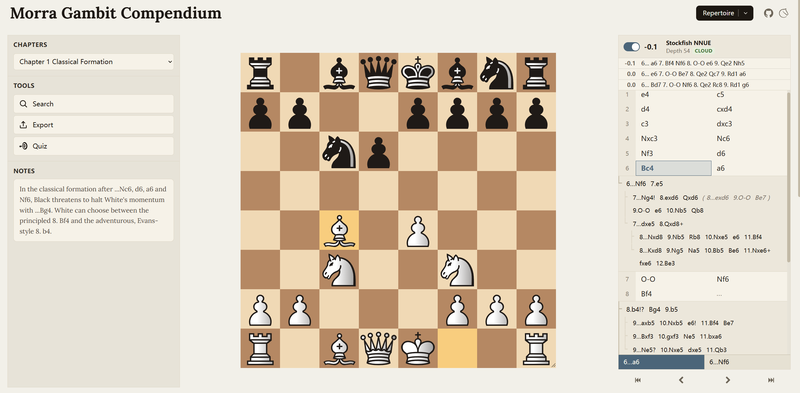
I built a website for the Morra Gambit: history (the article above) and repertoire.
The repertoire is essentially a study with two (hopefully) useful features: fuzzy search and quiz mode.
The website is free and doesn't require an account.
website: zl050.github.io/morra-gambit-compendium
GitHub repo: github.com/zl050/morra-gambit-compendium
I'd genuinely appreciate you trying it out. Thanks for reading!