
Chrome
Summer Lock in Blog 1
This is the first blog in the series of reaching your prime that starts in the summer. In this blog we will go through some of the most common endgames.
Have you heard the saying that chess is 20% openings and 40% middlegames and 40% endgames. Well that's why I thought lets build up on that theory. As we have seen the endgame is quite vast but if you start noticing patterns it becomes much easier. So in todays blog we will be looking at one of the most common endgames! The Capablanca Endgame!
The Capablanca Endgame: Mastering the King and Pawn Basics
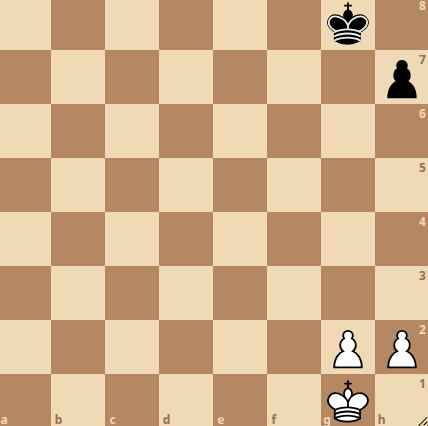 This is the starting position. Before reading how to continue I would recomend you play this out with stockfish level 6-7 on lichess. But how do we win here as white? Well I will show you what I did against stockfish myself and how it should be done.
My game
I played with level 8 to show you guys how to play against the best moves.
The Process
So basically what you want to do is, you want to bring your king out first. If it was only white to move the whole game and black never got the chance to move, white wants to put their king on h6. But since black can move we want to be getting our king near the h6 square but not on it. So after both players get their kings out, white wants to give black the opposition. Then take it back with h3.
Note: Don't play pawn g4 directly because that causes the kings way to get close to the h6 sqauare or f5 sqaure (this square is important as we will see) to get blocked. So we will play h3.
Black wants the opposition because than it will be a draw so they play h6. But fortuanetly we have our g2 pawn and we push it one step. This doesn't block the kings way, gives white the opposition and lets white have a tempo in the back pocket. Then the king needs to move to e6 because remember if the king goes back the 7 file, black just allows our king to get closer to our goal! So ke6 is best.
Then we will play h4. Not h4 before g3 becuase then king can get into the h5 sqaure. That was the square we wanted to control! This also causes some stalemates tricks where the king can get trapped. So remember to play h4 ONLY AFTER king e6!
Then the black king comes back to f6 and gets the opposition. That's alright because we have a reserve tempo but if we play it now the king can be closer to his pawns. That's why I prefer to play king e4 first and lure the black king away. After that is the perfect chance to play g4. But I think both variations transpose into one another. But this one is safer and after this we get the opposition again.
BUT instead of using the opposition we will outflank the black king. Outflanking means attacking something from the side. This is an important king manouvre. This restricts blacks sqaures, brings us closer to squares we want to go to, and lets us keep the opposition. After a couple of moves of outflanking, our king will get close to its motive. Notice how vital the f5 square has been for our kings way. Playing g4 at the start would make this manouvre almost impossible.
After this black will be forced to play h5. But taking is never good! Taking the pawn makes the position a draw because the h-pawn's critical squares will be controlled by blacks king.
Every pawn has critical squares. A pawn that is on its own side of the board has 3 key squares, meanwhile a pawn on the opponents side of the board has six key squares. Critical squares are the squares which:
-
If the stronger side's king stands there --> promotion is hard to stop.
-
If the weaker side's king stands there --> the pawn can be defended or taken.
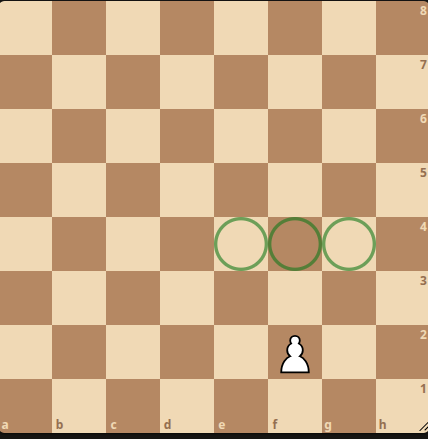
Here are the critical squares for a pawn on it's own side of the board.
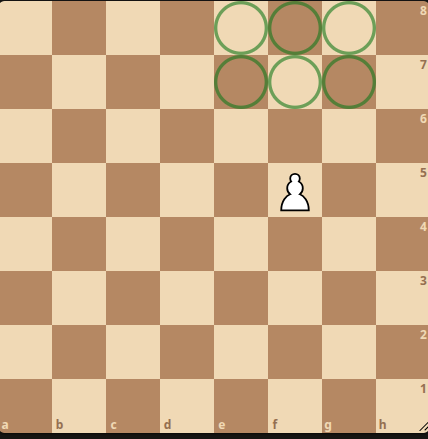
 Here are the critical squares of a pawn on the opponents half of the board.
 But back to the Capablanca Pawn Endgame. That's why we don't take the pawn on h5—we push! Then this position arises: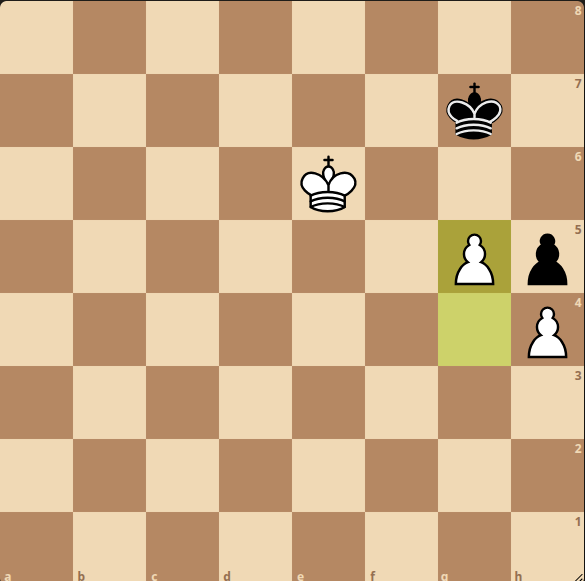
What's the plan here??
Well firstly, we want to push our g-pawn and promote it. The dream plan is to push the g-pawn forward with check, forcing the black king away so we can easily pick up the h5-pawn.
But if that doesn't work, we look at our second, more realistic plan: force the black king to come down. The most critical move after Black plays ...Kg6 is for us to play Kd6. This intentionally allows black to play ...Kf5, giving up our vital square. Why do we do this? Because when their king comes up, we will slowly twist the knife and squeeze them out of the position by outflanking! If their king chooses to go down instead, then we just march our pawn up and promote.
The End and Support Me
That's it for this blog. Remember this is part 1 in the blog series of Summer Lock in! If you enjoyed, please feel free to like and join my team The Classroom of the Elite. This way you show your support, which keeps me motivated to write more blogs!
Together we shall grow!
– Ayanokoji Kiyotaka
You may also like
 Ayanokoji_Kiyotaka55
A Guide That Will Help You Reach Your Prime
Every chess player hits a wall. Not everyone breaks through. This guide is for those who are ready. CM HGabor
How titled players lie to you
This post is a word of warning for the average club player. As the chess world is becoming increasin… Ayanokoji_Kiyotaka55
How to deal with Chess Downfall/Burnout
Everyone has bad tournaments. It's part of the journey. But when multiple bad tournaments stack up, … NM ZugAddict
Are you rated 1600? Good.
It's good to be 1600 and I will explain why Ayanokoji_Kiyotaka55
A Simple Guide to Time Management
Have you ever been in a completely winning position, only to lose on time? It’s one of the most frus… thibault