
How to Improve Chess Memorisation
Say what you like about chess improvement, but a large part of chess ability is the ability to actually remember what we have studied. And this is not just about openings. It’s about remembering everything to do with chess. Tactics, positional concepts, endings, anything!
Not just remember but to know the patterns and ideas so well that they are completely ingrained into our playing psyche. So much so that these winning patterns and ideas spring into our minds instantly at the board. From there we can use calculation to check if that exact pattern or idea works in that individual context. But how to improve chess memory?
Can we learn anything from memory champions who manage to achieve what appears to be superhuman feats of memory? Such as Kim Su Rim’s record of 2530 playing cards in an hour or Ryu Song’s record of 4620 random digits in the same time frame. Incredible, when the average person can memorise just 7 items in their short-term memories.
I dabbled around with these techniques myself for a few months, but even I was able to memorise lists of more than 400 items and 3 whole packs of playing cards. So, can we apply some of these methods to chess?
Well, yes and no, but more on that later.
What is essential is that we are at least using spaced repetition with our learning. Sites such as Chessable have this feature in-built, but we should study spaced repetition (correctly!) when it comes to books or other chess learning material such as learning from errors within our own games. It’s simply not enough to look at these once as the brain will forget the vast majority of material. If we want to remember what’s important then we simply must recap and recap over delayed intervals.
Intervals could look like:
Now
4 hours
24 hours
3 days
1 week
2 weeks
1 month
3 months
6 months
But it’s not enough to leave it there. If you want to commit the pattern or idea to long term memory (especially if you are an ageing adult...) you need to keep the plates spinning beyond this. Revisit these continually from time to time. Every 3-6 months at least.
The good news is each recap interval requires less and less time investment.
But what about other memory techniques?
Well, I haven’t found a way (and neither has anyone else) to utilise the full potential of the memory palace technique in chess, but there are a few things I’ve taken from my toe in the water in the world of memory. One is the ‘position of the day.’
What is position of the day?
What I’ve started to employ is a ‘position of the day’ where I take something chess related that’s really stuck with me that day. It could be a nice tactic, an interesting positional idea, a key endgame or opening idea – anything really.
Here’s one I looked at yesterday:
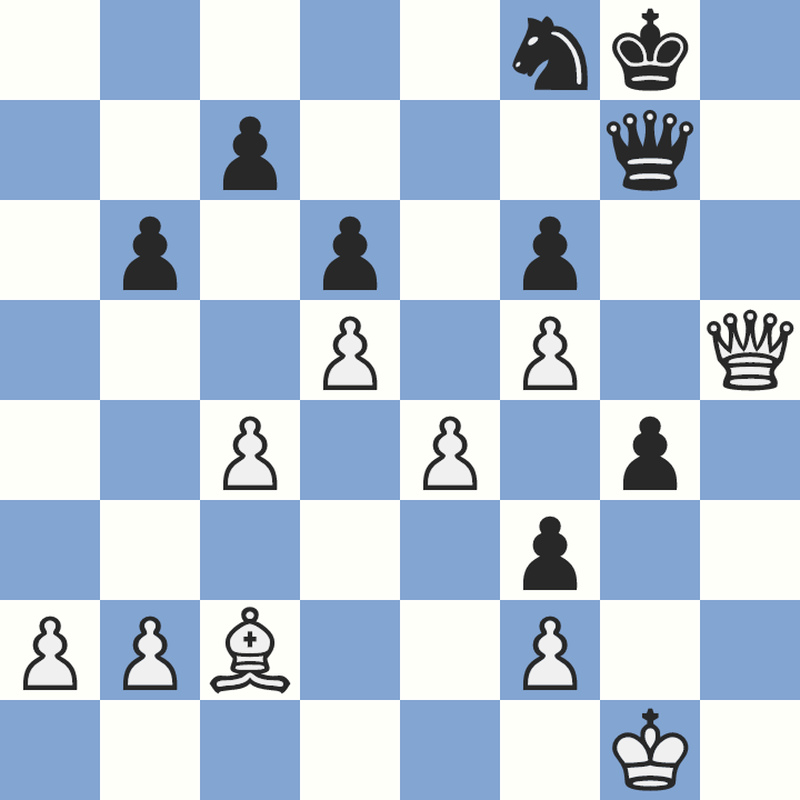
In this position Alekhine played 1.e5! and opened up the position. See more details in the video below.
Once I have this position what I do is set it up to a physical board and go over the variations and ideas – and the ‘what ifs’ that might go beyond the puzzle solution. Old school analysis if you like. Engaging with a position like this helps memory and it’s what chess players have been doing for centuries. After that I learn something to add context to this position. So, I researched Alekhine’s opponent as I’d never heard of this Johner guy. A quick look on Wikipedia tells me:
Hans Johner was a Swiss chess champion and IM (1889-1975) who was also an accomplished musician. He also had an older brother (Paul Johner) also a chess master.
There. I have a little context and colour that I can use with this position to aid memory. So, when I see this position again (and I will because I will recap it many times!) I will say, ‘ah, this is the position where Alekhine played Hans Johner in 1934. Johner was a Swiss IM and a talented musician. He also had an older brother who was a chess master.’
*Memory nerd alert*
If I wanted to take that further, I could make up some colourful and silly - silly is good as it aids memory – image of this on that actual position. For example, off the top of my head, I could imagine the pawns or bishop acting like a Swiss army knife opening up the position as the black King plays the violin. This links me to the context of his opponent and the moves on the board.
What I will then do with the ‘position of the day’ is to think and try to visualise this before I sleep (thinking chess is better than sheep or remembering that I need to mow the lawn). I try to see this position in my minds eye and visualise the moves blindfold.
In the morning, If I’ve time, I could even push my memory and try to set this position up on the board. If I can’t do this exactly, that’s OK. It’s the engagement with the position that’s important.
You could try this too.
What could you do with the ‘position of the day’ after that?
You could collate key positions in a separate database or Chessable course – you definitely should store them somehow to recap and review! If you do this every day (or five times a week even) by the end of the year, you will have amassed a whole book of key positions directly relevant to you and will have trained visualisation and blindfold chess into the bargain. Try it out. What will your ‘position of the day’ be today?
...
If you liked this post then please give a like.
Thank you!
See more in the video below:
https://www.youtube.com/watch?v=3yIpwEi_QWo
My flagship Chessable course Common Chess Patterns (and the free Basic Chess Patterns) are available at the link below:
https://www.chessable.com/common-chess-patterns/course/13348/
Follow me on Gumroad for free resources, exclusive offers, and the latest updates from the channel.. https://8FuVgj.short.gy/YKB9YK
You may also like
 Benedictine
What Would Your Rating Be if You Stopped Making Stupid Mistakes?
Have you ever played a chess game you were really pleased with? Benedictine
The 0-1-2-3 Chess Calculation Method
Try this method if you're stuck in your calculations or you just want to get into winning habits. Benedictine