
doubao.com
Zukertort Opening
Opening Insights: Chess Openings Series
Hi, I am Jason. Today, let's talk about Zukertort Opening.
P.S,(It is my favourite Opening)
See this: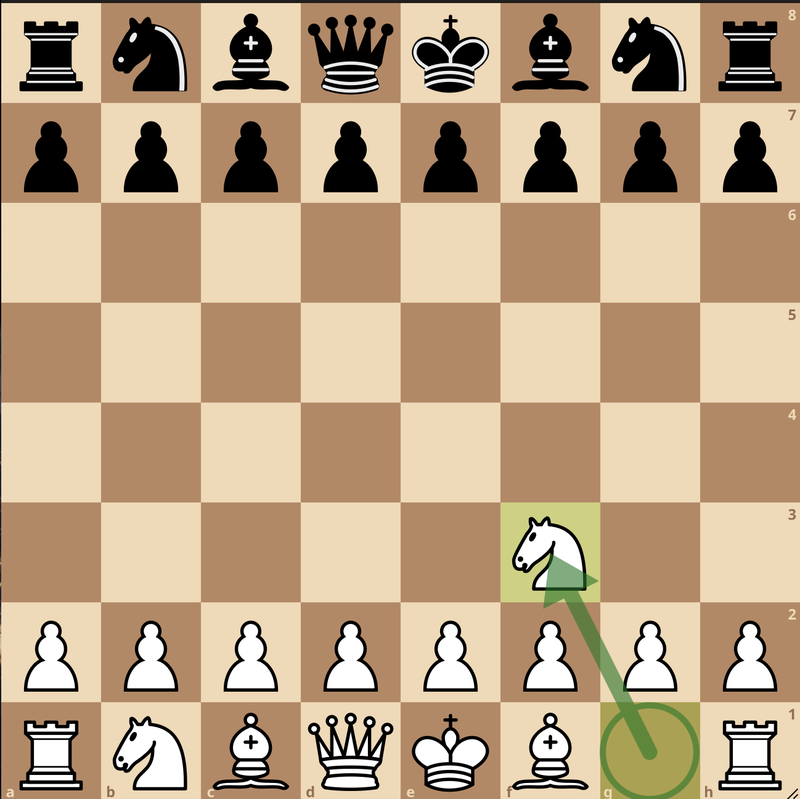
This is a Zukertort Opening!
The Zukertort Opening is an opening in chess that starts with 1. Nf3. It belongs to the category of open openings. However, since the first move is a knight instead of a pawn, it is often classified as a "Hypermodern Opening" or "flank opening". It is named after the famous chess player Johann Zukertort in the late 19th century. This master, who competed with Steinitz for the first world championship, was good at using this opening, making it gradually well - known.
Opening Definition and Core Characteristics
- Initial Move: 1. Nf3 (White moves the knight on the king's side to square f3).
- Core Concept: Instead of hastening to control the center by pawn advancement (such as 1. e4 or 1. d4), White first develops pieces, maintaining the flexibility of the central pawns while indirectly influencing the center (Nf3 attacks square d4 and creates conditions for future e4 or d4 advancements).
- Style Tendency: It belongs to the "circumventing control of the center" strategy, suitable for players who prefer strategic confrontations, piece coordination, and flexible formation transitions, rather than direct tactical clashes.
Historical Background
The Zukertort Opening is named after the 19th-century German chess player Johann Zukertort (1842–1888). He was one of the world's top chess players at that time. In 1886, he played the first official World Championship match against Wilhelm Steinitz (eventually losing with 10 wins, 15 losses, and 5 draws). Zukertort was good at starting games in unorthodox ways. 1. Nf3 was one of his signature opening moves, so this move was later named after him.
However, it should be noted that 1. Nf3 was not originally invented by Zukertort. Chess players had used it before him. But through a large number of actual games, he made it popular and gave it a symbolic meaning.
Main Variations and Response Strategies
After 1.Nf3, Black has various ways to respond, and different responses can lead to completely different opening systems. The following are several common variations:
1.Black should respond with 1...d5 (the most common response)
Black directly controls the center, and at this time, White has several options, leading to different branches:
- 2.d4: Transfers to the early stage of the Queen's Indian Defense or Nimzo-Indian Defense. White chooses a symmetrical pawn formation and develops pieces later through c4 or e3.
- 2 .c4: Enters the typical position of the Reti Opening. Instead of immediately closing the center, White probes Black's center through c4 while retaining the possibilities of d3 or d4, focusing on the activity of pieces.
- 2 .g3: White prepares to fianchetto the kingside bishop (Bg2), controlling the long diagonal. Subsequently, White may play d3, 0-0, Nc3, etc., forming a solid "hypermodern" formation.
2. Black should respond with 1..Nf6 (symmetrical response)
Black mimics White's move of developing the knight on the kingside, forming a symmetrical structure. At this point, White's common choices are:
- 2 .d4: Transfers to the symmetrical variation of the Queen's Pawn Game, and may later evolve into the Tarrasch Defense or the Indian Defenses.
- 2 .c4: Enters the transition of the English Opening. The white side expands the queenside through c4, and may later play Nc3, e3, etc., to build a flexible formation
- 2 .b3: The white side prepares to fianchetto the queenside bishop (Bb2) to control the central diagonal, which belongs to a stable "piece - priority" strategy.
3. Black should respond with 1...e5 (Central Counterattack)
Black directly advances the e-pawn to fight for the center. At this time, White usually chooses:
- 2 .e4: Forms a symmetrical center (e4 vs e5), transitioning to a position similar to the King's Pawn Game, but since the knight has already moved, complex variations like the Ruy Lopez may be avoided in the subsequent play, and it tends to be more simplified.
- 2 .d3: White does not close the center but chooses a steady development, preparing moves like Nc3, Bg5, or f4, gradually expanding the space.
4. Black responds with 1...c5 (Transposition to Sicilian Defense)
Black advances the c-pawn on the queenside. If White plays 2. e4, it directly transposes into Sicilian Defense; if White plays 2. c4, a symmetrical pawn structure is formed, and White may break through the center with d4 later.
Opening Advantages and Suitable Players
Advantages:
- High Flexibility: 1. Nf3 does not commit to a fixed central structure. White can convert to the Reti Opening, English Opening, or Queen's Pawn Opening according to Black's response, avoiding getting into complex variations familiar to the opponent.
- Priority of Pieces: Developing the knight in the early stage conforms to the principle of "rapid piece development". Nf3 attacks the d4 square, indirectly restricting the advance of Black's central pawns, and at the same time creates conditions for kingside castling.
- Avoidance of Sharp Variations: Compared with 1. e4 or 1. d4, which are likely to lead to complex tactical systems familiar to both sides (such as the Sicilian Defense, French Defense), 1. Nf3 is more suitable for players who hope to win through strategy rather than tactics.
Target Audience:
- Intermediate and Advanced Players: Those who are skilled at flexibly switching formations and controlling the strategic tempo.
- Players Who Dislike Complex Opening Theories: They can avoid numerous forced variations by playing 1. Nf3 and lead the game into a "bookless" strategic confrontation.
- Lovers of the Hypermodern Style: Players who prefer "yield first and then attack", and control the center through piece coordination rather than direct pawn advances.
Examples of Classic Games
In the 1883 London Championship, Zukertort himself used 1. Nf3 against Steinitz. Although he didn't win, he demonstrated the strategic potential of this opening. Among modern players, former World Champion Anatoly Karpov and hypermodern master Tigran Petrosian also often use the 1. Nf3 opening, preferring its solid strategic style.
In conclusion, the Zukertort Opening (1. Nf3) is an opening centered around flexibility and piece development. It is suitable for players who pursue strategic depth and avoid complex theories. It does not enforce fixed subsequent lines but adjusts the formation according to Black's response, ultimately achieving a balance between piece coordination and central control.
aslo this:
2014.02.04
Aronian, L. (2826)
Carlsen, M. (2872)
Ok, That is all.
Do you like Zukertort Opening? Tell me right down!!
You may also like
 Chejason
Van't Kruijs Opening & Hungarian Opening
Opening Insights: Chess Openings Series FM ChessisEternal
From 1400 to 1800: Chess Training Guide
Jumping from a 1400 rating to 1800 isn’t magic, luck, or the result of sleeping with a chess book un… Chejason
The Queen's Pawn Opening: The Solid Strategic Foundation in Chess
Opening Insights: Chess Openings Series HollowLeaf
Repertoire Builder v1.0
Built by a Chess Addict, for Chess Addicts CM Kingscrusher-YouTube
The Complete Guide to Chess Opening Principles -"King Safety Driven Development"
An unexpected perspective on the classic golden chess opening principles Chejason