
Freestyle: The Chess Format Where There’s Nowhere to Hide
Are You Playing to Create or to Preserve?The Freestyle Chess event that Magnus Carlsen just won left me with more than a championIt tasted like freedom. I’m not sure if it’s because for the past few weeks I’ve been thinking more than ever about what that word really means... but that will be a topic for another blog (I’ll happily leave that pending)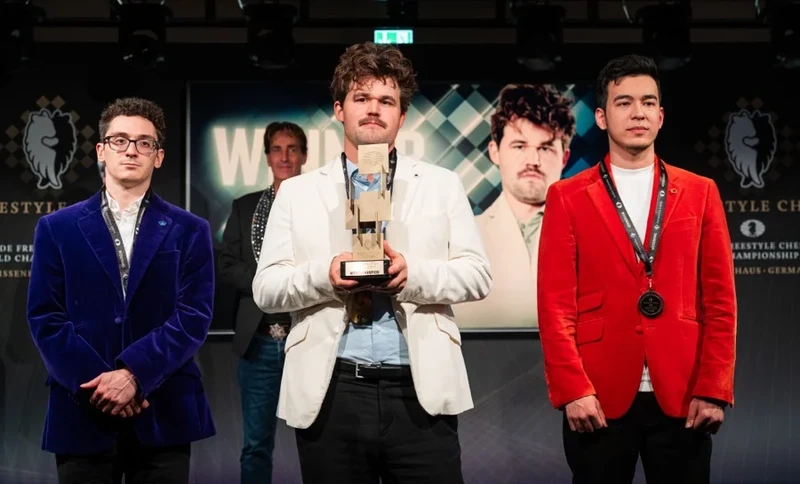
In Freestyle Chess (Chess960), there’s no memorized theory to protect you. There are no 20 prepared moves studied at home. The pieces start in an order we’re not used to, and precisely because of that, understanding matters more than memory. And that changes everything. Because when we can’t hide behind theory... we have to think.
When the Position Forces You to Decide
We can look at several of Carlsen’s games in this event — his 21st world title — where from the very opening he faces completely asymmetrical structures. Rooks on unnatural files, unusual piece coordination. development that doesn’t follow classical patterns. And yet, he almost always does the same thing: instead of simplifying, he keeps the tension, refuses automatic exchanges, and prefers flexible structures with active pieces.
It’s not the “safe” option. It’s the option that keeps questions on the board. That is practical chess in its purest form.
We may sympathize — or not — with certain elite players. But with Carlsen in particular, there is something difficult to deny: his constant willingness to take responsibility in uncomfortable positions. And in Freestyle, that’s gold.
Technique in the Middle of Chaos
In innovative formats like Freestyle, plans and strategies don’t always follow familiar patterns. There is no “book” confirming whether a decision is correct. There is only your dynamic evaluation:
Which piece is better coordinated?
Who controls the critical squares?
What break truly changes the structure?
Many players get carried away by the tactical creativity of the format. But Magnus showed another equally important lesson: when the position allows it, technique remains the most powerful tool. It’s not always brilliance, sometimes it’s simply deeper understanding.
What This Tournament Really Exposes
This tournament left me with a very good feeling. A small boost of energy to play a little more. But beyond the attractive format, what it really exposes is something deeper: In classical chess, you can hide weaknesses behind good preparation. In Freestyle, your understanding is exposed. When you can’t rely on memorization, you rely on judgment.
And that applies to us too. Because in real life, there is almost never a script; there is no theory — and certainly no recommended moves.
Only evaluation, only decision.
So... Are You Creating or Preserving?
Freestyle removes excuses. You can’t say, “I didn’t know the line.” You can’t blame theory nor play on autopilot. Every move is a real choice and that leads me to ask you a couple of questions. When you play your online games...
- Are you creating uncomfortable positions to grow?
- Or are you trying to preserve familiar territory to avoid mistakes?
My Reflection
The Freestyle title Carlsen won was not just another victory; it was a reminder that when memory disappears, thinking appears. When preparation disappears, judgment appears. When the comfort zone disappears, the real player appears. And that’s where real growth begins.
I’ll read you in the comments:
Would you dare to play more Freestyle to train your thinking, or do you prefer the comfort of familiar theory?
We keep thinking.
We keep building judgment. ️
You may also like
 WFM Chess4always
The True Master Sees the Invisible
Recently at the IV Menorca Open, the chessboard witnessed something far greater than just results: t… WFM Chess4always
Freestyle: el ajedrez donde no puedes esconderte
¿Estás jugando para crear o para conservar? WFM Chess4always