
How to Study Chess Openings

One of the more controversial topics in chess circles is whether an improving player should memorize opening theory.
Actually, “controversial” is probably not the best word, since there’s pretty much a consensus at this point:
- You shouldn’t blindly memorize opening moves without understanding them
- Memorization becomes more important as you get stronger
Anyone whose advice strays far from this is probably trying to sell you something.
Having said that, there’s a lot more nuance to this topic than most people realize, and I say that not just as someone trying to sell you something (our new site ChessFlow.org), but also because it’s true.
Side note:
Before diving into the topic of openings, I want to mention how I think Openings should fit into an overall study plan.
I’ll write more about this in a future article, and also go over my own study plan, but I’ll share my main philosophy here.
(Side side note note: this advice is for players who’ve already done enough puzzles and played enough games that they’re not regularly hanging pieces or blundering one move tactics. If you’re not at that level yet, disregard this side note and try to stop doing that. If you need help, I’ll be writing an article soon on the best way to improve at tactics and avoid blundering). Edit: we’re hosting a puzzle speed run battle on our tactics platform 11am Saturday, IM Lawrence Trent vs IM Tani Adewumi, watch live commentary by FM Lefong Hua on Twitch: https://www.twitch.tv/lefonghua/)
My philosophy of chess improvement:
In a perfect world, the best way to study chess is from the endgame to the opening.
Why? Easy... Each phase of the game is best understood by knowing what you’re working towards.
Say my goal was 2200. If I knew theoretical endings to 2200 level, it would be easier to understand how I should play in the endgame phase with more pieces on the board (often called “practical endings”).
Similarly, if I got my practical endings to 2200 level, I’d be able to better handle the late middlegame phase and know when to trade down.
Then comes the early middlegame, late opening, and finally the first moves of the game... with each progression, I’ll have a better intuition for why certain moves are better than others based on first hand understanding, not just trusting some heuristics or rules of thumb which I’d have to do when learning more forwards from Opening to Endings.
Unfortunately we don’t live in a perfect world, and so this approach has two major drawbacks:
- In the meantime before getting to the Opening phase, I’ll be laughed out of tournament halls for being lost after move 10 against 1600s while telling everyone “I swear I’m a great chess player, I’m 2200 at endgames, if only I could get to one where I’m not already in a lost position.”
- Mastering early middlegames before mastering openings means I’m trying to master the most complex phase of the game without any specific structures or openings to narrow my focus.
Put another way, playing at 2200 level in ALL early middlegames is certainly more difficult than playing at 2200 level just in e.g. Ruy Lopez early middlegames.
Which brings me to my “adjusted imperfect world philosophy on the optimal order to study chess”:
Work forwards and backwards at the same time.
In practice it looks something like this:
Step 1: Pick a rating goal.
Step 2: Study openings and theoretical endings until you’re playing them at that target rating level.
Step 3: Work forwards from the opening and backwards from theoretical endings while reinforcing what you’ve already learned so you don’t forget.
Step 4: Meet in the middle.
Step 5: Boom, rating goal achieved!
At least that will be my own approach to training, and I’ll be sharing progress reports along with these instructional blogs, so you can see how it’s working.
For this article I’ll be focusing on the Opening and early middlegame phase. Later articles will focus on the other phases.
https://youtu.be/-V3Z_DaIC7E?si=ezZwfsrDFIbGYxH2
Why study openings at all?
Studying openings has many benefits. These are just the ones I can think of, but feel free to write more in the comments if I missed any.
-
Confidence:
Playing the first moves quickly and confidently will make you feel like a chess god. By contrast your opponent will be quivering in their chair with each move you confidently bang out on the board.
Note: Don’t let confidence become overconfidence. Playing a blunder quickly because you misremembered theory, or blitzing out bad moves after your opponent surprises you may only work if you have a very intimidating presence at the board and an excellent poker face.https://lichess.org/study/KigPBHGP/ZHLaDZMt#38 -
Time advantage:
Knowing more opening moves than your opponent will win you some time on the clock, that you can spend later on more complex positions. By contrast, your opponents may reach time trouble before you and make more mistakes. -
Objectively better positions:
If you know your openings in depth, you can often trust that your opponent will be the first to deviate from the best path. Moreover if you play quickly and confidently, they may deviate on purpose to get you out of book, but at the cost of playing suboptimal moves. -
Better understanding of early middlegame plans:
This won’t happen by itself without targeted study, but the deeper you get with your knowledge of a certain opening, the more often you’ll see similar structures and middlegames. If you’re studying your games and learning from your mistakes, you’ll have a big edge vs opponents who don’t know the typical middlegame plans. -
Surprise factor:
Something that matters more at higher levels where people often look up your games and you’re more likely to have them in databases, but if you spend more time building out your repertoire, in particular knowing a few different openings for each side, you’ll be difficult to prepare against. Of course there’s a tradeoff when you focus your energy more on breadth vs depth, and this could be a whole topic for its own article. -
Conserving energy:
I got to 2000 rating without any study of opening theory. Ok that sounds like a point against studying openings, but let me finish: I had to fight back from a ton of lost positions, and my games would very often be the last ones to finish. This was not only bad because I’d lose steam by the end of a tournament especially with the grueling North American weekend tournament schedules, but it also put a target on my back as the guy who was holding up pairings every round.
How should you study openings?
Ok, so we see there’s a lot of benefits to learning openings, but how should we study them?
https://youtu.be/ANTPN6eEggU?si=eoBQYoMlJX904Ea4
Active Learning:
Watching YouTube videos is entertaining, but when compared to an approach of actively recalling what you’ve learned, there’s no contest: active learning wins.
Let’s go a bit deeper though.
What’s the absolute maximum you could extract from an Openings course?
At first it seems simple, remember all the moves in your course when you face them in a game (and that in and of itself seems like a daunting task...).
But there’s much more to an openings course than that.
There’s:
- Your moves
- Your opponent’s replies
- All the opponent’s moves available at a given branch.
- Comments / ideas behind the moves
- Evaluations
- Middlegame plans (often shown as arrows at the end of each line, along with comments)
Let’s go even further.
Take a random position from the course:
- Recognize which line it came from, or lines in case of transpositions
- Be able to visualize all the moves from that point, not just play the next move
All those aspects of Openings courses or skills you could glean from them are quite useful.
1)is self explanatory. 2) and 3) help you instantly recognize if a move isn’t in your course and it’s time to start thinking. 4) helps you connect the ideas with the moves and retain the moves better and for longer. 5) helps you make the right decisions both with what lines to play, and knowing where you stand objectively during a game. 6) helps you keep the momentum and confidence when you leave your theory. Aside from being a cool party trick, 7) allows you to save time by studying new lines from a point you already recognize by actively training that skill. Lastly, 8) improves your overall intuition for the course, and your ability to visualize.
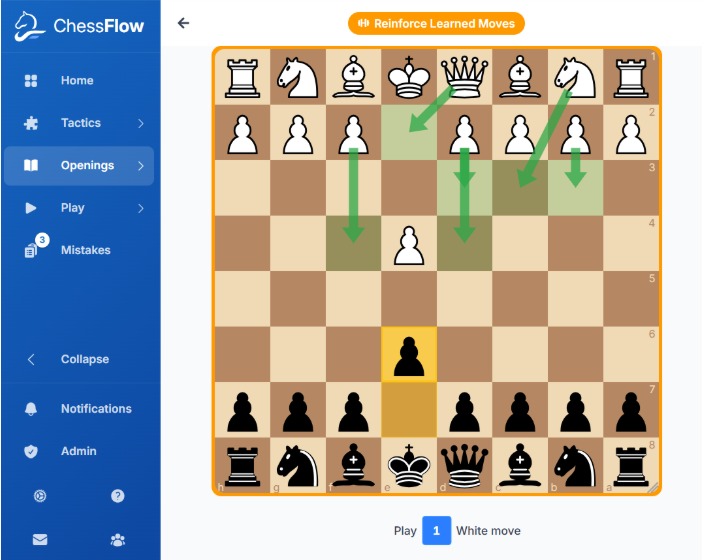
But how many of these are traditional move trainers actively training?
Amazingly, only one. 1) your moves. The rest are shown passively if at all.
Repetition, repetition... repetition:
Another key learning tool is repetition. Unless you have a photographic memory, you’ve probably noticed that repeating something over and over helps to remember it.
The good news is that the science for this has been figured out, “spaced repetition” right when you’re about to forget something is well established as the most effective way to get new knowledge into long term memory.
The bad news is that studying chess is not as simple as memorizing a list of Spanish nouns before your high school exam. Learning moves 25-30 in the Najdorf isn’t so useful if you don’t remember moves 6-24 for example, so order matters, and not all moves are equally important. The solution? Ensure you know the first few moves before moving on to the later moves. Surprisingly, most training websites aren’t doing this part very well.
But the other extreme isn’t ideal either. Too many reps on moves when you already know them well is tedious and a waste of time. If you’re backing up to move 1 each time, to help orient yourself when learning moves 25-30, you’ll be seeing those early moves extremely often.
The solution? To strike the right balance of not too many reps and not too few, it’s best to start training from a position where you know the moves well that came before, but need a refresher on the next few moves, and then you tack on the new moves at the end of the line (Don’t worry about setting this up yourself, our site does it for you). Another helpful shortcut is to play the moves by clicking the destination square only, which over thousands of reps saves you a ton of time.
But remember, we also want to get the maximum we can out of Openings courses. If we combine the active training rule with the repetition repetition repetition rule, and the list of different skills and knowledge packed into a course, it means adding more modes to the training, like comment / evaluation / middlegame plan active training with flashcards, showing a position and having you input the moves to get to it, visualization training, etc etc.
This may sound overwhelming, but it isn’t. That’s the beauty of active training, the feedback loop of seeing how much you’re actually learning and retaining, makes it possible to keep you at the edge of your comfort zone, regardless of where that comfort zone may be. And the multifaceted approach to training keeps you on your toes and helps you store moves better in your memory than traditional Opening move trainers.
Practice, Practice, Practice:
Okay, so you’ve got your opening training routine down, you grab your morning coffee, pop open your course, maybe put on some music, and bam you’re the Openings king.
Then you play a game OTB, their coffee machine isn’t working, they won’t let you put on your favourite tunes, your opponent plays a move on move 6 that’s not in your course. Time to freak out? No! You’ve trained for this exact situation. Ok maybe not the broken coffee machine, that’s just pure bad luck, really sorry about that.
The point is, that’s a normal part of chess, sooner or later you’ll leave your preparation and be on your own. But the more games you’ve played in that opening, the more mistakes you’ve made and learned from, the more comfortable you’ll be when you reach that point.
Now that’s easy to say as a blanket statement, but when should you start practicing? How should you balance study time vs practice time? Our site takes out the guesswork for that as well.
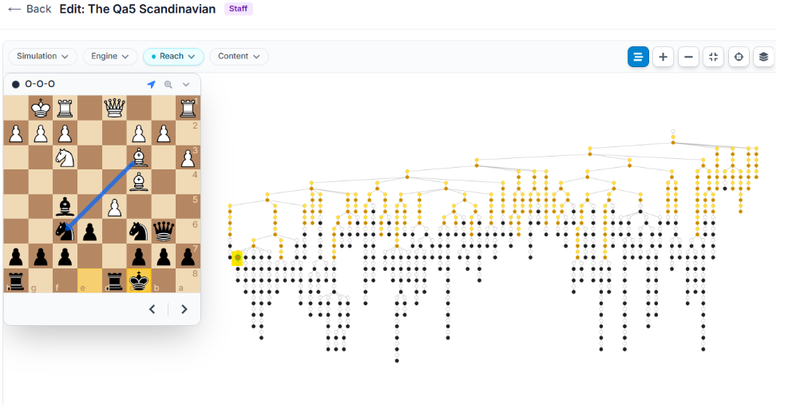
Firstly:
- you study deeper in more popular lines, and shallower in less popular lines. At this point you’ve only learned a third of the course but you’re already ready to get some otb practice. Unlike traditional trainers where you learn chapter by chapter and you could be completely caught off guard if you’ve never seen a line before that you haven’t covered yet.
Secondly, at any point during your training, you can play vs the engine to start getting that game feel, and get a handle on the middlegames you’ll face:
- Try to recall the opening moves that you’ve learned
- The site handholds you from there until the end of the course moves
- Now you’re on your own
The site will start recommending these games more as you finish more of the course.
Thirdly, the first mistake you make after theory ends will automatically generate a flashcard for you to review. Take a look at the engine lines and try to understand why you got the move wrong, and what you missed. You can add a note to the flashcard as well.
Fourthly, (funny how each time I increase the number it looks less and less like an English word, too bad I’ll stop before I hit eleventhly), oftentimes it’s difficult to understand why the engine suggests certain moves over others, even if you follow along the best lines.
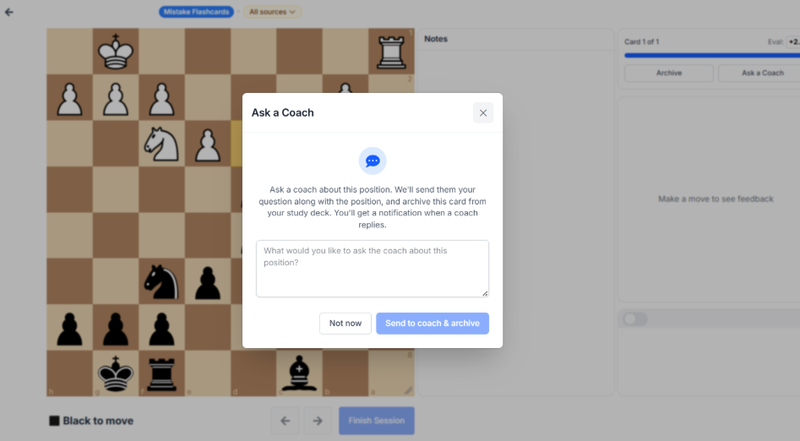
The stronger a player you are, the more you can gain from the engine, but there’s no substitute for a human explanation especially for those hard to understand engine moves, even as a stronger player.
Our site makes this straightforward, where you request the explanation, a titled player responds, and their explanation gets tagged to your flashcard. Once again, active learning and repetition. These mistakes are very high ROI to understand and fix, as they may reoccur in a later game, either in the exact same position, or a similar one.
I hope you enjoyed this article! I’ll be writing one on each aspect of chess studying, and different phases of the game, as well as highlighting different features on our site, and blogging about my own chess improvement journey. Check out our site at ChessFlow.org and let me know what you think in the comments below.
Happy chessing - may your chess games be wins, and may your coffee machine always work.
You may also like
 FM MattyDPerrine
Your Opponent Gives You a Gift Every Move (Most Players Never Open It)
Most players ask what their opponent is threatening. The better question is what their move stopped … IM datajunkie
You’re studying chess openings the wrong way (do this instead)
If memorising opening lines made you stronger, many club players would be masters. CM HGabor
How titled players lie to you
This post is a word of warning for the average club player. As the chess world is becoming increasin… thibault
How I started building Lichess
I get this question sometimes. How did you decide to make a chess server? The truth is, I didn't. flash3s
How you should create and execute your middlegame plans
The process of selecting and achieving your post-opening ideas ChessMonitor_Stats