
Mind Sports Olympiad
Inside Michal Mazurkiewicz's World Record: 16 Chess Games While Diving 700 Times
Chess has been played on mountaintops, in zero gravity, and even by mail - but nothing compares to the sheer physical and mental demands of diving chess.This extreme hybrid sport, which combines deep strategic thinking with intense physical endurance, has found its ultimate champion in Candidate Master Michal Mazurkiewicz from Poland.
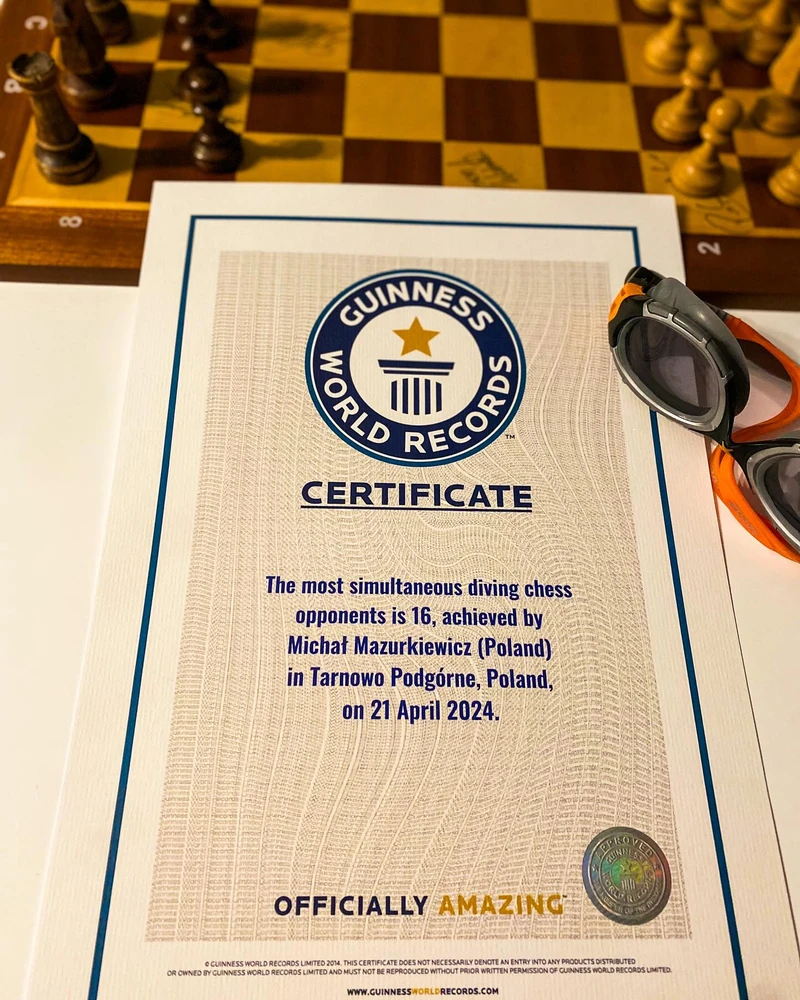
In an astonishing feat that pushed human limits, the 34-year-old recently entered the Guinness World Records by playing 16 simultaneous chess games while making approximately 700 dives in a single session. His record of "Most simultaneous diving chess opponents" isn't just about chess skill - it's a story of extraordinary preparation, superhuman stamina, and a passion for pushing boundaries.
What Exactly Is Diving Chess? (And Why It's the Hardest Chess Variant Ever Invented)
Imagine this:
- A magnetized chessboard sits at the bottom of a swimming pool
- Players must hold their breath, dive down, study the position, and make their move—all before surfacing for air
- There's no time to relax—as soon as you surface, your opponent immediately dives to respond
- Games are played at tournament time controls, meaning serious calculation is required
"It's like playing blitz chess while running sprints," Mazurkiewicz explains. "Your brain is working at 100% capacity while your body screams for oxygen."
The sport was invented by Elan Ilfeld, organizer of the Mind Sports Olympiad, as a way to test both cognitive and physical endurance. Since its creation, it has developed a cult following among chess players and freedivers alike.
From Chess Prodigy to Diving Chess World Champion: Michal's Journey
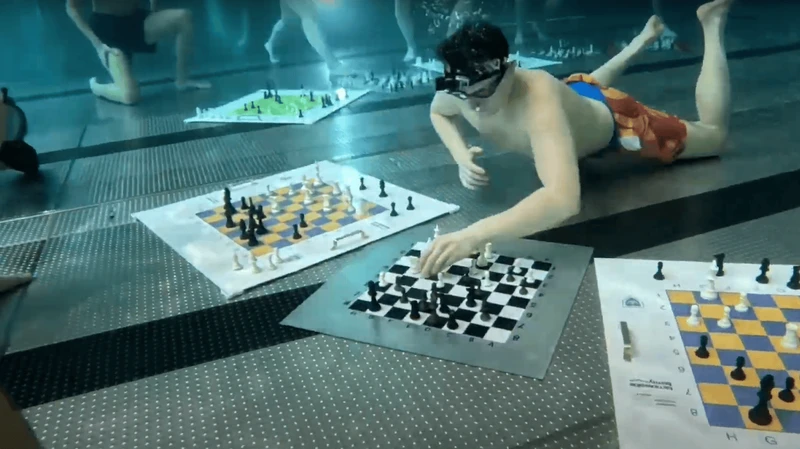
Mazurkiewicz was no stranger to high-pressure chess. A lifelong player with the Candidate Master title, he had competed in numerous tournaments. But his path to becoming a three-time Diving Chess World Champion began unexpectedly during the pandemic.
"I suffered a back injury that limited my ability to sit for long periods," he recalls. "Swimming became part of my rehabilitation, and when I heard about diving chess, I realized it was the perfect challenge for me."
After dominating the Polish Diving Chess Championships in 2021, Mazurkiewicz set his sights on something even more ambitious: a Guinness World Record attempt that would put this niche sport on the global map.
Inside the Record-Breaking Attempt: 700 Dives in 100 Minutes
The logistics of Mazurkiewicz's attempt were staggering:
The Physical Demands
- Estimated 700 dives over nearly two hours
- No breathing equipment allowed—just pure lung capacity
- Water temperature of 28ºC (82ºF) to prevent hypothermia during the extended session
- Continuous movement between 16 boards without rest
The Chess Challenge
- All 16 opponents were rated 1400-2450 FIDE, including one International Master
- Required to score at least 80% (13/16 points) to qualify for the record
- Multiple camera angles documenting every move for verification
- No takebacks—any accidental move stood as played
"The hardest part wasn't the chess or the diving alone," Mazurkiewicz reveals. "It was managing the cognitive load while oxygen-deprived. After about 50 minutes, every decision felt like solving a puzzle while being strangled."
The Psychology of Extreme Chess: How Your Brain Changes Underwater
Neurologists who studied Mazurkiewicz's attempt noted several fascinating effects:
- Time dilation: Subjects report time moving differently underwater, with seconds feeling like minutes
- Tunnel vision: The brain prioritizes only the most critical information when oxygen is limited
- Enhanced pattern recognition: Some players report improved tactical vision due to heightened focus
"Your mind goes into survival mode," Mazurkiewicz describes. "You stop thinking about anything except the most forcing lines. Surprisingly, this can lead to more accurate play in some ways."
The Aftermath: A New Frontier for Chess Sports
Mazurkiewicz's final score of 13.5/16 (including a loss to the IM) secured his place in history. But more importantly, it sparked global interest in diving chess:
- Training programs now combine chess study with apnea exercises
- New tournaments are being organized worldwide
- Sports scientists are studying the benefits for cognitive performance
"I'm convinced 20 opponents is possible," Mazurkiewicz says with a grin. "But more than that, I hope this inspires people to see chess as the ultimate full-body sport it can be."
Could You Handle Diving Chess? Try This Beginner Challenge
For readers inspired to test their limits:
- Set up a chess puzzle near your pool
- Take a deep breath and dive down
- You have 10 seconds to find the solution before surfacing
- Repeat for 5 minutes straight
"Most people are exhausted after just three puzzles," Mazurkiewicz laughs. "That's when they understand what this record really means."
The Future of Extreme Chess Sports
As chess continues evolving beyond traditional formats, Mazurkiewicz's record stands as a testament to human potential. From underwater chess to high-altitude matches on Everest, players are constantly finding new ways to challenge themselves.
"Chess isn't just about sitting quietly anymore," Mazurkiewicz concludes. "It's about pushing limits, both mental and physical. And we're just getting started."
Michal Mazurkiewicz's incredible Guinness World Record in diving chess proves that chess is more than just a mental battle - it's a test of endurance, creativity, and sheer willpower. Just as he redefined what’s possible in chess, platforms like CircleChess are revolutionizing how players train, compete, and improve.
Whether you're exploring extreme chess variants or looking to sharpen your classical game, innovation is key. Could diving chess be the next big trend? Maybe. But one thing’s certain - chess continues to evolve in thrilling new ways. For cutting-edge training tools and AI-powered coaching, check out CircleChess and take your game to uncharted depths - no swimming required!
You may also like
 CircleChessTeam
The World's Biggest Chess Tournament by CircleChess with Free entry & Rs 5 Lakh
In the ever-evolving world of chess, CircleChess, Proudly endorsed by World Champion Gukesh who stan… CircleChessTeam
India’s Largest Free Chess Initiative for Schools Opens National Onboarding
India is set to witness one of the most ambitious school-level chess movements in its history. The N… CircleChessTeam