
Models of Expertise - Stages from Novice to Master - Introduction
Is there a universal process from beginner to Master? Examining the main theories of expertise in relationship to chess performance.
Most chess players who seriously study the game do so to improve their performance, achieve a higher rating, and demonstrate their newly developed skills by victory in casual, club, internet, and tournament play. Although a few intellectuals may study chess for the pure joy of puzzle solving and sharpening mental skills, generally, chess is a competitive game. The desire to win, ego, is the motivating factor. Once the skills are achieved, the rating follows, along with victory over former equals and adversaries. Often, children study until they can beat their dad or coach or gain recognition in formal tournament competitions. Some admire a higher internet rating as a sign of personal progress boosting self-confidence. The amount of available chess educational material is overwhelming. Students of the game can be perplexed by the path of improvement, with countless various systems and Master coaches with different methods. One already on the path of chess improvement often finds it difficult to chart their progress, despite dedicated study, coaching, and training, other than by winning more games and achieving a higher rating. In this series, we will examine the main models of expertise and try to understand the various paths from novice to Master.
From the dawn of psychology, chess has been important for studying many topics, including intelligence, decision-making, memory, and expertise, later computer science and artificial intelligence. One reason for the interest in chess is the clearly defined levels of performance measured by the rating systems. Ratings are assigned based on past performance and predictive of future performance. Each game was worth 32 rating points in the early USCF rating system. So, two players with the same rating have equal expectations, where the victor gains 16 rating points, and the loser loses 16 rating points. A player rated a class higher (200 rating points) is expected to win over 75% of the time and would win 8 points for a victory and lose 24 points for a loss, while the lower-rated player is expected to lose 75% of the time would only lose 8 points, and gain 24 points for a victory. A 400-point difference is nearly insurmountable, so winning against someone 400 points lower would only earn 1-2 rating points, whereas a loss would cost over 30. Beginners start in the low hundreds, and Master is awarded with a rating of 2200. A Grandmaster (~2600), the world-class player, is expected to beat a mere weak master in nearly every game. So, the path from beginner to Master has five distinct levels, and the player, having achieved the higher level represented by the higher rating, can beat the lower-class player in nearly every game. Hence, chess was an early subject for studies in the stages of expertise.
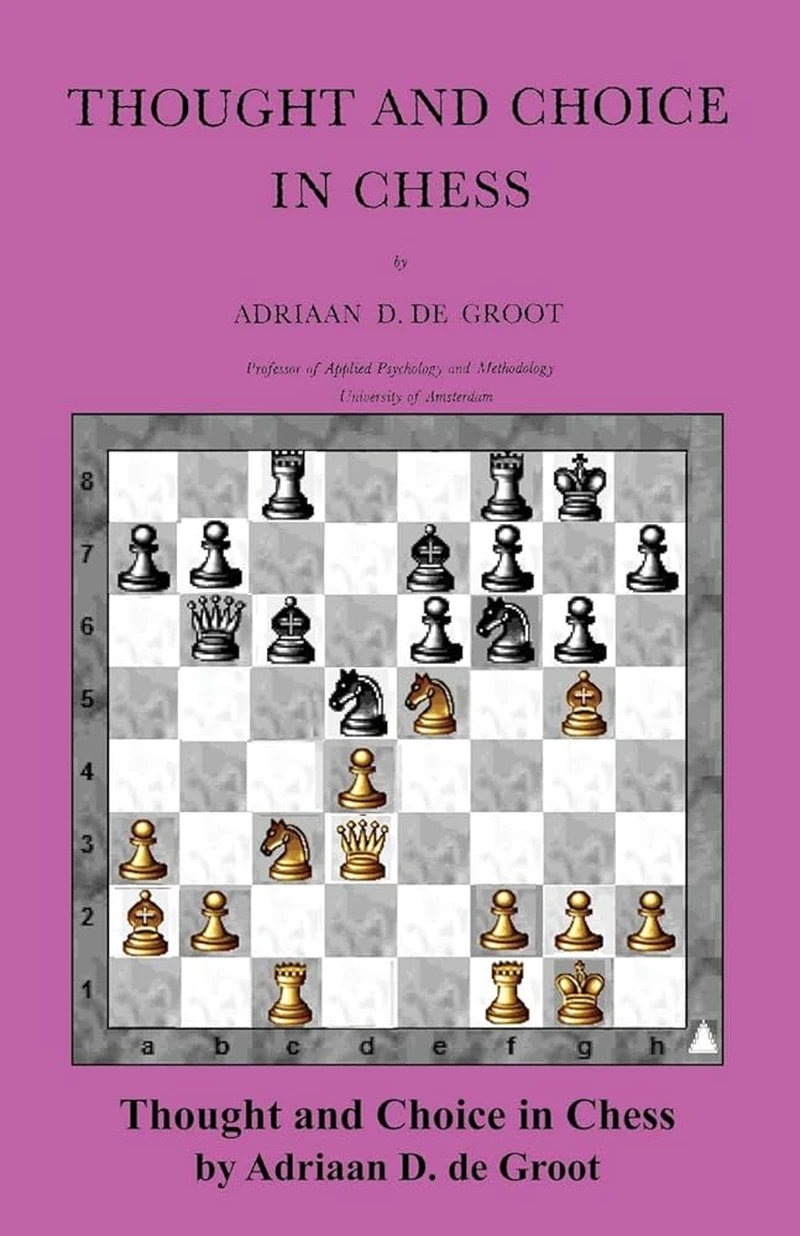
Although chess and the rating systems produce these performance levels, a more exact way of defining what makes these performance levels remains elusive and highly debated. Progress from beginner to Master is a long process and multifactorial, including study, practice, and play, with knowledge structures gained from experience, talent, and other cognitive abilities. Chess can be broken down into technical aspects such as openings, endgames, tactics, strategy, and pattern recognition, each with many subcategories. Students often quickly fill up a shelf of books on various technical aspects of the game. Evidence-based psychology had a breakthrough in 1946 with Adriaan deGroot's thesis, translated into English and published as 'Thought and Choice in Chess' in 1965. deGroot wanted to understand and clearly define specific cognitive capacities that differentiated club players from Masters and gave a series of tests. Although deGroot failed to show much individual difference in mental capacity, one difference that stood out was memory for chess position. William Chase and Herbert Simon advanced deGroots work in their 1973 'Perception in Chess', hypothesizing that over an estimated 10,000 hours from novice to Master, players develop memory chunks. Chunking is a process by which individual pieces of an information set are broken down and then regrouped together in a meaningful whole. Grouping data into chunks improves short-term retention of the material, thus bypassing the limited capacity of working memory and allowing working memory to be more efficient. Chase and Simon estimated that chess masters had tens to hundreds of thousands of these chunks, and levels of performance differences were based on the number of chunks acquired over thousands of hours of practice and play. A superior player will win almost every game against the next lower performance level due to pre-stored knowledge structures that are easily accessible and nearly impossible to figure out without hundreds of hours of practice.
With Chunking Theory, now cognitive psychology has a mechanism to explain the path from novice to Master, which can be subjected to evidence-based psychometric testing and computer modeling. Michelene Chi was the original test subject in Chase and Simon's study at Carnegie Melon, as the novice chess player (later married William Chase, the intermediate player test subject). Chi became a leader in the field of expertise, defining two approaches to the study of expertise: the absolute and the relative. The absolute approach studies exceptional individuals who are known experts and usually assumes that greatness or creativity arises from chance and unique, innate talent. The relative approach assumes that expertise is a level of proficiency that novices can achieve. The relative approach led to new theories of expertise and stages or phases that people pass through on the journey from novice to expert. Through the 1980s, almost all chess studies used the absolute approach, trying to get into the minds of chess masters. In the last 25 years, this has switched; now, almost all research into chess focuses on the relative approach. Researchers like Anders Ericsson insisted that innate ability has little role, crediting exclusively deliberate practice; most researchers today take a multifaceted approach, recognizing there are multiple factors. Ericsson (1993) defines deliberate practice as an activity that is most effective in improving performance, highly effortful, and not inherently enjoyable. Deliberate practice consistently appears as the most significant factor in developing expertise, with around 25-50% variability. Although some progress through the ranks quicker than others, all people who acquire mastery put in thousands of hours of practice over many years to obtain expertise. Factors such as talent, parental support, coaching, ambition, and others also play a significant role. Chess was one of the first test cases for the science of expertise and deliberate practice. Over the last 40 years, the theories have been applied to a variety of fields of expertise, including music, sports, and mathematics. From the 1970s to the 1990s chess was at the center of expertise studies, but now somewhat relegated to the history of cognitive science.
In this series, I will overview the major theories or models of expertise and their specific application to the road to chess mastery. As I tell my students in Detroit, to master the game of chess, you have to master every aspect of it. Different players might have different proclivities, natural talents, interests, and other factors that make it difficult to define clear borders and the type of knowledge that defines skill levels. Current research into expertise focuses on athletics, music, education, and professional certification. The original factors that made chess the main subject of models of expertise now make chess less useful. Chess is a competitive game, and skill level is based on the rating system and win-loss result. Although producing clearly defined performance levels, besides performance, it is hard to clearly define what skills and knowledge structures define the skill level. Professional training and licensing require well-defined knowledge to be acquired, and skills are demonstrated at various levels and based on task performance, not victory at a game. This contrast between chess and other forms of mastery will be a constant theme in the series and have implications for chess training.
In this series, I will follow Dr. Raman K. Attri's 'The Models of Skill Acquisition and Expertise Development: A Quick Reference of Summaries' (2019). The book summarizes twenty-three major skill acquisition and expertise development models presented by leading researchers during the last half a century of classic and new research. This book presents new researchers in learning, training, cognitive sciences, or education disciplines with a big-picture starting point for their literature review journey. Attri divides the models into four types: Stage-based models, Practice-, time- or task-based models, Factor-based models, and Modeling-based models.
- Stage-based models include the theories and models that suggest the acquisition of knowledge and skills, development of expertise, and performance improvement occurring in the form of stages.
- Practice-, time-, or task-based models include theories or models that suggest the progression of acquisition of knowledge and skills, development of expertise, and performance improvement occurring as a function of practice, time, and task.
- Modeling-based models include the theories or models that suggest modeling an expert through elicitation or guidance as the key mechanism for acquiring knowledge and skills, development of expertise, and performance improvement.
- Cognition-based models include the theories or models that focus on the mechanism of cognitive learning for the acquisition of knowledge and skills, development of expertise, and performance improvement.
On my youtube channel I have read this whole book for oral learners, and many of the important original studies, with commentary.
Doooovid's Week in Review playlist
You may also like
 DIAChessClubStudies
IM Carissa Yip conducts Simultaneous Exhibition at Detroit Institute of Arts
4x US Woman's Chess Champion encourages Detroit girls to pursue their ambitions! DIAChessClubStudies
Horde Chess - How to approach strategy in Horde?
Why play the Horde Chess Variant? One of the most unique and imaginative chess variants. NDpatzer
Science of Chess: Can you tell a human opponent from a machine?
Do chess engines pass the Turing Test? BenjiPortheault
10,000 hours? Understanding the conditions for expert learning
An introduction to key ideas about the expert learning process DIAChessClubStudies
Chess as a Pedagogical Tool – Four Basic Concepts
How to use Chess to teach children basic thinking skills! DIAChessClubStudies