
AI generated
Dominate the Board: The Absolute Fundamentals Required for Mastery
Stop thinking chess is only for geniuses. The secret to immediate improvement isn't memorizing openings—it's mastering three simple, powerful fundamentals. Unlock the easy side of chess today!
Chess is Easy If You Learn the Fundamentals!
For years, chess has been seen as a game reserved for the select few—the intellectual elite, the grandmasters who can calculate 20 moves deep. Many beginners quit before they even start, intimidated by the sheer number of possible moves and the endless complexity.
But here’s a secret: Chess is actually quite simple. The game only becomes impossibly difficult when you ignore the most important rules.
I'm not talking about memorizing the latest variation of the Sicilian Defense. I'm talking about the bedrock, the iron laws that govern the first 10-15 moves of every successful game. These are the Fundamentals, and mastering them is the fastest path to transforming your game from confusing blunders into confident wins.
If you can learn and apply just three core principles consistently, you will immediately play better chess than 80% of casual players. These principles aren't theory; they are essential good habits.
Ready to put the complexity aside and start winning? Let’s break down the Three Fundamentals that make chess easy.
Control the center with your pawns
- What it means: Fight for the control of the four central squares: e4, d4, e5, d5.
- Why it's easy: Pieces are most powerful and mobile when they are centralized. When you control the center, you have more options for moving your pieces and restrict your opponent's options.
- Actionable Tip: Open with 1. e4 or 1. d4 to occupy the center with a pawn immediately. Develop your Knights to f3/c3 (White) or f6/c6 (Black) as they instantly attack these central squares. Also, place your pieces in the center whenever possible.
The center is important. Have you ever wondered why openings like Grob Attack and Alekhine's Defense are harder to play for intermediate players and beginners than openings like London System and Scotch? This is exactly why! They don't control the center! Instead, they push forward the side pawns. The ones that you have to think twice about before moving. As you know, pawns cannot be moved backward. So, you should always think twice about moving your pawns forward, as they are an important part of the game. (Another rule of thumb) An endgame is really hard to win without them! So, FIGHT FOR THE CENTER!!
The center squares are e4, e5, d4 and d5.
Why?
The main reason why you should control the center is because those squares are like the center of attention. They are great outposts for pieces like your knight and bishop. Placing them in the center helps as they will be able to control more squares. This is what I mean:
Controlling the center:
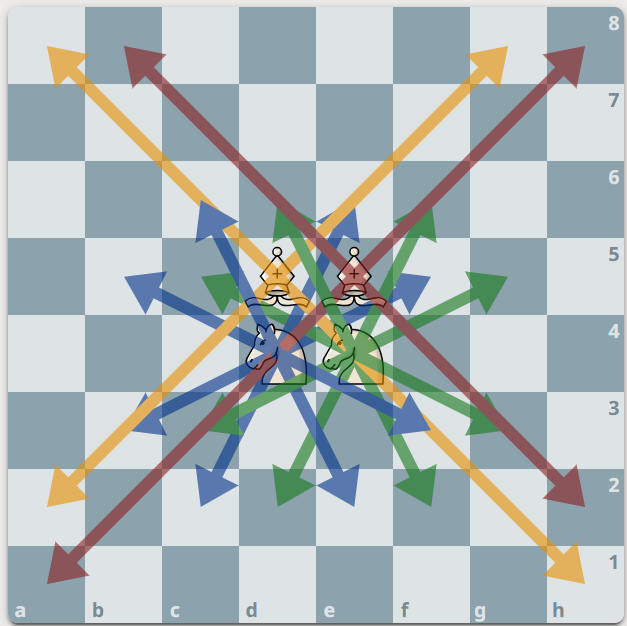
In this position, the pieces are controlling a total of 31 Squares! That's a lot, isn't it?
NOT Controlling the center:
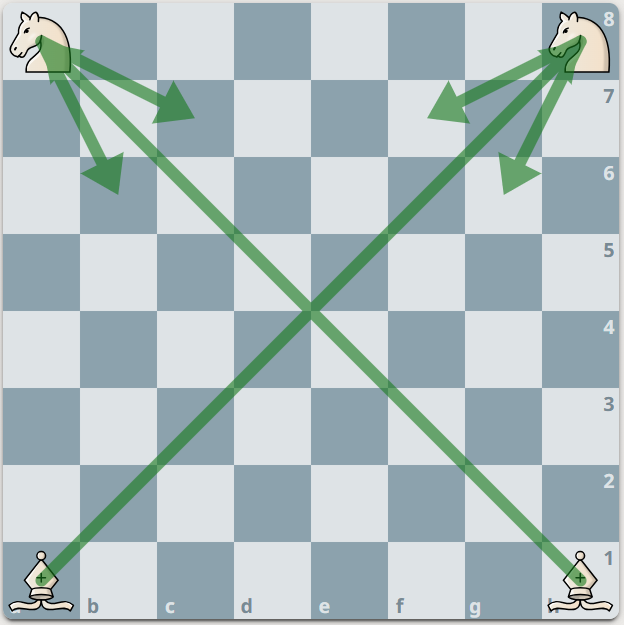
In this position, the pieces are controlling only 20 squares in total, not tacking in account that there will be pawns blocking the bishops.
Now, you see the importance of this concept in Chess. Let's move on to the next topic!
Develop your pieces
- What it means: Get your minor pieces (Knights and Bishops) off the back rank and into active, influential positions.
- Why it's easy: A piece sitting on the back rank is a spectator. You need all your pieces to fight! The goal is to bring out your army quickly and efficiently.
- Actionable Tip: Move your Knights before your Bishops. Avoid moving the same piece twice in the opening unless you are winning material or facing a serious threat.
Aren't pieces the main part of the game? You need them to attack, defend, and also occupy the center! Without them, it is impossible to deliver mate to your opponent's King!
See the difference - Developed pieces v/s Undeveloped pieces
Developed pieces are much better than pieces that are not. See the following example to see what I mean!
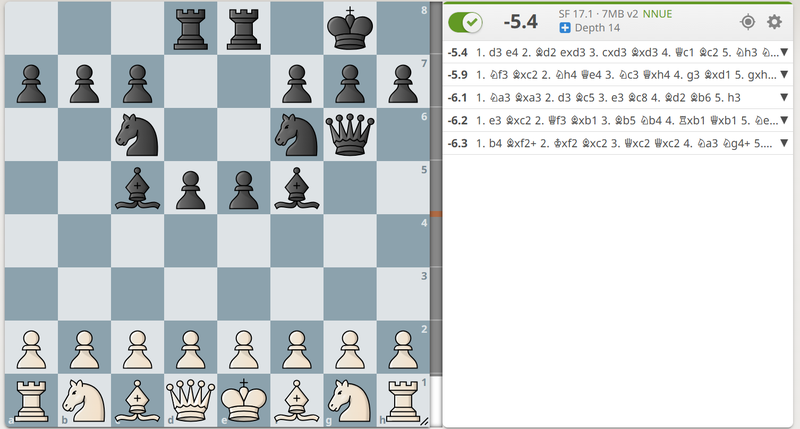
(Imagine White just moved the Knight back and forth)
See what I mean? Just because Black's pieces are developed and White's are not, the Engine give Black a -5.4 Advantage. It's huge!
Until now, you might have thought piece activity was the most important element of Chess... But here's something that might change your perspective of Chess!
King Safety
- What it means: Protect your King as quickly as possible, usually by castling.
- Why it's easy: The King is the most important piece. Getting it off the center files and behind a solid pawn shield is the most critical defensive move you make in the opening. Castling also connects your rooks, bringing them into play.
- Actionable Tip: Aim to Castle before move 10. Don't make unnecessary pawn moves in front of your castled King.
2 Important tips on how to manage your King.
- Build A Fortress
- Try to Fianchetto your Bishop.
- Don't make useless pawn pushes in front of your King.
- Have at least 1 Heavy piece (Queen or rook) and 1 Minor piece near your King.
Without King safety, your King will be vulnerable to your opponent and your opponent will be able to Checkmate you faster and more easily.
The End of Complexity, The Beginning of Clarity
You've learned the three unbreakable laws of the opening: Control the Center, Develop Your Pieces, and Ensure King Safety.
If you take only one thing away from this post, let it be this: Chess doesn't have to be complicated. The masters didn't become great by ignoring the basics; they became great by making these fundamentals so ingrained that they became second nature.
Stop chasing tricky traps and trying to memorize long lines of opening theory. Instead, focus 100% of your energy on developing these three habits in your very next game.
- Did I move e4 or d4?
- Are all my minor pieces out?
- Is my King safely castled?
If you can confidently answer "Yes" to these three questions by move 10, you are already giving yourself a massive, winning advantage against most opponents.
Your challenge is simple: For your next five games, forget about tactics and fancy attacks. Simply execute the Three fundamentals perfectly. The results will speak for themselves.
Ready to Test Your New Knowledge?
What was the hardest fundamental for you to grasp? Let us know in the forum below, or click here to find some easy opening practice games that reinforce these principles!
This is my last blog for this year, 2025. To stay tuned for more such educational content by following me and liking this post.
Wishing you a Merry Chessmas and Happy New Year!! Enjoy your celebrations!
Thanks for reading my blog posts this year, and I hope you will tune in for my blogs next year too. Once again, MERRY CHESSMAS AND A VERY HAPPY NEW YEAR!!
You may also like
 DiligentKnight23
When Grandmasters Forget the Rules - 2025 Blunder File
Hi all, and wishing you a very happy new year! As 2025 ends, it's finally time to review the top 3 b… DiligentKnight23
The Irresistible Lure: A deadly capture you need to know about! (Attraction)
Why chase when you can lure? Attraction is the sneaky chess tactic that pulls an enemy piece right w… DiligentKnight23