
Opening statistics and the Markovich doctrine
Opening success across the rating range
Opening statistics and the Markovich doctrine
I was interested -- even excited -- to see the blog post by jk_182
https://lichess.org/@/jk_182/blog/how-well-do-different-opening-moves-score-across-rating-ranges/JUtaqwSn
and I thought I’d try to duplicate and extend it
Just to be clear what I’m doing, I’m selecting a particular rating range: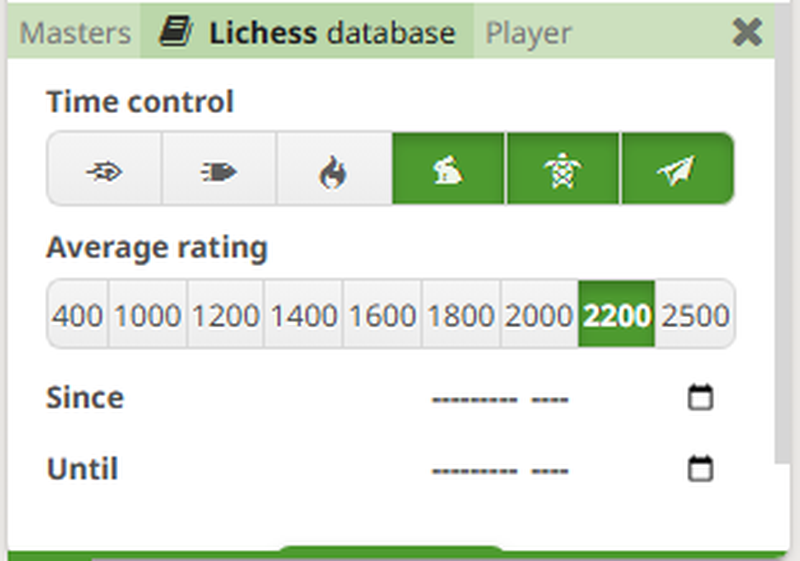
And at the same time I’m selecting just the slower games (rapidplay, classical and correspondence).
Then I’m going to pick the position just before a particular move:
https://lichess.org/study/RajXngQZ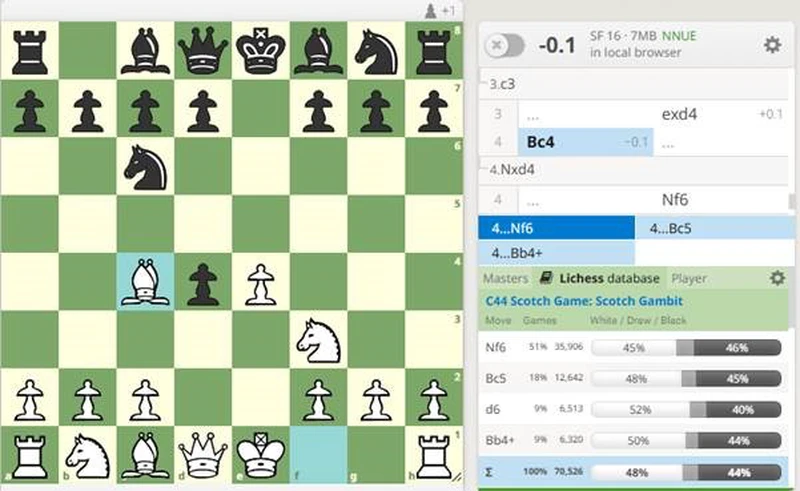
And from this, I’m picking off the percentage success for White from the Lichess database
So here we’ve got the Scotch Gambit
And I can see the percentage success for White against three chosen moves: Nf6, Bc5 & Bb4+
I’m counting “White success” as the difference between the White winning percentage and the Black winning percentage
Against Nf6 it’s -1
Against Bc5 it's plus 3
And against Bb4+ it’s +6
What jk_182 did was look mostly at early moves.
Here’s my attempt to reproduce what he did: (Full table -- see end)
- The shading shows in green those figures that fare better than average for white, while orange shows better than average for black. I’m taking the average as plus 5% (see below)
- The small squiggles at the side of each row are sparklines, which are a sort of mini-line chart of the figures in the row, and while this set isn't too bad, you should beware the use of different minimum and maxima on the axes from row to row
What can we tell from this table?
- The advantage of White’s first move doesn’t really seem apparent until you reach master level. I believe it's still the case that White scores about 55% to Black’s 45% in master play, which I would score as plus 10. But we can see on the table that the overall advantage at lower levels (and perhaps at faster speeds) is +5% at best
- I’m not hugely interested in these small differences between first move choices, as the results at each level seem to me to be more similar than they are different. Perhaps White does a little better with 1.e4 when they start out, but we don't know how Black is replying -- it may be the loss of effectiveness of 1.e4 is due to Black defending better, or picking different but superior defences.
- However, I’d certainly say if you want to play Bird’s opening: if you’re under 1600 you probably don’t know what you’re doing and shouldn't try it, while if you’re over 2000, maybe you do know what you’re doing, but so does your opponent, and once more I would discourage you from trying it
Anyhow here’s the whole chart: (Full table -- see end)
The selection of variations here is quite personal: they're mostly either lines that I've recommended to my students over the years, or lines in which I've had an interest in playing myself, or both.
There are some health warnings that need to be placed upon or near these figures:
- Sometimes they're based on rather few games
- The rating ranges are rather broad, so we can’t tell for sure if the Grünfeld is a generally successful defence, or if within each rating range it is played mostly by better players in that range, who would score well with any opening choice. However, we can expect the better players will migrate up into the adjacent rating range, taking their chosen openings with them, so that's not a very convincing interpretation
- I haven't made any attempts to account for transpositions, for example, I've listed separately the four knights variation of the Sicilian and the Sveshnikov off but of course the four knights variation is sometimes used as a transpositional device to get into the Sveshnikov while avoiding certain options for white
- Playing a variation by accident? I have a soft spot for the Abrahams-Noteboom variation for Black, but this does absolutely terribly lower levels. I am quite convinced that a lot of these players of the black side have no idea who Abrahams or Noteboom were and are not really playing their eponymous variation at all – they're just getting as far as move four and either noticing at last that c4 is en prise, or perhaps finally getting the courage to take an undefended pawn. in the 2000 plus range, clearly the Black players know what they are doing and they score very well
So, from the whole list, we can pick out some nuggets:
- There are certainly some openings which should be left to more experienced players. you can see several examples where the sparkline slopes strongly up or down from left to right. If it's slopes up then White would do well to play something else until they are stronger, while Black may find it effective only it lower levels; if it slopes down the complementary advice can be given to each player. For example: the Polerio variation of the Two Knights with ...Na5 shows a marked slope upwards with rating, so Black might be advised to try a different defence at Master level; the London system shows a decline in effectiveness among the stronger players.
- There are some interesting valley-shaped or humped sparklines where either White or Black does well at intermediate levels, but not so well at lower or higher rating levels. For example, the Dutch system against the English opening does well only at intermediate levels for Black, and we have already noted that Bird's opening does OK for White at intermediate levels, but badly elsewhere.
- All the Scotch gambit rows are bright green. The Markovich doctrine [ https://chessbookreviews.wordpress.com/2018/04/01/opening-lines/ ] declares that beginners should play open games and there is strong encouragement here for them to do so. Only above 2000 does the Scotch Gambit lose its venom. Similarly, Evans’ Gambit may be ill-advised at the top level but can be recommended enthusiastically to beginners.
- The Doctrine also demands that you play the Tarrasch defence against the Queen’s Gambit, which still seems fair enough advice from these figures, but the outstanding success at amateur level among these games is the Tartakower variation (which Purdy refers to as the All Purpose system).
- What's missing from these charts of course is how common some of these options are. Although I hold the Tartakower variation in high esteem, it's not so practical a system to pick because White needs to know and follow a certain amount of opening theory for you to be able to play it. I fear at lower levels, very few Queen's Gambit players know enough to give you the chance to play this Tartakower, but some version of the All-Purpose System with ...b6 should be possible.
- Just to be extra clear, I mean by the Fried Liver Attack the position in the Two Knights Defence where White plays Knight to G5 and succeeds in playing Knight takes F7. this is absolutely terrific for White and it scores very heavily across the rating range
- However, if White heads for this, but Black dodges (as they should) on move 5 with either ...Na5 or ...b5, then White gets a pretty heavy minus score
- My preference for the Ulvestad variation (5....b5) over the knight-on-the-rim variation (Polerio) is also supported by these figures
- The scores for this group of Two Knights Defence lines do rather refute the idea that beginners shouldn't learn theory. If you can get as far as a position where you can play 6.Nxf7, you should damn well do so; equally, if you're going to use the Two Knights Defence as Black at all, it is imperative to know enough to avoid the Fried Liver Attack... and yet, if you do you can look forward to better than average results. So should beginners be taught as White to head for the Fried Liver at all?
- The statistics do seem to endorse an attacking attitude from Black: the Two Knights Defence, the Schliemann Gambit and the Marshall Gambit all score very well for Black
- White too can be encouraged to play gambits: I've not been very interested in the Vienna Gambit throughout my life but there's certainly a renewed interested in it at the moment which is supported by these figures
- The Sämisch system against the King's Indian Defence certainly scores well although I haven't compared it with other Lines that are at all commonly played at top level
- The Benkö is another Gambit that seems to do well, although I would say that only intermediate level players should try it as they seem to do best with it; against 2500 players it perhaps should be avoided
- I would always have advised beginning and intermediate players to steer clear of most of the half-open defences, which I think are mostly difficult to handle (exception IMO = French Defence), but in fact they all seem to score quite well – The results are clearly against me
- The exception in the results is the Alekhin defence, which it seems should not be touched, even with a pole of regulation length for use on a barge, at least until you are approaching 2000 level.
- I had thought that the Open Sicilian, with all its little pawn moves, would be particularly difficult to handle for Black when facing any of the standard White attacks, but the evidence is against me here too – it scores very well and all the open Sicilian Lines are showing up in orange throughout the rating range until we hit 2500
- I think there is a bit of evidence to say that the Sicilian variations that involve more pawn moves are less effective than those lines that emphasize piece play – the Accelerated Dragon and the Four Knights’ Variations score best of all. There's certainly no need to get involved with the vast swathes of Najdorf or Dragon theory to get a good game and good results
- The Caro Kann always had a drawish reputation when I was a boy, but it seems to produce as many wins for Black as the Sicilian.
- The Petrov is another variation that was always considered rather drawish, but that certainly seems not to be true among beginners; I imagine they just can't keep the game under enough control and one other side will drop a piece and produce a result
- My insistence that white should aim at Isolated Queen Pawn (IQP) positions against the half-open defences I still think is good advice: Alapin/Sveshnikov c3 Sicilian scores better than when going for the Open Sicilian from White's point of view; the Panov scores better for White than does the Caro-Kann as a whole, and the Monte Carlo variation scores a little better than White's average against the French.
- I expect if you dug deeper into the different alternatives that are available to White you could find something that scores better than these three recommendations. However, always heading for IQP positions has a signal advantage in its thematic unity. At one stage of my life, I found some lines that I wanted to play with 1.e4 as White, but I was playing a slow fianchetto against one half-open defence, a very attacking line against another one and then a gambit against a third – so my repertoire had no consistency. At the moment, I stand behind my previous advice.
- I would have guessed that anything remotely hypermodern -- like the English, Grünfeld, Pirc or the Catalan -- would not do well at amateur level, but they seem to perform quite well, and indeed the Catalan scores above average across the rating range
- Only 2500 players seem to be able to get the Trompowsky attack to work
- I hold the Colle system in higher esteem than the London but there's no doubt that the London seems to be scoring better at the moment. Perhaps that’s because White is not allowed to play the best lines of the Colle (3...Bf5!?). Perhaps Black will also find the antidote to the dismal London system...
Your own observations and comments are invited. I would be very pleased to see somebody extend this type of analysis further... and even more pleased if someone could hack the API to spit out these figures, without me having to do quite so much fiddling with tabs!
| Avg 400 | Avg 1000 | Avg 1200 | Avg 1400 | Avg 1600 | Avg 1800 | Avg 2000 | Avg 2200 | Avg 2500 | Master | |
|---|---|---|---|---|---|---|---|---|---|---|
| All | 4 | 5 | 4 | 4 | 4 | 4 | 4 | 4 | 4 | 9 |
| 1. e4 | 6 | 6 | 6 | 9 | 4 | 3 | 2 | 2 | 3 | 8 |
| 1. d4 | 3 | 5 | 6 | 6 | 6 | 5 | 5 | 5 | 6 | 10 |
| 1. c4 | 0 | 5 | 6 | 7 | 7 | 7 | 7 | 7 | 2 | 11 |
| 1. Nf3 | 1 | 3 | 4 | 4 | 6 | 8 | 9 | 9 | 5 | 12 |
| 1. f4 | -14 | -9 | -6 | -3 | 6 | 5 | 2 | 0 | -3 | -6 |
| Giuoco Pianissimo | 9 | 9 | 9 | 6 | 1 | -1 | -3 | -3 | 12 | 2 |
| Giuoco Piano, 4.c3 | 15 | 14 | 12 | 10 | 9 | 7 | 6 | 4 | 0 | 6 |
| Evans' Gambit | 16 | 15 | 13 | 10 | 10 | 10 | 10 | 3 | -6 | -2 |
| Two Knights, 4.Nc3 | 6 | 6 | 4 | 2 | -3 | -10 | -13 | -6 | -14 | |
| Two Knights, 4.d3 | 7 | 8 | 8 | 10 | 7 | 5 | 2 | 0 | -6 | 8 |
| Two Knights, 4.d4 | 6 | 8 | 10 | 13 | 13 | 10 | 6 | 0 | -2 | -3 |
| Two Knights, Fried Liver 6.Nxf7 | 45 | 48 | 47 | 45 | 43 | 37 | 30 | 22 | 74 | 28 |
| Two Knights, 4.Ng5 & 5_Na5 | -18 | -14 | -9 | -8 | -6 | -4 | -5 | -3 | 0 | 9 |
| Two Knights, 4.Ng5 & 5_b5 | -2 | -13 | -12 | -16 | -18 | -15 | -10 | -3 | -14 | 1 |
| Ruy Lopez | 7 | 9 | 9 | 8 | 8 | 9 | 9 | 5 | 3 | 10 |
| Ruy Lopez, Schliemann | 4 | 1 | -4 | -6 | -6 | -4 | 16 | 19 | ||
| Ruy Lopez, Exchange | 10 | 11 | 9 | 3 | -1 | 0 | 2 | 8 | 15 | 6 |
| Ruy Lopez, Marshall | -21 | -1 | -9 | -10 | -14 | -18 | -15 | -9 | 8 | 4 |
| Scotch Game | 7 | 5 | 6 | 6 | 7 | 9 | 7 | 4 | 4 | 5 |
| Scotch Gambit, 4_Bb4+ | 16 | 17 | 17 | 13 | 14 | 18 | 14 | 6 | -10 | -12 |
| Scotch Gambit, 4_Bc5 | 10 | 13 | 17 | 21 | 22 | 19 | 12 | 3 | -3 | -14 |
| Scotch Gambit, 4_Nf6 | 8 | 11 | 13 | 15 | 12 | 5 | -2 | -1 | 4 | -6 |
| Vienna Gambit | 20 | 20 | 21 | 21 | 20 | 18 | 14 | 8 | 5 | -1 |
| Vienna Game | 5 | 4 | 4 | 4 | 5 | 5 | 4 | 3 | -3 | -2 |
| Petroff | 14 | 14 | 12 | 8 | 4 | 3 | 4 | 2 | 4 | 16 |
| Philidor | 9 | 10 | 9 | 8 | 9 | 11 | 12 | 11 | 8 | 16 |
| Alekhin | 6 | 11 | 15 | 12 | 1 | -5 | -6 | -3 | 5 | 16 |
| Alekhin, Exchange | 22 | 20 | 20 | 14 | 5 | 0 | -3 | 1 | 3 | 14 |
| Caro-Kann | -3 | -1 | -2 | -3 | -3 | -2 | 1 | 3 | 4 | 9 |
| Caro-Kann, Panov | 1 | 2 | 7 | 9 | 10 | 8 | 6 | 4 | -4 | 5 |
| French | 2 | 2 | 2 | 0 | -1 | 0 | 1 | 3 | 4 | 9 |
| French, Monte Carlo | 0 | -1 | 3 | 5 | 5 | 3 | 1 | -1 | 0 | 1 |
| Modern | 2 | 2 | 2 | 2 | 2 | 3 | 4 | 3 | 3 | 5 |
| Owen | 7 | 6 | 4 | 4 | 4 | 7 | 9 | 7 | -9 | 19 |
| Pirc | 1 | 2 | 3 | 3 | 3 | 3 | 4 | 9 | 13 | 13 |
| Czech | 6 | 6 | 4 | 4 | 3 | 3 | 5 | 8 | 14 | 14 |
| Scandi | 3 | 5 | 6 | 6 | 4 | 3 | 2 | 3 | 9 | 17 |
| Sicilian | -1 | -2 | -4 | -4 | -3 | -1 | 0 | 2 | 4 | 8 |
| Sicilian, Alapin | 1 | 2 | 2 | 2 | 3 | 3 | 4 | 4 | 3 | 1 |
| Sicilian, Scheveningen | -2 | -10 | -11 | -10 | -11 | -11 | -10 | -8 | 2 | 9 |
| Sicilian, Sveshnikov | -1 | -1 | 0 | 1 | -1 | -2 | -3 | 1 | 9 | 7 |
| Sicilian, Four Knights | -18 | -15 | -12 | -14 | -13 | -14 | -15 | -6 | 6 | 12 |
| Sicilian, Najdorf | -6 | -4 | -2 | -2 | -2 | -1 | 0 | 3 | 4 | 6 |
| Sicilian, Dragon | -4 | -4 | -3 | -3 | -3 | -3 | -3 | -2 | -5 | 16 |
| Sicilian, Acc Dragon | -11 | -17 | -6 | -6 | -3 | -1 | -1 | -1 | 4 | 10 |
| Queen's Gambit | 13 | 12 | 14 | 14 | 10 | 10 | 9 | 7 | 8 | 14 |
| Queen's Gambit, Exchange | 4 | 5 | 6 | 8 | 10 | 10 | 13 | 13 | 9 | 19 |
| Queen's Gambit, TMB | -16 | -14 | -12 | -10 | -8 | 3 | 6 | -4 | 9 | |
| Queen's Gambit, Swiss | 4 | 8 | 6 | -7 | -6 | -1 | ||||
| Queen's Gambit, Slav | 9 | 8 | 8 | 8 | 3 | 6 | 7 | 9 | 10 | 14 |
| Queen's Gambit, Semi-Slav | 4 | 10 | 6 | 6 | 3 | 4 | 7 | 8 | 8 | 5 |
| Queen's Gambit, Noteboom | 20 | 14 | 18 | 14 | 2 | 3 | -4 | -7 | -7 | -2 |
| Queen's Gambit, Tarrasch | 2 | 6 | 6 | 8 | 9 | 6 | -1 | -8 | 0 | 18 |
| Queen's Gambit, VHSG | -6 | 23 | 6 | 12 | 9 | 6 | -1 | -7 | -11 | 13 |
| London | 9 | 9 | 9 | 10 | 7 | 5 | 5 | 5 | 0 | 2 |
| London, Modern | 11 | 11 | 10 | 8 | 8 | 7 | 7 | 5 | 1 | 8 |
| Colle | 3 | 3 | 4 | 4 | 3 | 3 | 2 | 2 | -8 | -2 |
| Dutch | 5 | 6 | 8 | 7 | 4 | 3 | 5 | 6 | 6 | 14 |
| Dutch, Leningrad | 2 | 9 | 10 | 12 | 11 | 6 | 6 | 5 | 4 | 11 |
| Dutch, Classical | -36 | -12 | 12 | 8 | 15 | 10 | 7 | 15 | 21 | |
| Dutch, Stonewall | 6 | 2 | 9 | 2 | 2 | 3 | 6 | 4 | 4 | 8 |
| Nimzo | -6 | 0 | 0 | 0 | 1 | 0 | -3 | -1 | 4 | 5 |
| Queen's Indian | -3 | -3 | -1 | -1 | 0 | 1 | 3 | 4 | 8 | 8 |
| Bogo-Indian | 11 | 6 | 6 | 8 | 8 | 7 | 4 | 5 | 14 | 14 |
| Grünfeld | -3 | -10 | -6 | -6 | -9 | -7 | -5 | 1 | 6 | 10 |
| King's Indian | 4 | 2 | 2 | 1 | 0 | 1 | 2 | 6 | 12 | |
| King's Indian, e3 | -6 | -6 | -6 | -4 | -7 | -10 | -13 | -11 | 12 | -4 |
| King's Indian, b4 | -29 | -6 | -3 | -1 | 5 | 3 | ||||
| King's Indian, f3 | 39 | -1 | 15 | 14 | 18 | 11 | 5 | 0 | -8 | 4 |
| King's Indian, Bg5 | 4 | 2 | 6 | 4 | 1 | 1 | 3 | 9 | 6 | 17 |
| Benoni, Modern | 10 | 10 | 6 | 7 | 2 | -3 | -6 | 1 | 12 | 18 |
| Benkö | -9 | 4 | 1 | -4 | -8 | -12 | -9 | -3 | 9 | 14 |
| Old Indian Nbd7 | 1 | 3 | 3 | -1 | 0 | -2 | -1 | -1 | 14 | 7 |
| Blumenfeld | 10 | 1 | 14 | 2 | -1 | 0 | 6 | 13 | 14 | |
| Tromp | -10 | -6 | -2 | -4 | -3 | 0 | 3 | 5 | 14 | 5 |
| English, King's | -2 | 2 | 6 | 6 | 8 | 8 | 8 | 6 | -5 | 6 |
| English, Symmetrical | 7 | 9 | 9 | 8 | 7 | 6 | 8 | 8 | 2 | 13 |
| English, Dutch | 10 | 11 | 12 | 10 | 4 | 4 | 4 | 7 | 8 | 13 |
| English, Indian | -2 | -2 | 0 | -1 | 1 | 2 | 3 | 7 | 7 | 15 |
| Réti | 1 | 3 | 4 | 4 | 6 | 8 | 9 | 9 | 5 | 12 |
| Catalan | 13 | 14 | 16 | 17 | 15 | 15 | 15 | 12 | 8 | 12 |
| 1. g3 | 1 | 1 | 1 | -1 | -1 | -1 | 1 | 5 | 3 | 11 |
| 1.b3 | 2 | 1 | 2 | 2 | 2 | 3 | 4 | 5 | 10 | 3 |


