
How Chess Was Born: A Journey Through Time (Part 1)

 "Every chess player has wondered about it at least once... Who looked at a wooden board with 64 squares and thought, 'You know what? Let's settle arguments with tiny horses and elephants instead of actual armies.'"
Welcome, fellow chess addicts.
Whether you're a 600-rated beginner who still wonders why knights move like they're avoiding taxes, or a 2400-rated tactician who calculates mate in eight before breakfast, you've probably asked yourself one question:
Where did chess actually come from?
The answer?
Well... it's complicated.
It's a story involving kings, warriors, mathematicians, merchants, Persian scholars, Arab philosophers, and enough legends to make even Stockfish raise an eyebrow.
So grab your favorite drink, sit back, and let's travel nearly 1,500 years into the past.
Chapter 1: The Most Famous Chess Story Ever Told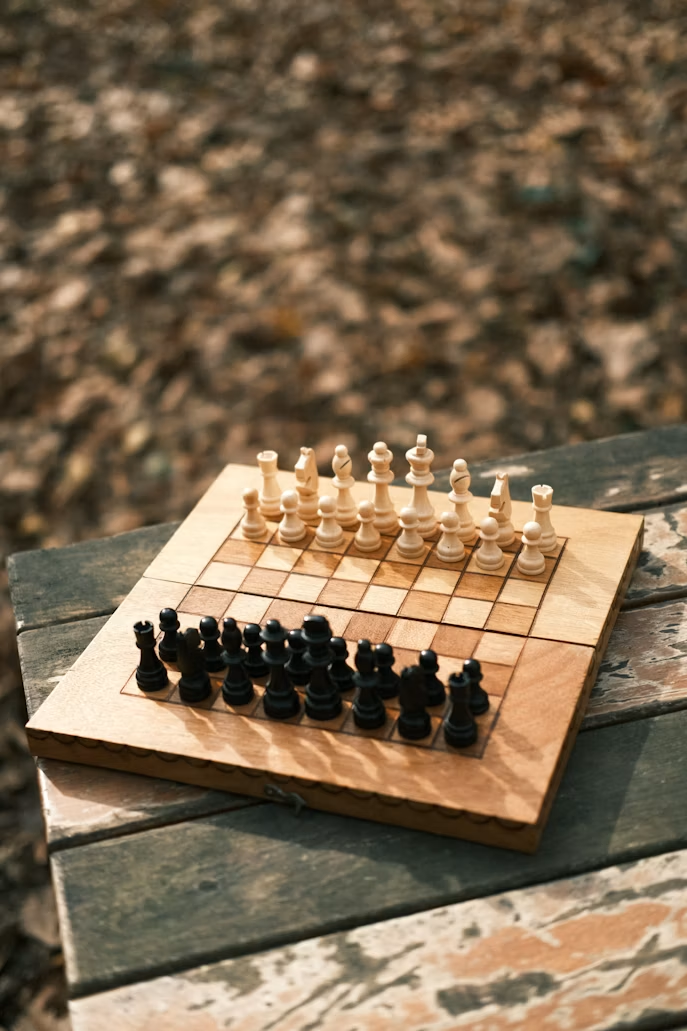
Let's begin with a tale.
Not because it's historically proven...
...but because it's simply too good to ignore.
Long ago, an Indian king became fascinated by a mysterious new game created by one of his wise scholars.
The game represented a battlefield.
Infantry.
Horsemen.
Elephants.
Chariots.
And a king whose survival meant everything.
The ruler loved it so much that he decided to reward its inventor.
"Ask for anything," the king declared.
"Gold? Jewels? Land? It's yours."
The inventor smiled.
"I ask only for wheat."
The king laughed.
"That's all?"
"Yes," replied the scholar.
"Place **one grain of wheat on the first square of the chessboard. Double it on every square after that until the board is full. That will be my reward."
The king almost burst into laughter.
He had expected a palace.
Instead...
...he got a grocery list.
"Done," he said.
Easy.
Or so he thought.
Chapter 2: The King's Biggest Mistake 
Let's do the math.
Square 1:
1 grain.
Square 2:
2 grains.
Square 3:
4 grains.
Square 4:
8 grains.
Nothing impressive.
Even by Square 10...
only 512 grains.
The king probably thought,
"Is this scholar sure? I've tipped cooks more than this."
But chess has always rewarded patience.
By Square 20...
over half a million grains.
Square 30...
more than half a billion.
By Square 40...
we've entered the trillions.
The royal accountants probably started sweating.
By Square 50...
they're questioning career choices.
By Square 60...
someone quietly updates their résumé.
And by the 64th square...
the total reaches
18,446,744,073,709,551,615 grains.
Yes.
That's an actual number.
No, your browser didn't glitch.
If someone tried counting one grain every second without sleeping, they still wouldn't finish before several hundred billion years had passed.
In modern terms?
There isn't enough wheat that has ever been harvested in human history to pay that debt.
The king had unknowingly promised something impossible.
The scholar didn't defeat him with an army.
He defeated him with mathematics.
Chess players today would simply call that...
a forced win.
Chapter 3: So... Did This Really Happen? 
Probably not.
Sorry.
I know.
I wanted it to be true too.
Historians generally agree that the wheat story is a legend, passed down for centuries because it teaches two beautiful lessons:
- Never underestimate exponential growth.
- Never accept a challenge from someone who smiles too confidently.
Even though the story isn't accepted as historical fact, it has survived for over a thousand years because it's unforgettable.
And honestly...
it's still one of the greatest mathematical stories ever told.
But if that isn't the real birth of chess...
then where did chess actually begin?
Chapter 4: Following the Real Trail
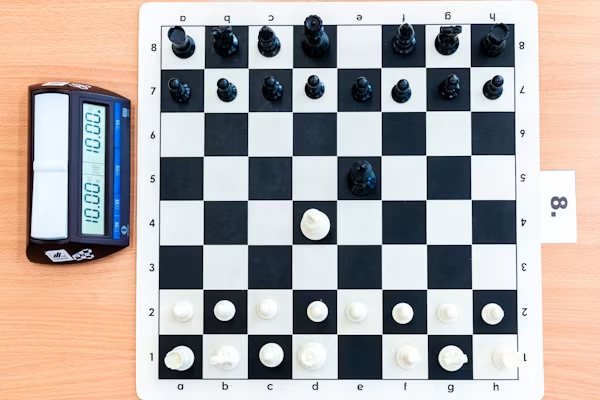 To uncover the truth, we have to travel back to 6th-century India.
No castles.
No digital clocks.
No engines telling you your brilliant sacrifice was actually -7.3.
Just kingdoms constantly preparing for war.
At that time, India was home to a strategy game called Chaturanga.
If modern chess is your smartphone...
Chaturanga was the first working prototype.
Simple.
Elegant.
Revolutionary.
Its name literally translates to "four divisions of the military."
Those divisions were:
- Infantry
- Cavalry
- Elephants
- Chariots
Sound familiar?
They would eventually evolve into the pieces we know today.
Pawns.
Knights.
Bishops.
Rooks.
The king already existed.
And yes...
even back then, everyone was trying to protect him.
Some things never change.
Chapter 5: Not Just a Game
 To us, chess is entertainment.
A hobby.
A competitive sport.
Sometimes a reason to question every life decision after hanging your queen.
But Chaturanga was something deeper.
It reflected the battlefield.
Success wasn't about brute force.
It was about planning.
Coordination.
Sacrifice.
Timing.
One careless move could destroy an entire campaign.
That sounds familiar too, doesn't it?
Because that's exactly how chess still works today.
Every sacrifice asks a question.
Every move tells a story.
Every checkmate is simply the final chapter.
A Small Thought Before We Continue...
Isn't it amazing?
A game created roughly fifteen centuries ago still survives in an age of quantum computers, artificial intelligence, and space exploration.
Empires disappeared.
Languages changed.
Kings became history.
Yet every single day, somewhere in the world...
someone opens with 1.e4.
Someone else replies ...c5.
And another timeless battle begins.
Coming Up in Part 2...
Our story is only getting started.
Chess is about to leave India and enter Persia, where it will receive a new name, new ideas, and even one of its most famous words:
"Checkmate."
We'll meet kings, conquerors, scholars, and travelers who carried the game across continents, unknowingly creating one of humanity's greatest intellectual traditions.
Trust me...
the journey has only just begun.
try my study <KARNAN2565's Study • lichess.org