
Anna Shtourman / FIDE
2025 Women's World Chess Championship Game 4: Neck and Neck
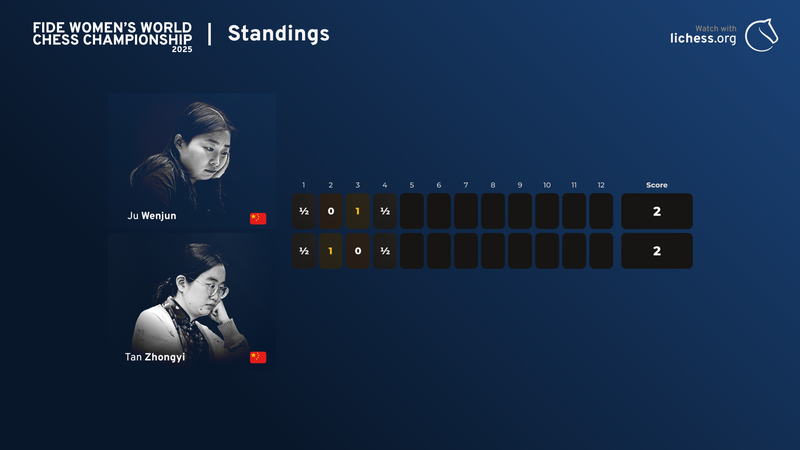
Ju Wenjun holds the draw, despite the time disadvantage and harder position to navigate, with the match entering the second rest day tied.
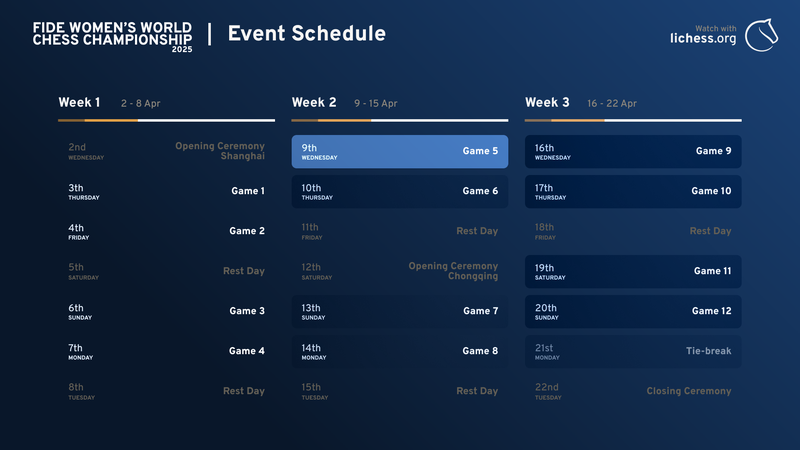
Lichess is providing a live stream for every day of the Women's World Championship. Make sure to tune in to our Twitch or YouTube channels for live stream coverage with our hosts GM Toms Kantāns and WIM Jesse February, joined by a rotating panel of guests. Game 5 starts at 07:00 UTC on Wednesday, April 9th, and GM Felix Blohberger will join our stream!
Additionally, we will cover every game in our blog, with annotations by WIM Silvia Raluca Sgîrcea for games 1-6 and WGM Petra Papp for games 7-12.
The annotations by WIM Silvia Raluca Sgîrcea for Game 4 can be found here.
Lichess has also run player profiles on GM Ju Wenjun and GM Tan Zhongyi, and published a Match Preview ahead of the match.
Schedule
Videos
https://www.youtube.com/watch?v=uZ_zT_rFoEs
https://www.youtube.com/watch?v=W9RuT7YjWnA
https://www.youtube.com/watch?v=kwepRXw6_h8
Annotations by WIM Silvia Raluca Sgîrcea
Match Score
Recap
Don't change a winning team - or so they say in other sports. Whether this proverb's wisdom translates well into chess and opening choices is very much up to debate; that being said, Tan Zhongyi, following her game 2 win, opted once more for the English opening. What did, however, change, is Ju's response choice; going for 1...e6, a lot of transpositions to other openings (including a few d4 lines) are possible, however with 2.Nc3 they entered the Agincourt Defense, which is a fairly solid yet flexible choice for black; arguably the resulting positions can very much suit Ju's style.
Navigating a less common sideline with Bb4-Ba5, a fresh position is already reached by white's move 6.e3
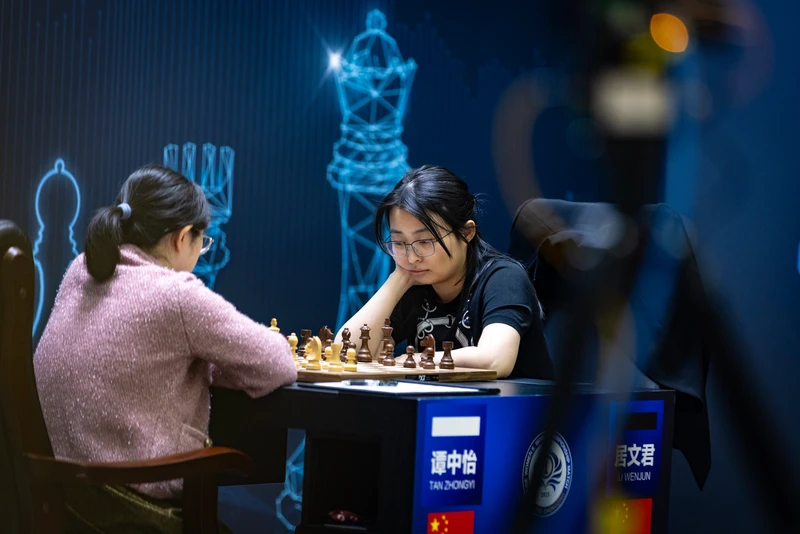
Photo: Anna Shtourman / FIDE
This is move, a typical possible idea in different English lines, is keeping the structure flexible and allows white to develop her pieces preparing a future d4. There are a few ways for black to deal with it; some of which being e5, totally changing the nature of the position, or playing d5 herself, and temporarily sacrificing a pawn but with strong compensation. In this position, however, Ju decides to play a6!? first, and strike back with d5 after 9.d4 cxd4. The differences in the position including and not including a6, and which version is better for white, would merit a deeper analysis.
This is, again, a pawn sacrifice, which Tan, despite exchanging on d5, interestingly decided not to accept. In fact, Tan, only a few moves later, returns this sacrifice, possibly in order to keep her bishop pair and superior piece placement. This time the pawn sacrifice is accepted, but it again comes with a good compensation. Ju however comes up with an interesting idea: 19...Nb5!?.
Now, according the the engine, this might not be the most accurate choice in the position, however it changes the nature of the position. Qa4 Nxc3 Rxc3 b5 would help black effectively equalize immediately, Nxb5 accepts entering an imbalance: White will (temporarily) have a superior pawn structure due to the weak b-d pawns of black, however black will immediately improve her rook's position, seizing the semi-open line with a tempo and later being able to exchange the a for one of the b pawns. Black will nevertheless need to be cautious of a possible strong b-passed pawn in some variations and plan accordingly.
One of the critical moments of the game came a few moves later:
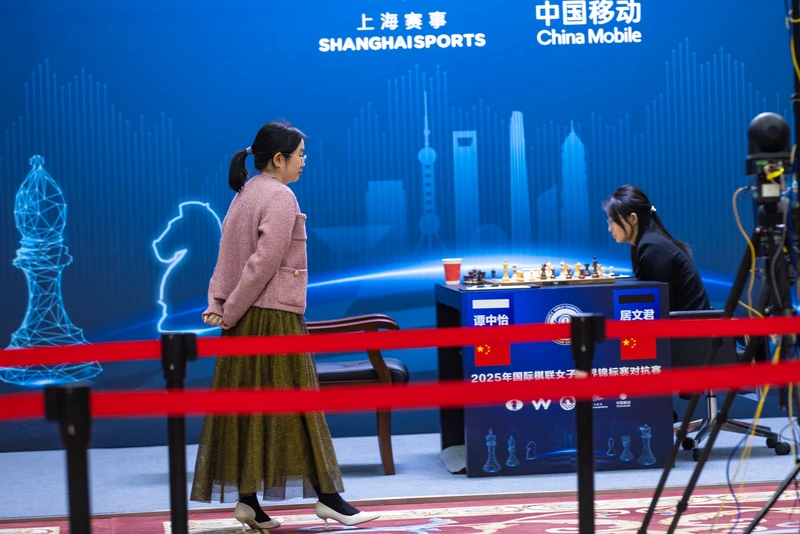
Photo: Anna Shtourman / FIDE
The most critical way to challenge Ju's imbalance decision would likely be to create a passed b pawn in a timely manner, and advance it. Tan had the opportunity to do so by Qxb6 followed by b4 - handling that pawn would be fairly complicated. She however decided to play Bd6 first and exchange a pair of rooks. Tan still managed to get the passed b pawn, but her opponent was able to improve her position in the meanwhile, making countering this pawn a bit easier.
Needless to say, however, that the resulting endgame was still fairly complex, and both players - with black a fair bit more so - needing to be quite precise:
The minor pieces, as well as black's passed pawn for white's a pawn were exchanged, and Ju was later able to get the draw by 80th move, ready to enter the rest day - and the last pair of games in the Shanghai leg - with the match score being tied. For a more detailed analysis of the endgame, and the game as whole, you can refer to the annotations section below

Photo: Anna Shtourman / FIDE
Stream
You may also like
 Lichess
FIDE World Cup R4: Praggnanandhaa, Keymer, Vachier-Lagrave, Blübaum Eliminated
GM Daniil Dubov eliminated GM Praggnanandhaa R, while GM Andrey Esipenko got the better of GM Vincen… Lichess
Lichess: End of Year Update 2025
Is it just us, or has this year flown by? As we say goodbye to 2025 and enter 2026, let's look back …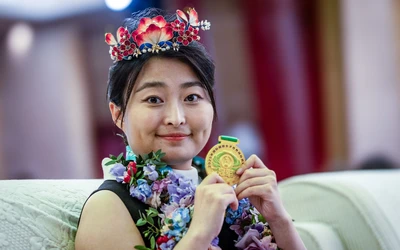 Lichess