
Rules of Chess On lichess!
Learn to play chess, free forever!
Chess
English
Chess is one of the oldest board games in the world, and also one of the most popular. Whether you want to learn chess to play casual games with your friends or to enter competitions, in this article you can learn all the information you need to know about the royal game.
Here's what you need to know about chess:
What Is Chess?
Chess is a board game played between two players that simulates a war between two kingdoms. It is one of the most popular games in the world. Millions of people play it both for fun and as a profession.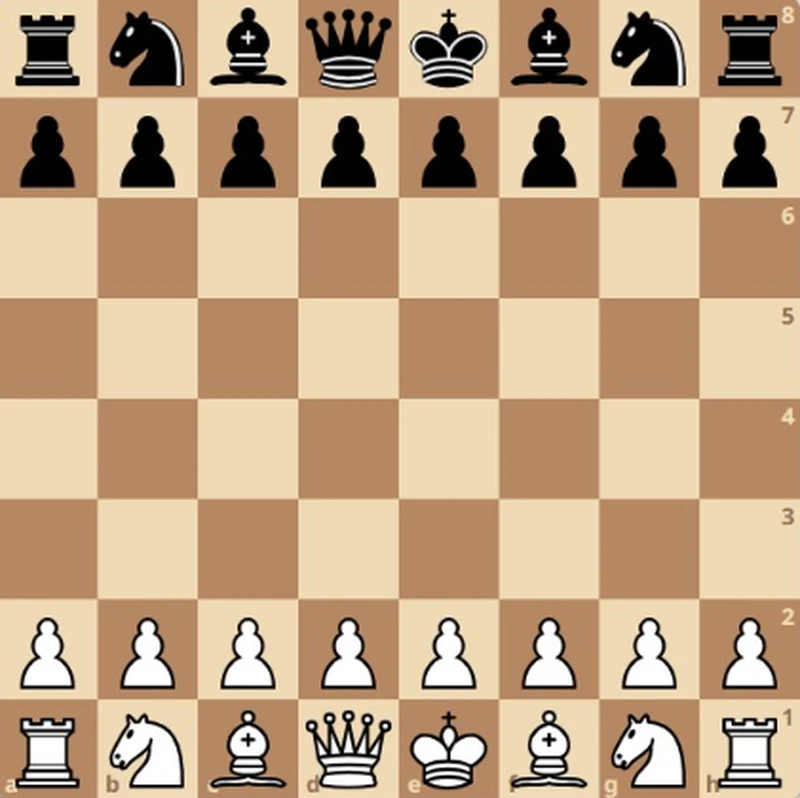
There is no such thing as luck in chess!
Rules
Equipment
To play chess, players need at least a set of chess pieces and a chess board.
A chess piece set has two different armies of pieces, each containing eight pawns, two knights, two bishops, two rooks, a queen, and a king. Players can distinguish their armies based on their colors, with light and dark pieces. Regardless of the actual color of the pieces, the light side is called White, while the dark side is called Black. The chessboard has 64 squares organized in an eight-by-eight grid. The board is checkered with dark and light squares. The board is divided into ranks (rows) and files (columns). The chessboard has 64 squares arranged in an eight-by-eight grid of dark and light squares. Rows are called ranks, and columns are called files.
Chess clocks are tools that can mark the remaining time each player has. They can also add extra time for each player after they make a move (called increments).
Chess Pieces
There are six types of chess pieces. They are the pawn, the knight, the bishop, the rook, the queen, and the king. Each of those pieces moves differently and has a value.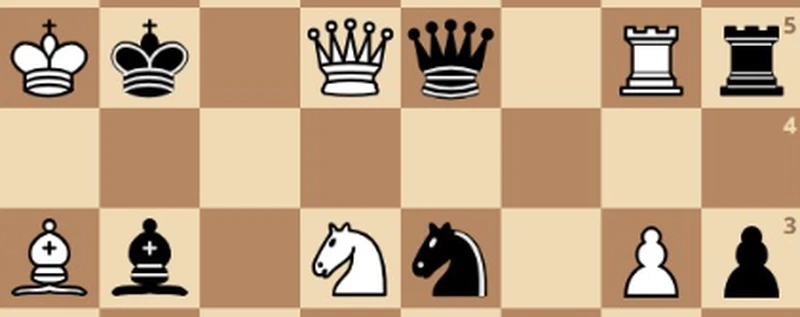
Pawns are worth one point and are not considered a piece. Knights and bishops are worth three points.
Rooks are worth five points, while the queen is worth nine. The rook and queen are the major pieces. The king is the most valuable piece in chess
Note that the value of pieces is only an abstract concept and doesn't determine the game's outcome. A player can be up a lot of material but lose the game if their opponent checkmates them.
Initial Setup
It's essential to learn the initial setup of the board and pieces to start a chess game. The board must have a light square as its bottom-right square.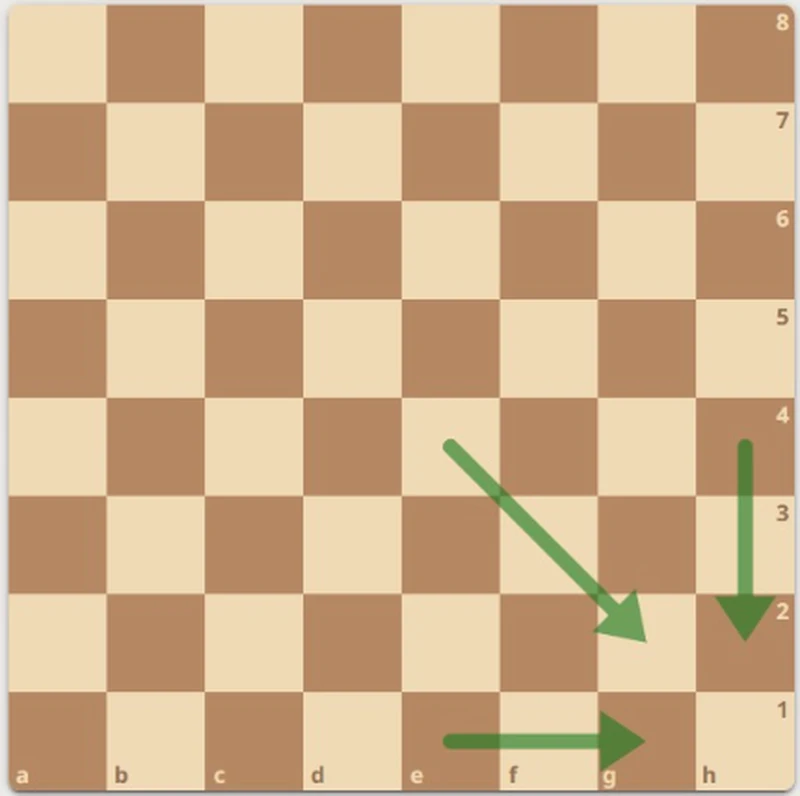
The bottom-right square must be light.
As stated in the previous section, both players start with eight pawns, two knights, two bishops, two rooks, a queen, and a king. The white pawns go on the second rank of the board, while the black pawns go on the seventh.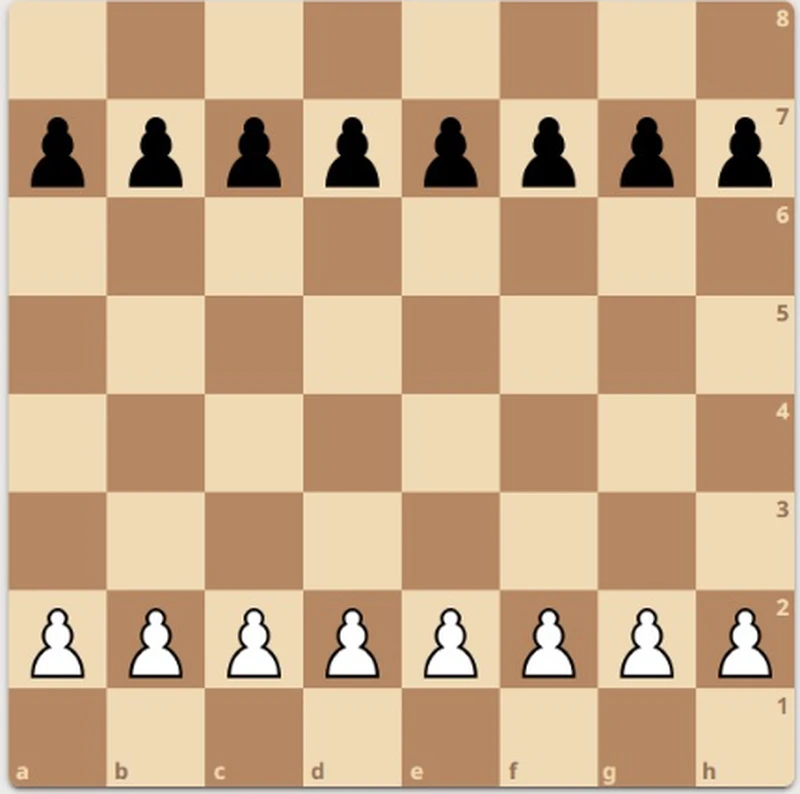
Pawns start on the second and seventh ranks.
The rooks, knights, and bishops start filling up the first rank for White and eighth for Black from the outside in. The queen always is going on the square that matches its color (the white queen on a light square, the black queen on a dark square).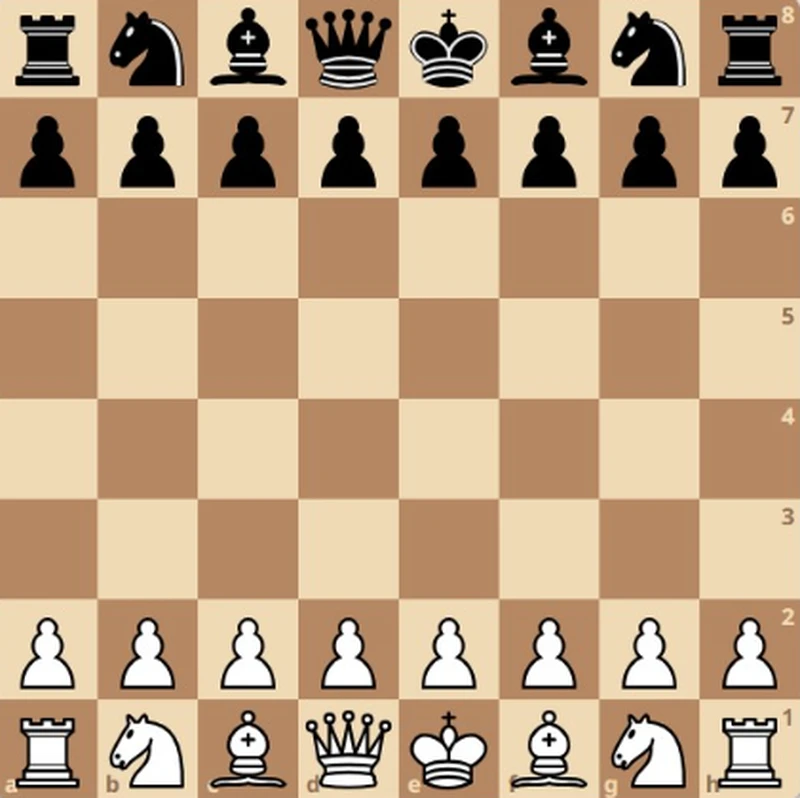
The initial setup for a chess game.
Piece Movement And Captures
Each of the pieces in chess has a distinctive movement:
Pawn
Pawns move up the board one square unless it's the first time they're moving when they may move two squares. Note that they cannot move backward.
The pawn captures pieces one square diagonally and is the only chess piece that captures differently than the way it moves. It is also the only piece that can capture using the special en passant rule which is discussed below.
Pawns can move up the board one square or two on their first move. They capture one square diagonally to either side.
Knight
The knight moves two squares horizontally and one vertically, or two squares vertically and one horizontally. The way the knight moves resembles the upper-case "L."
Knights capture by landing on top of a piece and are the only pieces that can jump over others.
Knights move in an "L" shape and can jump over other pieces.
Bishop
The bishop can move any number of squares diagonally. Because of how it moves, the bishop can never step on squares of another color than the one it started on. Players start the game with two bishops, a light-squared and a dark-squared one.
Bishops move diagonally.
Rook
The rook can move any number of squares vertically or horizontally. Rooks are also the only piece that, together with the king, can castle (discussed below). Unless blocked, rooks can move horizontally or vertically as many squares as they want.
Queen
The queen is the most powerful piece on the board. It can move diagonally, horizontally, or vertically as many squares as it wants (unless another piece blocks it). Queens can move in all directions as many squares as they want.
King
The king can move one square in every direction. The king can make use of the special castling rule together with a rook. (discussed below) Kings move one square in any direction.
If you want to learn more about the way each piece moves, check out Lichess' Learn chess page on the subject.
Check And Checkmate
When a player's king is under the attack of an enemy piece, the king is in Check. The player whose king is under attack needs to protect the king with one of their pieces, move the king out of the attacker's range, or capture the piece attacking their king. If the attacked player can't do any of those, the king is in checkmate (also shortened as "mate") and they lose the game.
Checkmating the opponent is the ultimate goal of chess. To learn more about checkmate, check This lesson from lichess.
Special Rules
Chess has three special that apply only in specific situations. Below the three special chess rules are explained:
Castling
Players can castle to protect their king and develop a rook simultaneously. When a player castles, their king moves two squares to either side, and the rook from that side jumps over the king, landing next to it.
A player can only castle if all of the conditions below are true:
- The player has never moved the king or the rook.
- There are no pieces between the king and the rook to the side where the player is castling.
- The king is not in check.
- The opponent is not attacking any of the squares between the king and where it'll land.
Pawn Promotion
When pawns reach the rank farthest from the one where they've started, they can promote into any minor or major piece. White's pawns promote when they reach the eighth rank, while Black promotes on the first.
Pawns can turn into any piece except for the king.
Pawns can promote to any piece, regardless of how many or which other pieces are still on the board.
En Passant Capture
The en-passant is the most difficult rule in chess for a beginner player. It's a special type of rule that allows pawns to capture other pawns in the following conditions:
- The capturing pawn is three ranks away from the rank where it started the game.
- An enemy pawn on an adjacent file moves forward two squares in one move, landing right next to the capturing pawn.
- The en passant capture happens on the turn immediately after the one when the pawn being captured lands next to the capturing pawn.
If all of the conditions are true, the attacking player can choose to make the en passant capture. The attacking pawn moves one square diagonally, landing one square ahead of the captured pawn.
The en passant rule is the only capture where the capturing piece doesn't land on the same square as the captured one.
Game Outcomes
In chess, a player can either win, lose, or draw a game. A player can win by checkmating the opponent or if the other player lets their time run out, or "flag, which means lose on time" A player loses if their opponent checkmates their king.
The game can end in a draw in several different ways. Those include draws by mutual agreement between players, 3-fold repetition, dead position, 50-move rule, or stalemate.
Playing Chess Against Other People
To play chess against another human player, all you have to do is go to Lichess' play page. There you'll find options to start a game against a random player at your level or invite your friends to a game.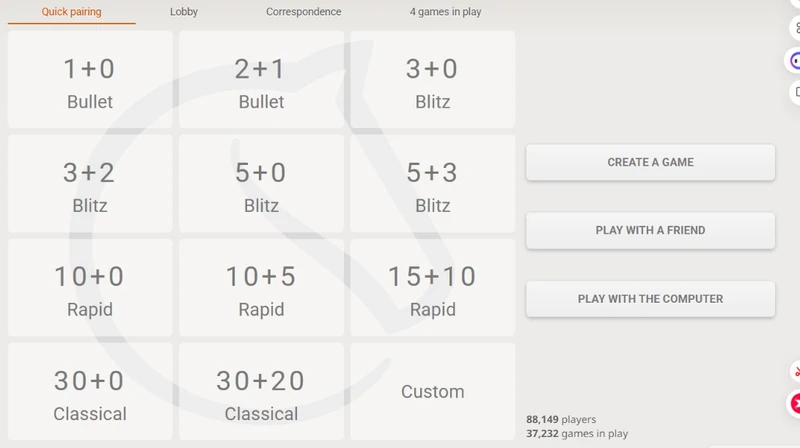
You can play against other people on lichess' homepage.
Chess Notation
Chess Notation is a way of recording or describing the moves of a chess game. Although there are different techniques of achieving that, the official way to record them today is through algebraic notation. This kind of notation shows you the move number, the piece being moved, and the square where it lands.
In algebraic notation, every square of the board has a name. The name consists of a letter that identifies the file, followed by a number that identifies the rank.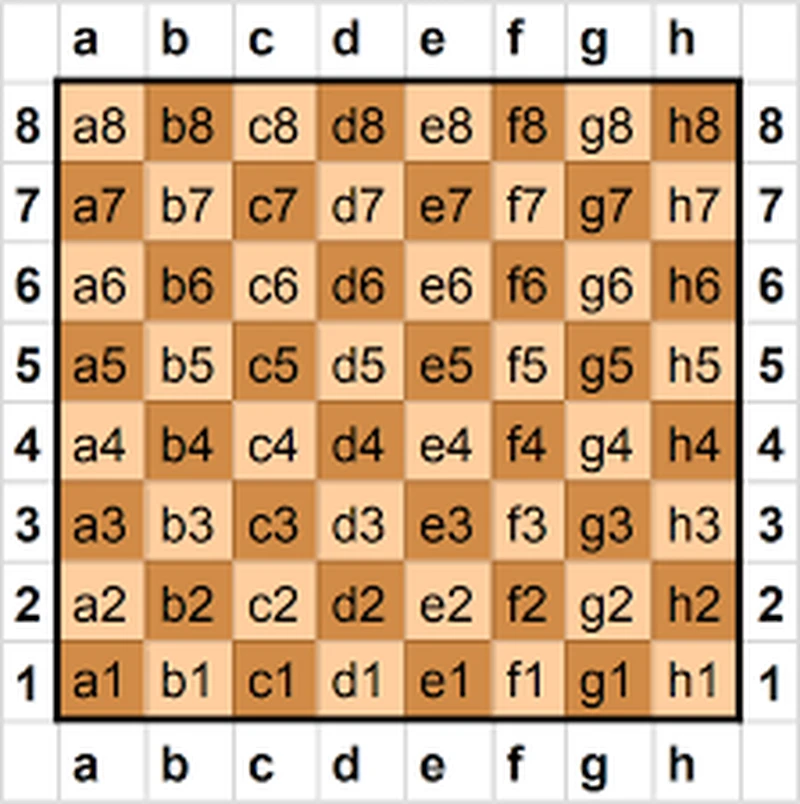
Every square on the chessboard has a name that consists of a letter representing the file and a number representing the rank.
Each of the pieces is abbreviated by a capital letter: "K" for the king, "Q" for the queen, "R" for rook, "B" for the bishop, and "N" for the knight. Pawns are not pieces and, therefore, don't have an abbreviation.
Captures are represented by the letter x, while castling short is represented by 0-0 and castling long is 0-0-0. 1-0 illustrates that White won the game, 0-1 means Black won, and 1/2-1/2 indicates a draw.
The moves 1.e4 e5 2.Nf3 Nc6 3.Bb5 a6 4.Ba4 Nf6 5.O-O Be7 6.Bxc6 describe the following game:
[Event "MBurns2020's Study: Chapter 1"]
[Site "https://lichess.org/study/Uhv2UaK8/4RwgYbPl"]
[Result "*"]
[Variant "Standard"]
[ECO "C85"]
[Opening "Ruy Lopez: Closed, Delayed Exchange"]
[Annotator "https://lichess.org/@/MBurns2020"]
[StudyName "MBurns2020's Study"]
[ChapterName "Chapter 1"]
[UTCDate "2025.01.20"]
[UTCTime "12:16:39"]
1. e4 e5 2. Nf3 Nc6 3. Bb5 a6 4. Ba4 Nf6 5. O-O Be7 6. Bxc6 *
Conclusion
You have now learned everything you need in order to play a game of chess. Check out lichess.org/learn for more information about the game.
Lichess.org is free forever, so are all of its amazing features
You may also like
 MBurns2020
The Great Escape Part 1
The beginning of a new series regarding saving lost positions MBurns2020
I Played GM Vaishali Rameshbabu!
Hi Everyone! I had the fortunate opportunity to be selected for a simul, where I played GM Vaishali … MBurns2020