
How to Use the Boleslavsky Hole to Beat the Sicilian
The position below comes from the game Boleslavsky–Lisitsin. It’s one of the first games where the famous idea of the Boleslavsky Hole in the Sicilian Defense was used.How can White continue the game?
https://lichess.org/study/9F8Nnwkk/465UGLM7
You can see that, despite being up a pawn, Black has a lot of weaknesses. There’s the backward pawn on d6, which sits on the semi-open d-file. Also, the square in front of that pawn is weak (usually, squares in front of pawn weaknesses are great spots for a piece).
But there are two problems for White that stop them from placing a knight on the d5-square - which is a perfect outpost. Those problems are the knight on f6 and the bishop on c4.
So White simply removes them:
https://lichess.org/study/9F8Nnwkk/OW3GOilO
Now that White fully controls the center, they can choose where to attack. The best plan here is a pawn storm on the kingside.
You can check how White managed the attack on the kingside below:
https://lichess.org/study/9F8Nnwkk/4O3tSPz6
LESSONS TO REMEMBER
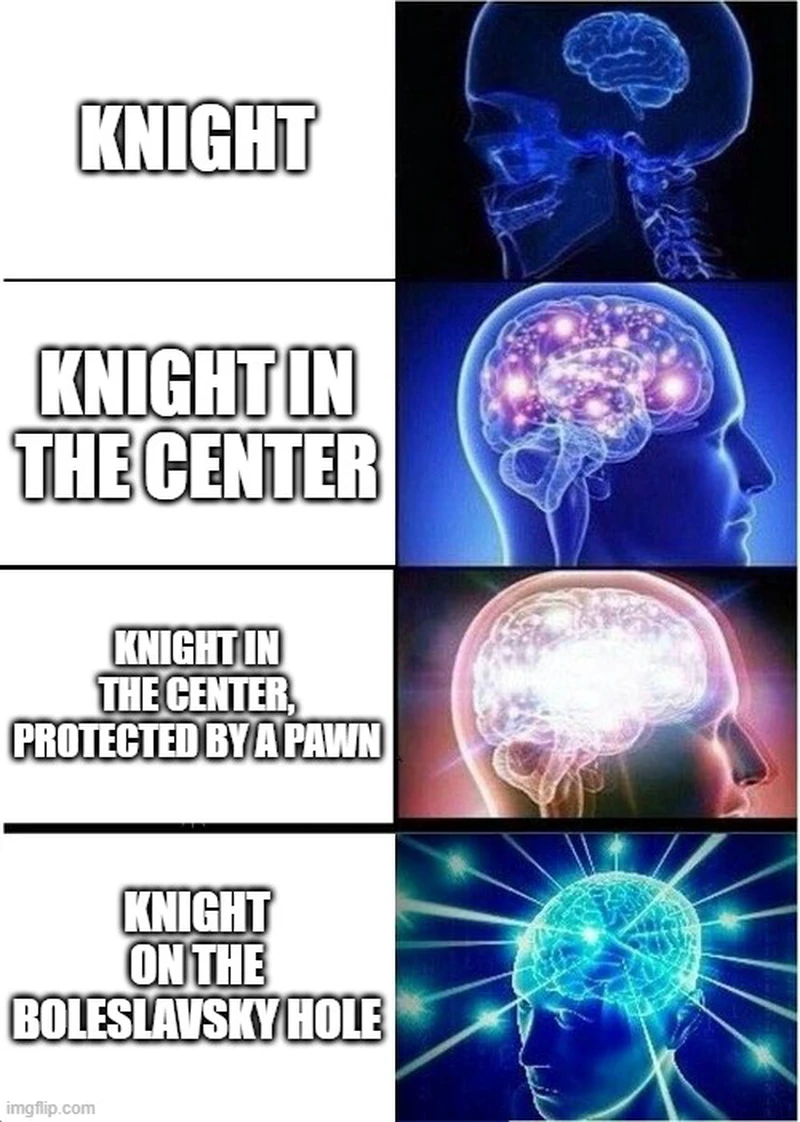
- The Boleslavsky Hole is the weak d5-square in a typical Sicilian structure (Black pawns on d6 and e5).
- The square in front of a pawn weakness (like an isolated or backward pawn) is usually a great outpost for one of your pieces.
- When you're attacking a pawn weakness, step one is usually to block it so it can't move forward.
- With opposite-side castling, the default plan is to launch a pawn storm against the opponent’s king - faster wins!
- If you control the center, you can usually choose any area of the board to attack.
Discuss this blog post in the forum IM MatBobula
 CM HGabor
 D2D4C2C4
 GM Avetik_ChessMoodIM MatBobula
 ChessMonitor_Stats
You may also like
IM MatBobulaThe Opening Mistake That's Wasting Your Time
Many club players spend hours memorizing long opening lines. Hoping for a small advantage. But here'…CM HGaborHow titled players lie to you
This post is a word of warning for the average club player. As the chess world is becoming increasin…D2D4C2C4Why Opening Statistics Are Wrong
Opening statistics, such as those in the opening explorer have a methodological flaw. They tend to s…GM Avetik_ChessMoodThe Risks of Playing Chess When You Don't Want to
Why you should never play chess when you don’t want to! And what should you do instead and save 100s…IM MatBobulaHow to Actually Build a Repertoire That Fits You
Most players pick openings the wrong way. They copy what their favorite GM plays. Or they grab whate…ChessMonitor_Stats