
The Threat Hierarchy: When to Fight Back Instead of Defending
Stronger players don't defend more. They defend less. Here's how.When your opponent makes a threat, you have three types of responses, and most players only ever use one of them.
The one everyone uses is defense. Your opponent attacks something, you protect it, you move on. That’s fine, and sometimes it’s the right call. But it’s only one of your three choices, and it’s usually the weakest one. The other two are ignoring the threat and hitting back with a bigger threat of your own, and stronger players lean towards those first.
The reason this matters goes deeper than any single move. The player who's always defending is the player who's given up control of the game. You're letting your opponent decide what happens next, over and over, and you're just responding. Strong players hate that feeling. They want to be the one setting the pace, and you can't set the pace while you're reacting to everything. So they look for every chance to flip the script and make their opponent do the reacting instead.
The tool that lets you decide between the three is the threat hierarchy.
The idea is simple: not all threats are worth the same which means you can rank them. When your opponent threatens something, you figure out how dangerous their threat really is, then you check whether you’ve got a threat that’s equal or stronger. If you do, then you don’t have to defend at all. You make your threat and let them be the one who has to react.
Here’s the basic ladder, strongest to weakest:
- Check (the only move in the game your opponent is required to answer)
- Threat of checkmate
- Threat to win the queen
- Threat to win a rook
- Threat to win a minor piece
- Threat to win the exchange
- Threat to win a pawn
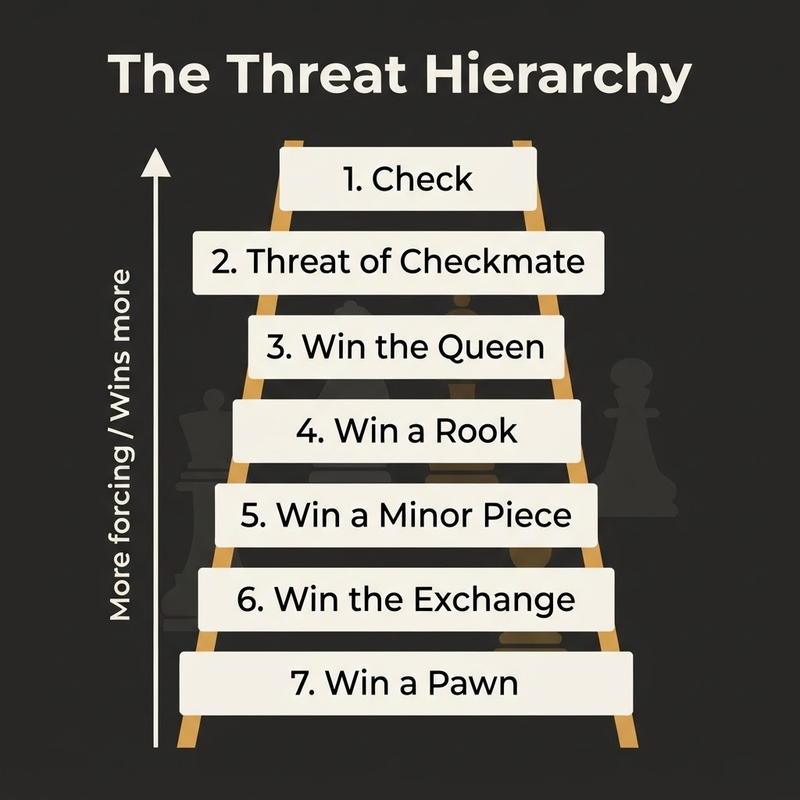
Two things are being measured here at once. A check sits on top because it’s the most forcing; your opponent has no choice but to respond to it. Everything below the check is ranked by how much material it wins. So when you’re deciding what to do, you’re really asking two quick questions: how forcing is my move, and how much does it win? A threat to win a rook is great, but if your opponent can just ignore it and make a bigger threat back, it wasn’t worth as much as it looked.
Positional threats belong on this ladder too, but they don’t have a fixed spot. They float up and down depending on what the position cares about. A threat to wreck the pawns around your opponent’s king might outrank winning a pawn in a sharp position and be almost meaningless in a quiet endgame. Threats like creating a passed pawn, winning the bishop pair, or locking down a key square work the same way. You place them by feel based on what actually matters in front of you.
Before you can compare your threat to theirs, though, you have to size up theirs honestly, and this is where a lot of players go wrong. They feel the danger and assume it's worse than it is. So slow down for a second and ask what the threat actually wins if you do nothing. Sometimes you'll find it's just a pawn, or it's a piece you can win right back, or it's not even a real threat because the capture loses material for them. The jolt of "I'm being attacked" makes everything feel like an emergency. It usually isn't. Naming exactly what the threat costs you takes the panic out of it and tells you how big your reply needs to be. This is where calculation is especially more important than explanations or feelings about the position. I wrote more about this topic here: https://chesschatter.substack.com/p/the-difference-between-words-and
So how do you use this over the board?
When your opponent moves and you see a threat, resist the urge to defend right away. Instead, ask yourself three questions in order:
First, can I ignore this threat completely because I have a bigger one?
Second, if I can’t ignore it, can I make an equal threat and force them to react?
Third, only if both of those fail, how do I defend?
That order is the whole point. Most players collapse the three options into one; they see the threat and go straight to defending. But defending should be the last resort, not the first instinct.
There's a trap to watch for here, and it's the flip side of defending too early. Sometimes you'll spot a counter-threat, get excited, and fire it off without checking whether it actually holds up. The move looks like it out-ranks theirs, but when your opponent responds you realize your threat wasn't as forcing as you thought, and now you're down material with no follow-up. A counter-threat only counts if it's real. That means you still have to calculate it, at least a move or two deep, and make sure your opponent can't just answer your threat while keeping their own alive. The hierarchy tells you which moves are worth calculating first. It doesn't let you skip the calculation.
This connects directly to the SCAN thinking process I’ve written about before. The “S” is seeing what your opponent’s move did, including their threats. The “C” is checking your own forcing moves. The mistake most players make is doing the S and then skipping straight to defense, which means they never do the C at all. The threat hierarchy is what makes the C useful, because it gives you a fast way to compare your threat to theirs and decide whether you even need to defend.
There’s a practical reason this matters so much. Once you start defending, it’s easy to get stuck defending. Every passive move you make gives your opponent another free turn to improve their position while you’re just holding things together. They attack, you defend, and the gap grows. The player who finds a counter-threat breaks that cycle and turns the pressure back on their opponent.
If you want a concrete way to get better at this, train the zwischenzug tactic theme category. A zwischenzug is an in-between move where instead of answering your opponent’s threat directly, you throw in a stronger threat of your own first and make them deal with it before you go back to the original problem. It’s the threat hierarchy turned into a tactic. One of my students, Joel, started drilling zwischenzug puzzles specifically to get his brain used to looking for the aggressive reply instead of the defensive one, and he told me it made a real difference in how he finds candidate moves over the board. The pattern recognition carries over. Once you’ve solved enough positions where the answer is “hit back instead of defend,” you start seeing that option in your own games without having to force yourself to look for it.
Example 1
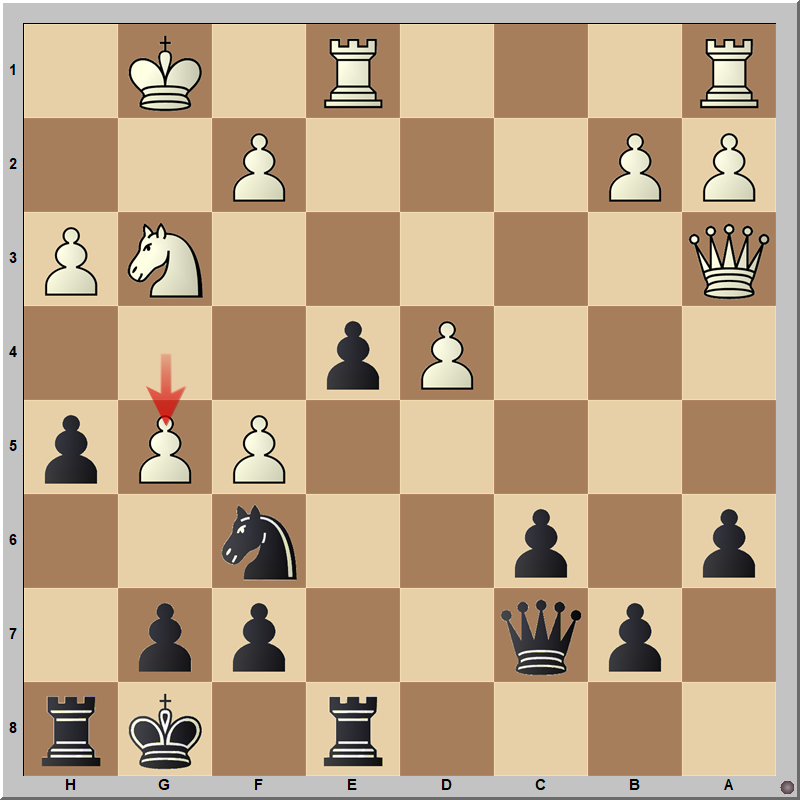
This position is from an OTB tournament game I played against IM Juksta. White has just played 1. g5. attacking our knight. How would you respond?
The best way to play is 1...h4! counterattacking white’s knight on g3 since moving our knight off f6 would have allowed White to win the e4-pawn. The game continued 2. gxf6 hxg3 3. Qxg3 Qxg3+ 4. fxg3 Rxh3 where the endgame is objectively equal but I went on to win the game later.
Example 2
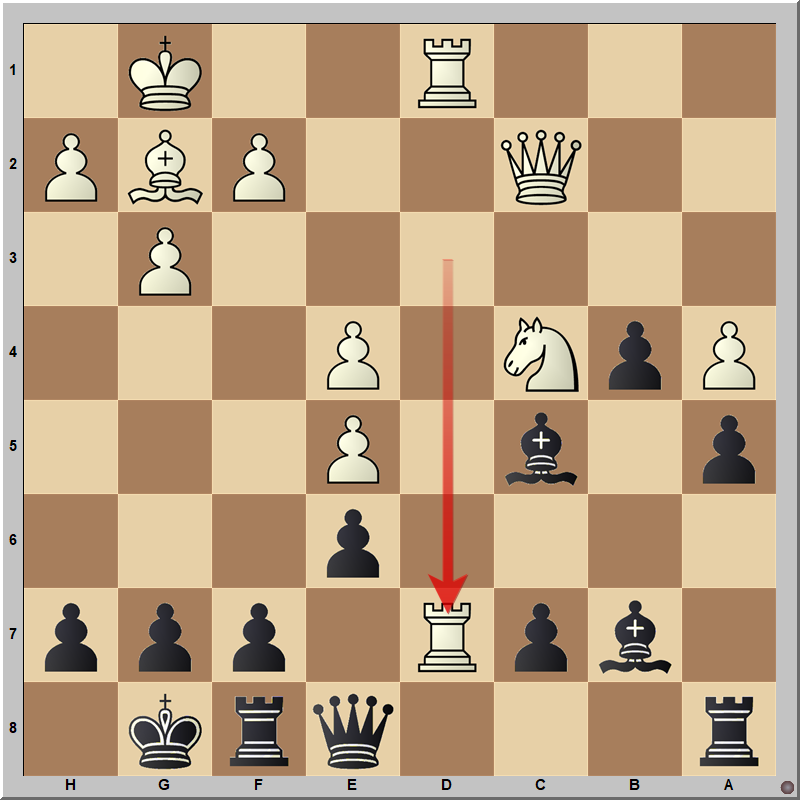
This position is from an online rapid game I played. White has just played the move 1. Rd7 attacking our c7-pawn. How would you respond?
The best way to play here is to play 1...Bc6! which ignores white’s attack on our pawn and instead makes a bigger threat against white’s rook and also a threat against white’s a4-pawn (with help from the queen on e8). After the sequence 2. Rxc7 Bxa4 White is losing the exchange due to the skewer from a4-d1 towards white’s queen and rook. Playing 1...Bc6 at the start is significantly better than a passive move like 1...Rc8 (which loses the a5-pawn) or 1...Qc8 which passively defends the c7-pawn.
Example 3
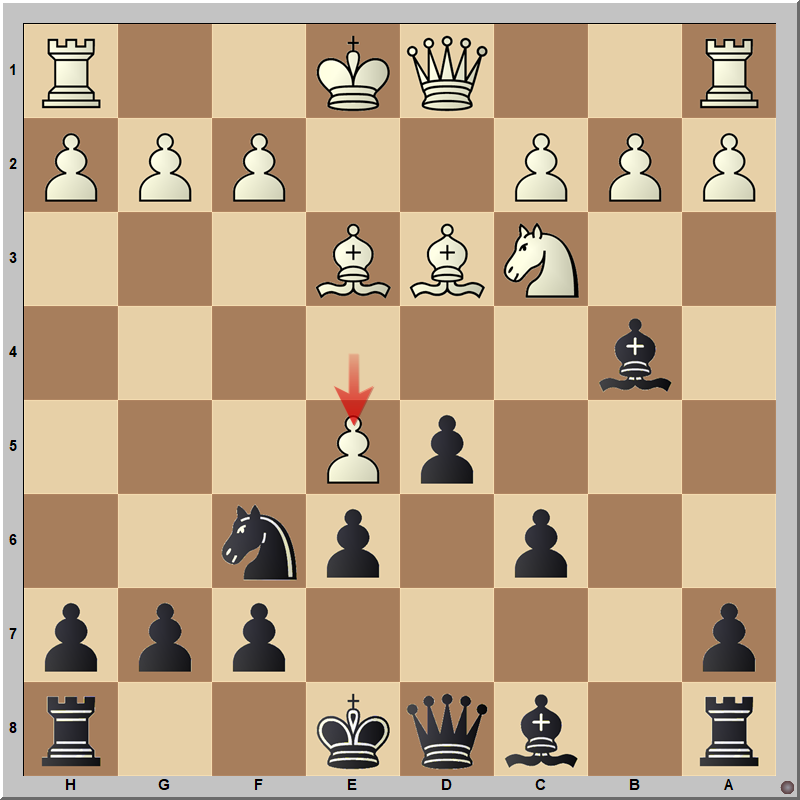
This position is from opening theory in the Four Knights Sicilian Defense. White has just played the move 1. e5 attacking our knight. How would you respond?
The best way to play here is to play 1...d4! which ignores white’s attack on our knight and instead forks white’s knight and e3-bishop. After the sequence 2. exf6 dxe3 3. fxg7 exf2+ (another counter-threat) 4. Kxf2 Qd4+ (another counter-threat!) 5. Kf1 Qxg7 then Black has the advantage due to the bishop pair and safer king.
Alternatively, if you had thought about playing 1...Nd7!? with the intention to counterattack white’s e5-pawn, White can answer this with 2. Qg4! forking the bishop on b4 and g7-pawn which puts us in a bit of a tricky spot.
Example 4
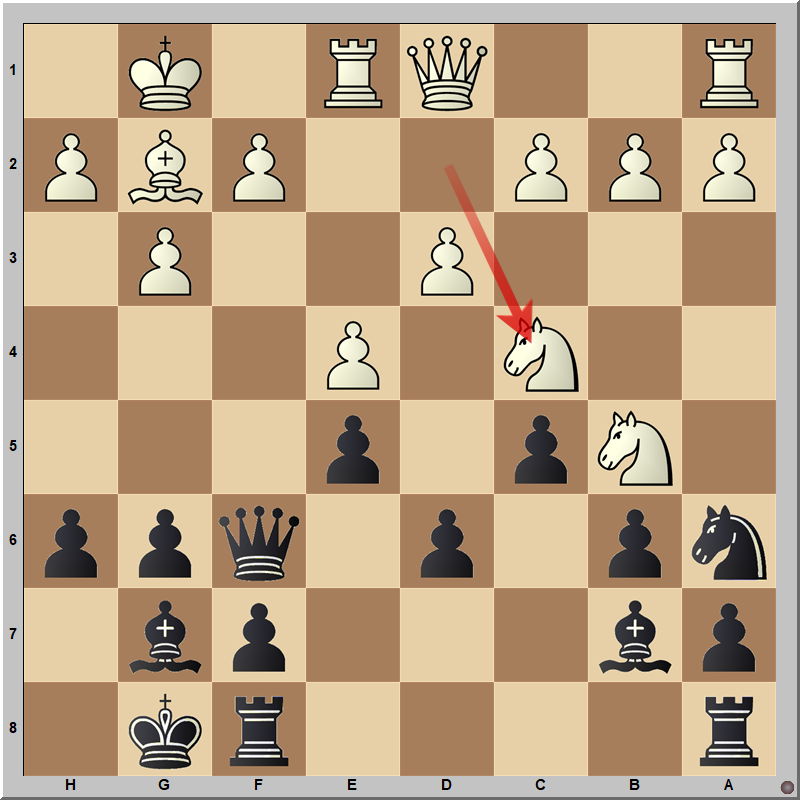
This position is from an OTB tournament game I played against GM Margvelashvili (I was playing White). I had just played the move 1. Nc4 attacking black’s d6-pawn. How would you respond?
In the game Black played 1...Bc6! ignoring white’s attack on the d6-pawn and inviting them to capture it by attacking the knight on b5. If White plays 2. Ncxd6?? then after 2...Rfd8 the knight is trapped and Black will win two knights for a rook and pawn. If White plays 2. Nbxd6?? then after 2...b5 Black will win material due to the knights getting disconnected. Of course White doesn’t need to capture the d6-pawn, but playing an active, counterattacking move like 1...Bc6 is much better than a passive defense like 1...Rfd8.
The takeaway
Here's the key takeaway. When your opponent threatens something, don't reach for defense first. Run the hierarchy: figure out how dangerous their threat is, then look for a threat of your own that's equal or bigger. Ignore it if you can, out-threaten it if you can't, and defend only when neither works. Defense is a tool, not a reflex. The best defense really is a good offense, and the more you practice looking for the punch before the block, the more often you'll find it was there all along.
If you want help spotting the moments you played passive when you had a stronger reply, Chessalyz.ai is a solid tool for breaking down your games. We’re also adding attacking and defending training tools soon.
Now I want to hear from you: what’s a position where you found a counter-threat instead of defending? Drop it in the comments.
If you found this article helpful, consider checking out my Substack newsletter "Chess Chatter".
You may also like
 ChessMonitor_Stats
Where do Grandmasters play Chess? - Lichess vs. Chess.com
This is the first large-scale analysis of Grandmaster activity across Chess.com and Lichess from 200… FM MattyDPerrine
Chessalyz June Update: See the Moment Your Game Leaves Your Prep
Build your repertoire, save any position as a flashcard, track your stats, and see exactly when a ga… GM Avetik_ChessMood
10 Things to Give Up to Enjoy Chess Fully
Discover how embracing a lighter mindset can help you enjoy chess again and achieve better results. FM MattyDPerrine
I'm on the Perpetual Chess Podcast
Give it a listen! FM MattyDPerrine
Higher-Rated Players Want You to Be Afraid of Them
Your fear is their biggest weapon. Here's how to stop handing them the game. thibault