
The Power of Square Clearances
Sometimes the real magic happens when you vacate squaresAs we improve as chess players, we often go through a phase where our attention shifts from simply focusing on pieces to recognising the value of squares. We start to target key squares around the opponents camp and try to control unoccupied one. This could be for example be outposts or weak colour complexes.
How much do we consider the squares that are already occupied by our own pieces? Are they optimally utilised or can they be better used by another of our own pieces? I believe this level of thinking marks another step in the club players chess improvement. We (myself included) tend to dismiss our own occupied squares as ‘already settled,’ but this mindset can lead to missed opportunities in many positions.
Many tactical and strategic resources lie hidden in vacating squares for other pieces. I have gathered seven examples in this post to illustrate this:
In a double-edged position both kings are in tight spots so we must act fast.
Example 1: White to play
Quite the unexpected move if you do not have the clearance motif in your tactical arsenal! The unexpected clearance move Qf6 vacates the f7-square for the knight checkmate, exploiting the clearance motif with tempo.
Tactics and strategies involving clearance of squares are among my favourite type of problems to solve. In my opinion training in the clearance motif enhances two vital skills:
Visualization of the Board: Training the ability visualise how pieces should ideally be utilised rather than how they currently stand, requiring some mental picturing that is useful for calculations.
The Concept of Time: Clearance moves can change the character of the game, but timing is crucial. If clearance is too slow, the opponent may counteract the plan. This trains us to use forcing moves effectively to maintain the initiative.
Example 2: White to play
The winning move may not be obvious, but when we understand the motif, it becomes clear! Similar to the first example, the g7-square was occupied by the Rook, but the square is much better suited for our Queen, which delivers checkmate. We must clear the square for our Queen with tempo to ensure our opponent cannot prevent this or launch their counterattack.
In my previous article Fun with Bishop and Queen battery against h7 (3rd example) I explored a form of clearance tactic by clearing the diagonal instead of a square, but the principle remain the same so I will bring here again:
Example 3: Black to play
The clearance of the b8-h2 diagonal is the difference between harmless bishop and a devastating queen entering h2.
Clearance motifs is not just for checkmating attacks, the following examples show square clearances that win for other tactical reasons:
Example 4: White to play
The c4-square is cleared for our Rook to fork blacks minor pieces. An unexpected tactical shot in a quiet-looking position.
Next we see a clearance tactic used as a defensive resource. White has menacing checkmate threats looming on h7 and g7.
Example 5: Black to play
It is important to note that the clearance must take place in a way that doesn't grant the opponent counter-resources. We needed to keep f2 undefended by our opponent so we can play our sequence Nf2-h3 to lift the pin on h7. That's why the correct move must be Qe1+ and not Qf1+ (as white could otherwise respond to 2..Nf2+ with 3.Rxf2).
The clearance motif is not just about immediate tactics as above examples. Finally I will show two examples of square clearances for strategic reasons from my own games:
Example 6: White to play
My knight very much wants to occupy f4, which by itself is a great outpost and points towards an even stronger outpost on e6. To facilitate this I simply vacate f4 by advancing my pawn to grant my knight access. This pawn move also completely shatters Blacks kingside. This is well worth the pawn sacrifice. Did you also see the second square clearance on d5 (for Nb1) after dxe6 from afar? Its a simple but important concept to remember: Any pawn move is a clearance of the vacated square for another piece to utilise!
For the final example I'll show a square clearance with no immediate win but gains long term strategic advantage. In this position White will definitely prefer a closed position for their Knight. If it were Whites move, they would play e3-e4 and be strategically winning. It would have grounded my bishop to an lousy piece and given them eternal outposts on d5, f5 and c4. However it is my move and I'm interested in opening things up:
Example 7: Black to play
Notice how the position immediate changes after e5-e4, as all pieces come to life. Not only do we gain the e5-square for a Queen/Bishop battery against our opponents king, I also gain access to the weak dark squares on Whites queenside. A multipurpose clearance!
I hope you enjoyed this article! If you’d like to explore more bite-sized chess lessons, do visit my personal blog at chessinprogress.com, where I’m working on a collection of 100 tactical and strategic articles. While some are posted here on Lichess, the majority—along with insights into chess psychology and my own chess journey—can be found exclusively on my blog. Hope to see you there!
Final Thoughts: Vacating for Victory
There is many hidden potential in your already occupied squares. The ability to recognize and execute effective squares clearances can be decisive in both tactical shots and strategic manoeuvring. I hope these examples demonstrated this. Yet the clearance of squares is often an overlooked concept for club players, so do remember: Don’t just focus on attacking and occupying squares—sometimes the real magic happens when you vacate them.
You may also like
 Mcie
McieThe Elegant Cross Pin
Where Tactics meet Art! Mcie
McieFinding miracle tactics even in check!
If you can find tactics here, you can find them anywhere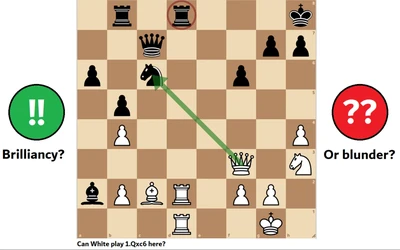 Mcie
McieCalculate until the end.. and one move more!
Blunder or brilliancy, sometimes it all hinges on one more move. Mcie
MciePinned Pieces Don’t Defend—Creative play to exploit them!
Exploiting the Pin to Win Mcie
McieReverse Your Move Order! The same idea might just win
How often do you check for move order improvements? Mcie
Mcie