
Did the Soviets Collude Against Bobby Fischer?
I Investigate The Claims By Looking At The Evidence
Fischer competed in the 1962 Candidates Tournament. The winner would contest the 1963 World Championship. Petrosian won and went on to challenge Mikhail Botvinnik for the title.
Fischer accused Petrosian, Geller, Keres and Korchnoi of colluding and rigging their games through prearranged draws. He also accused Soviet players of giving each other advice during the games and accused Korchnoi of deliberately losing games to Petrosian, Geller and Keres.
"The international Candidates' Chess Tournament that ended June 28 in Curacao left me with one conviction: Russian control of chess has reached a point where there can be no honest competition for the world championship. The system set up by the Fédération International des Echecs, the governing body of world chess, insures that there will always be a Russian world champion because only a Russian can win the preliminary tournament that determines his challenger. The Russians arranged it that way. As far as I am concerned, they can keep it that way. I will never again play in one of these tournaments."
Bobby Fischer, Sports Illustrated, August 20, 1962
The Format and Tournament
There were 4 'cycles'. A cycle means that every player plays every other player. This means that each player played each other 4 times in this tournament.
Each cycle was 7 games long.
The last cycle was only 6 games because Mikhail Tal left the tournament due to becoming ill as a result of a recent kidney operation.
Overall the other players played 27 games in total.
The Claims
Bobby Fischer published an article in Sports Illustrated after the tournament called 'The Russians Have Fixed World Chess'.
"At Curaçao it was flagrant. There was open collusion between the Russian players. They agreed ahead of time to draw the games they played against each other. Each time they drew they gave each other half a point. The tournament winner, Petrosian, got 5.5 points of his 17.5 total this way. They consulted during the games. If I was playing a Russian opponent, the other Russians watched my games, and commented on my moves in my hearing. Then they ridiculed my protests to officials. They worked as a team."
"Mikhail Tal however, the former world champion, had recently recovered from a kidney operation, became ill during the tournament, and withdrew to enter a hospital, having no part in the Soviet team effort thereafter. The other four Russians [Petrosian, Geller, Keres and Korchnoi] swam in the afternoons, dressed, came to the start of the games in the chess room at the Hotel Intercontinental, dawdled at the chess boards for half and hour or so, made a few quick moves, traded off as many pieces as possible and then offered a draw."
Bobby Fischer, Sports Illustrated, August 20, 1962
"The record of Victor Korchnoi, the fourth member of the Soviet team, is more complex. In the first half of the tournament he, too, drew every game he played with the other Russians. At the midpoint of the tournament there was a five-day rest period; we all went to the island of St. Martin. The four Russians were almost tied in points for first place, and the talk was that when they came back to start the second half, one of the four was certain to begin losing to the others. Whatever happened in the Russians' consultations at St. Martin, Korchnoi's game certainly collapsed abruptly afterwards. He lost three games in quick succession, first to Geller, then to Petrosian and then to Keres. Then, in the last time around, he drew quickly with Geller, drew with Keres and lost again to Petrosian. Anyone could draw his own conclusions from this sequence of events but, in any event, it revealed the advantage the Russian team had over Western individual players."
Bobby Fischer, Sports Illustrated, August 20, 1962
Bobby Fischer also pointed to the Cycle 4 game between Petrosian and Keres which was drawn in 14 moves as evidence of collusion.
"In this last game they overdid it, and while they drew, Petrosian clearly would have won if they had gone on. As shown on page 19, white's king is permanently trapped in the center of the board. White's queen wing is hopelessly weakened. As a matter of fact, black wins in a few moves. But when black had certainly won, and another move or so would make it obvious, they drew."
Bobby Fischer, Sports Illustrated, August 20, 1962
Summary:
Claim 1: Soviet players [Petrosian, Geller, Keres and Korchnoi] purposely colluded to eliminate Fischer.
Claim 2: Korchnoi lost his games to Petrosian, Geller and Keres in Cycle 3 deliberately.
Claim 3: Soviet players gave each other advice during the games.
Claim 4: Petrosian drew with Keres in a winning position. (Supporting collusion against Fischer).
The Evidence
Exhibit A - The Data:
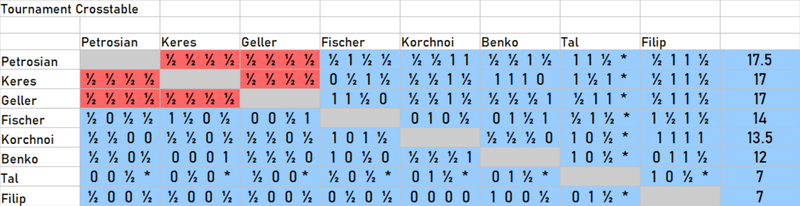
Tournament Crosstable (A.1)
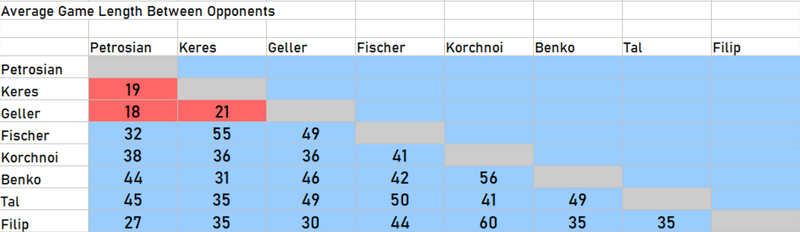
Average Game Length Between Opponents (Rounded Up To Nearest Whole Number) (A.2)
Game Lengths Between Petrosian, Geller and Keres (A.3)

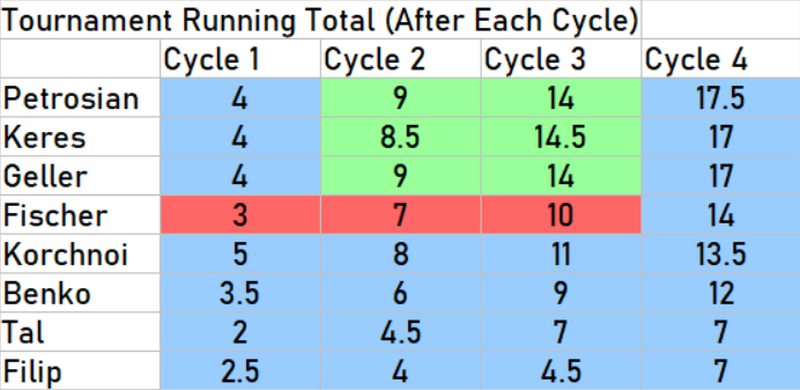
Tournament Running Total (After Each Cycle) (A.4)
Fischer vs Soviet Individual Games (A.5)
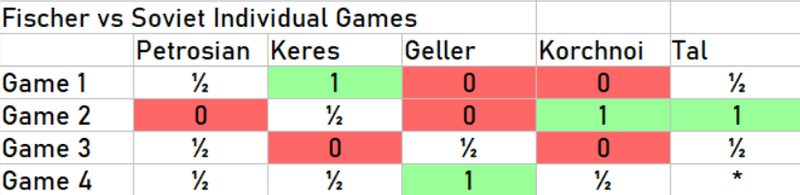
Exhibit B - The Testimony:
Korchnoi believed that Petrosian, Geller and Keres agreed to draw all their games. (B.1)
"There, as we all now know, everything was arranged by Petrosian. He agreed with his friend Geller to play draws in all their games together. They also persuaded Keres to join their coalition. In a two-month long tournament, held in tropical conditions, it was important to shorten the distance by eight rounds: this gave them a great advantage over the remaining competitors."
"At first I didn't grasp what was happening in the tournament. I recall how, on seeing a ten-move draw between Geller and Petrosian in the second cycle, I asked Geller whom he was intending to beat. 'You!' was his direct reply."
Victor Korchnoi Autobiography, Chess Is My Life (p.44-45)
Korchnoi disputed Fischer's claim that he deliberately lost his games. (B.2)
"In the next cycle I lost in turn to each of the three leaders. It was this that persuaded Fischer to write after the tournament that I had been chosen 'as a sacrifice' by the Soviet delegation. Surely he wasn't being serious. I am incapable, by character, of being made a sacrifice, the more so since, if I had won those three games, it wouldn't have been Petrosian who would have won the tournament!"
Victor Korchnoi Autobiography, Chess Is My Life (p.45).
Bisguier opinion. (B.3)
"I would not call this a pact, since I do not know whether they originally had such an agreement."
Arthur Bisguier (Fischer's second), quoted in Garry Kasparov, My Great Predecessors Part 4 (p.299).
Keres discusses his draws. (B.4)
"Keres, when asked about his relatively quiet play at Curacao responded : "Why should I take risks? In the 1959 Challengers Tourney I took chances and it didn't work. Now I'm trying another way!"
Eliot Hearst, Chess Life Magazine, Challenges At Curacao, p.8, August 1962.
"The fact is, and remains, that in the Candidates' Tourney he was never seriously in the running for first place, from the very start. Can you offer me a plausible reason why this "teamwork" should be put into operation against a competitor who was never a serious danger to the rest? Why should Korchnoi offer himself up suddenly as a sacrifice (as Fischer claimed) when he himself still had good chances of finishing first? Why did Korchnoi start his self-immolation as early as round 12 against Bobby Fischer himself, putting a piece en prise in a winning position? With the best will in the world I cannot see why any of us should have devoted special attention to the shutting-out of Bobby Fischer.
Next the matter of quick draws by which, according to Fischer. his rivals procured themselves extra rest days so that he tired more quickly than they. Admittedly these quick draws are no adornment to any chess contest. In my opinion, they are a symptom that the event is over-protracted. A monster tournament of 28 rounds is nothing (or the International Chess Organization as organizers to be proud of. That the players try, in effect, to shorten it a little, seems to me wholly natural-chess players are only human . These perfectly understandable tactics, Bobby Fischer uses as the basis for an attack on his fellow-contestants. If they draw with each other, how does that harm him? Elementary mathematics shows that a draw can only benefit the score of someone in the lower half of the table. Draws do not win! And the reproach that the culprits benefited by extra rest days and swimming comes pretty badly from the mouth of a youth not yet twenty years old. the only player in the tourney who had his own personal trainer."
Paul Keres, Chess Life Magazine, Chess Kaleidoscope, p.14, August 1964.
Averbakh discusses Petrosian draws. (B.5)
"Yuri Averbakh [...] said that "draws are a matter of style. Bobby is an aggressive player who shuns the draw, while Petrosian is not." Averbakh told the story of the game Bannik-Petrosian, an 11 move draw in a recent Russian Championship, where the judges immediately complained about the brevity of the game. Petrosian defended himself by replying that the game was a " theoretical draw" and that he would have to compromise his position in order to win- a risk he was reluctant to take."
"Averbakh also recalled a 1961 Soviet chess cartoon that depicted Geller and Petrosian sawing away together at a large wooden point and ending up with numerous half-points as shavings. The caption read : "The Fruits of a Long Friendship ." Further evidence of Petrosian's policy of non-aggression was his offers of draws to Fischer and Keres in the final rounds at Curacao, in positions in which he had a distinct advantage."
Eliot Hearst, Chess Life Magazine, Challenges At Curacao, p.8, August 1962.
Hearst Opinion. (B.6)
"At present the safest comment to make is that Petrosian, Keres, and Geller have played a large number of draws with each other in the past, and therefore the persistent draws at Curacao give no evidence of anything particularly suspicious."
"It's true, also, that Fischer's poor start, and the immediate rise of four Russians to the top of the scoretable, made it rather convenient for the Soviet stars to continue their point-splitting course. If Bobby had won his first few games, draws among the Russians would have been the worst possible course for them to follow, since that procedure would have placed them further and further behind the American."
Eliot Hearst, Chess Life Magazine, Challenges At Curacao, p.8, August 1962.
Keres disputes Fischer's claims that the Soviets were discussing his games whilst in progress (B.7)
"Finally, the accusation that other contestants audibly discussed his games. It is fully in keeping with his inadequate command of Russian and his egocentric outlook that he should seriously believe that the other players gave special attention to his games during play. His repeated protests to the tournament controllers had the ultimate result that a player could not even exchange a few words with his wife. On the eventual outcome of the tournament. they had not the least effect."
Paul Keres, Chess Life Magazine, Chess Kaleidoscope, p.14, August 1964.
Conclusion
Bobby Fischer's claims of Soviet collusion to prevent him from winning the tournament are not supported.
I've presented the evidence and believe that this conclusion is justified.
Claim 1: Soviet players [Petrosian, Geller, Keres and Korchnoi] purposely colluded to eliminate Fischer.
- Petrosian, Geller and Keres drew all their games with each other (A1). Their draws were also all extremely short by a large margin compared to everyone else (A2) (A3). This demonstrates that they got an advantage over the field by saving energy and not risking their lead.
- However, this does not show that the Soviets purposely colluded to eliminate Fischer.
- Firstly, Korchnoi did not make any exclusive or quick draws, neither did Tal (A.1) (A.2) (If the Soviets were a colluding ring, why did they not participate?)
- Secondly, Fischer did not manage to reach the top of the tournament standings, which means there would be no need for them to prearrange draws and for Korchnoi to deliberately lose games (A.4) (A.5).
- Thirdly, Korchnoi believed that the draws between Petrosian, Geller and Keres were prearranged to give them an advantage (not to target Fischer exclusively) (B.1). Korchnoi's anecdote about Geller shows they were giving themselves an advantage over the whole field (not just Fischer).
- Fourthly, prearranging draws could not stop Fischer if he won more games (B.6). Only 8 of the 27 games are accounted by the draws of Petrosian, Geller and Keres. The Soviets could not reasonably keep the World Championship to their selves by just drawing games with each other.
- We don't know if Petrosian, Geller and Keres had an explicit agreement or whether they just decided to draw with each other (tacit collusion). The ethics of Petrosian, Geller and Keres can be debated as they gave each other an advantage in the tournament over everyone else. Petrosian, Geller and Keres also had a history of short draws with each other. (B.5) (B.6). Korchnoi says the draws were prearranged ahead of time, but he seems to be offering his opinion rather then first hand knowledge.
Claim 2: Korchnoi lost his games to Petrosian, Geller and Keres in Cycle 3 deliberately.
- Korchnoi disputes this claim (B.2). There are no other sources supporting the claim that Korchnoi deliberately lost to Petrosian, Geller and Keres. Fischer was also already behind the Soviets due to his performance at the beginning of the tournament (A.4) (A.5).
Claim 3: Soviet players gave each other advice during the games.
- I have not been able to find any sources supporting this claim. Presumably this would have been supported by others in the tournament. Neither Benko nor Korchnoi has mentioned this occuring. Keres disputes this claim (B.7)
Claim 4: Petrosian drew with Keres in a winning position. (Supporting collusion against Fischer).
- The final position of that game was evaluated by Stockfish at -1.8 (winning for Petrosian). However, this happened at the end of the tournament in Cycle 4 when Fischer was far behind (A.4). Petrosian also had a history of short draws and conservative play (B.5) (B.6). Since Petrosian was leading the tournament he might wanted to draw his way to the World Championship without risk.
If you have any other sources regarding this article please post them in the forum.
Feel free to share your thoughts on the conclusion of this article in the forum as well.
Sources
- Bobby Fischer, Sport Illustrated, August 20, 1962 (provided by bobby-fischer.1971.blogspot.com)
- Eliot Hearst, Chess Life Magazine, Challenges At Curacao, p.8, August 1962
- Eliot Hearst, Chess Life Magazine, Chess Kaleidoscope, p.14, August 1964
- Victor Korchnoi Autobiography, Chess Is My Life, 1978
- Garry Kasparov, My Great Predecessors Part 4
- 1962 Curacao Candidates Information
- 1962 Curacao Candidates Information (Running Total)
You may also like
 RuyLopez1000
The Candidates Qualification System
Thoughts on the Candidates Qualification System RuyLopez1000
Alekhine vs Capablanca: The Rivalry
Explore one of the Greatest Rivalries in the History of Chess CM HGabor
How titled players lie to you
This post is a word of warning for the average club player. As the chess world is becoming increasin… ChessMonitor_Stats
Where do Grandmasters play Chess? - Lichess vs. Chess.com
This is the first large-scale analysis of Grandmaster activity across Chess.com and Lichess from 200… RuyLopez1000
Bobby Fischer's GOATed Endgame
Bobby plays a brilliancy. Instructive Lesson. RuyLopez1000