
Did the Soviets Collude in the 1953 Candidates Tournament?
I Investigate The Claims By Looking At The Evidence
The winner of the 1953 Candidates Tournament will challenge Mikhail Botvinnik for the title. It took place from August 29th-October 24th. The tournament had 15 players and 30 rounds. Each player would play against the other twice.
Out of the 15 players, these were the strongest:
David Bronstein: 1950 Candidates: 1st
Paul Keres: 1948 World Ch: 3rd=, 1950 Candidates: 4th
Samuel Reshevsky: 1948 World Ch: 3rd=
Vassily Smyslov: 1948 World Ch: 2nd, 1950 Candidates: 3rd
Photos:
 L to R: Taimanov, Smyslov, Petrosian, Kotov, Keres, Geller, Bronstein, Boleslavsky, Averbakh, Zurich Chess Club
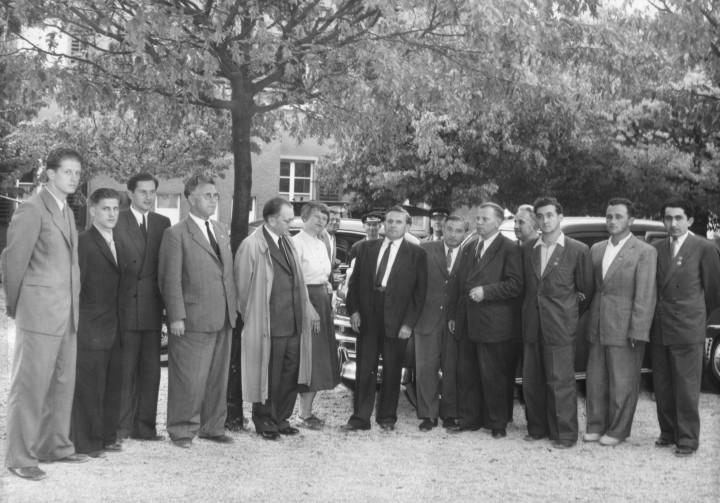 L to R: Averbakh, N.N., Keres, N.N., Perret, N.N., N.N., Kotov, Postnikov, N.N., Taimanov, Geller and Petrosian. From Edward Winter, Mark Taimanov Article
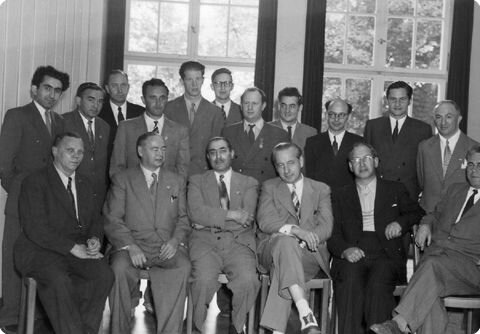 Top Row L-R; Petrosian, Kotov, Szabo, Geller, Averbakh, Smyslov, Boleslavsky, Taimanov, Bronstein, Keres, Najdorf, Zurich Chess Club
---
In March 1953, Joesph Stalin died. The set off a struggle for power within the party. Lavrentiy Beria had served as the head of the NKVD (Soviet Secret Police), being involved in the Great Purge. Beria was now one of the contenders for power. Malenkov, Molotov and Khrushchev then formed an alliance against Beria. In June 1953, Beria was arrested and accused of treason.
The 1953 Candidates Tournament took place at a difficult time. The events of the spring (the death of Stalin) and the summer (the arrest of Beria) disturbed the whole world - everyone was afraid of a new war and it was no time for chess. And for Soviet citizens the very idea of a trip aboard looked suspicious. Why did they need to go there at those troubled times? But nevertheless an imposing Soviet delegation - nine grandmasters and eight seconds (I alone did not have one) - flew to Switzerland.
The FIDE schedule had to be respected. The tournament was nervy and exhausting: two months' play and 30 rounds! The leaders of the delegation (the deputy head of the Sports Committee Postinkov, his deputy Moshitsev from the KGB, and grandmaster Bondarevsky, who worked for both of these organisations) inflamed passions, all the time reminding us that on no account must Reshevsky be allowed ahead. If he had qualified for a match with Botvinnik, we would all have had to pay for it. Just think: nine Soviet participants unable to stop one American!
David Bronstein and Sergey Voronkov, Secret Notes, 2007
Averbakh was a Candidate in the tournament. He finished 10th.
Kingston: It sounds very interesting. Switching now to another question, this involves a tournament in which you played, the 1953 Neuhausen-Zürich Candidates Tournament. There was an article recently by David Bronstein ...
Averbakh: Yes, I read it.
Kingston: I figured you were familiar with it. He said that there was a delegation of officials there: Dmitry Postnikov, Igor Bondarevsky, and a KGB officer named Moshintsev, and that they had two goals. The main one was to make sure that Reshevsky did not win the tournament and challenge Botvinnik, and they also ...
Averbakh: No, I will try to explain. These questions do not involve me directly, because I was playing my own chess. I lost to Reshevsky, by the way, and nobody blamed me. Anyway, these people from the sports committee, and from the KGB, and also Bondarevsky, who was the main trainer, the main coach of our team, they were assisting players from the USSR. They wanted to help our people.
Yuri Averbakh, Taylor Kingston Interview, 2002
Bronstein published a famous book annotating the tournament 'Zurich International Chess Tournament 1953' in 1956.
My account of Switzerland would be incomplete, if I did not finally reveal the truth about the tournament in Zurich. Yes, the book about it brought me world fame. But for many years the tournament itself has sat like a thorn in my heart. How long can one suffer? And I have decided to pull out this thorn.
David Bronstein and Sergey Voronkov, Secret Notes, 2007
Bronstein was supported in his chess career by his close friend Boris Veinstein who was a President of the USSR Chess Federation, Chairman of the Dynamo Chess Club and Director of the Department of Economics in the NKVD under Beria. Veinstein let Bronstein live in his apartment in Moscow and helped him obtain exit visas to play in overseas tournaments.
During the tournament Bronstein was concerned about the fate of his close friend Veinstein, who had been an officer in the secret police and had served under Beria.
Veinstein hadn't been allowed to travel to Switzerland as Bronstein's second. (As a result, Bronstein was the only Soviet player without a second.) But Veinstein had promised to "send some kind of innocent telegram" during the later stages of the tournament so Bronstein would know he hadn't been arrested. Veinstein never sent the message, explaining to Bronstein later "I was afraid."
Andy Soltis, Treachery in Zurich Part 1
C.N. 1949 quoted some remarks made by Bronstein regarding the 1953 tournament book in an interview with Antonio Gude on pages 38-42 of the March 1993 issue of the Revista Internacional de Ajedrez:
‘Most of the nice words and elegant expressions in the book overall are the work of Vainstein, who writes very well ... Of course, the analysis and technical concepts are mine, as are the views on my rivals, but it may be said that a large part of the text is by Vainstein. Also, it is a book for which I do not have particular affection because it reminds me of a tournament that was very special in a negative sense. Things happened there that I should like to forget ... We shall discuss that another time. I do not wish to be more specific for the moment.’
Edward Winter, David Bronstein Article
After the first 9 Rounds, Reshevsky had 6.5 points, followed by Smyslov with 6 points. Reshevsky went for a draw in Round 10.
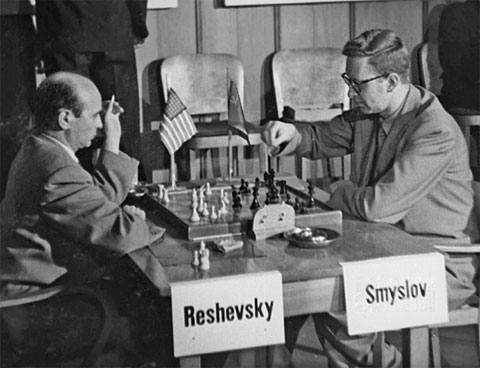 Reshevsky vs Smyslov, Round 10, a 19 move draw. Zurich Chess Club

Smyslov took the lead after Round 13 with 8 points after Bronstein defeated Reshevsky.
They [Bronstein and Reshevsky] were to meet for the first time in the next round. Bronstein has given various accounts of what happened before that historic game:
In his tournament book and again in David Bronstein, Chess Improviser, which appeared in Russian in 1976 and in English in 1983, he and his longtime collaborator Boris Veinstein describe Bronstein as being motivated by the realization of how important a win would be for his own chances, as well as for Smyslov's and Reshevsky's.
"I was behind Reshevsky by one and a half points and a win for me would reduce the difference to half a point," he wrote in the tournament book. "But should Reshevsky win and remain undefeated, he would catch up with Smyslov."
In The Sorcerer's Apprentice (1995) Bronstein gives a different view, saying he was under pressure from "the heads of our delegation," who simply ordered him to win.
In Bronstein on the King's Indian (1999) he added: "Your every move was scrutinized not only by fans, but also by officials of every rank. Mistakes were not forgiven. On the result of one game could depend, to put it mildly, your entire well-being."
Andy Soltis, Treachery in Zurich Part 1
But as bad luck would have it, Reshevsky in fact took the lead together with Smyslov. This unsettled our 'triumvirate'. And before the 13th round, when I was preparing for my game with Reshevsky, they came to my room (I thought they had had one too many) and stated that the following day, despite the black pieces, I had to win. lt was an order! There was nothing to be done and, contrary to my habit, for five hours I did not get up from the board I displayed my zeal. In time-trouble, Reshevsky as usual wanted to confuse me, but he met his match. The adjourned position looked only slightly better for me, but, fortunately, a study-like way to win was found .
David Bronstein and Sergey Voronkov, Secret Notes, 2007
"This game had some influence on the placement of the leaders, since I stood 1.5 points behind Reshevsky, and a win for me would decrease that gap to half a point. If Reshevsky, who was undefeated so far, were to win, he would catch up to Smyslov. So it would appear that a draw suited none of us three. (All of these ruminations may be considered as part of the pregame warmup.)
The opening was a well-known King's Indian, with both sides striving for the initiative. The second phase (up to move 23) was mostly maneuvering; by its close, a black pawn had appeared on a3, and a white one on e5. In the following phase, White tried to cash in his initiative in the center and kingside for a mating attack, inventing a remarkable combination which sacrificed a pawn, a rook, and the exchange—which Black neutralized by ex-changing off the enemy knight. A series of exchanges followed, which laid bare the deficiencies of Reshevsky’s pawn-pushing.
Queens plus opposite-colored bishops usually means a very sharp fight. In the game's concluding phase Black kept up his mating attack until the very last move, unwilling to trade queens anywhere except at b2, which would have been hopeless for White.
Even after all this, it still seemed as though Black might not get his win. He found it, however, by means of a joint maneuver by queen, bishop and pawn that left the white pieces in a state of absolute zugzwang."
David Bronstein, Zurich International Chess Tournament 1953, Second Edition 1960 (Translated by Jim Marfia)
During the Candidates' Tournament of 1953 Reshevsky played without a second, just as I did. For both of us the conditions were even. We did all the preparation ourselves. I decided to play my favourite King's Indian Defence. The evening before this game I was told by the heads of our delegation that, after evaluating the situation in the tournament, they had come to the conclusion that I could win against Reshevsky and I was ordered to do so. I came to the game, sat down at the table and never moved again until the game was adjourned! Of course I was fortunate to win, mostly because Reshevsky always avoided simple moves and was also playing for a win.
David Bronstein, The Sorcerers Apprentice, p.16, 1995
Annotations from The Sorcerer's Apprentice (p.108).
Smyslov held the lead from Round 13 till Round 20. In Round 21, Kotov beat Smyslov. Reshevsky was now tied for 1st with Smyslov on 12.5 points. Bronstien was behind them on 12 points, and Keres on 11.5.
But after Smyslov lost to Kotov and Reshevsky again caught up with him, they again grew nervous. Here, after one of the regular check-ups, the team's doctor Vladimir Alexandrovich Ridin reported to Postnikov that Bronstein and Keres were in a normal condition, whereas Smyslov had weakened and might not last out to the finish at the desired level (I was later informed of this fact in Moscow by Ridin himself). In addition, in the second half of the tournament none of the four of us had yet met, and anything could happen...
David Bronstein and Sergey Voronkov, Secret Notes, 2007
In Round 22, Smyslov beat Geller and Reshevsky beat Boleslavsky - they were still tied with 13.5 points. Bronstein had 12.5 and Keres 12.
In Round 23, Reshevsky lost to Kotov. Smyslov didn't play in this round (every player didn't play two rounds as you can't play against yourself in a round robin tournament). Smyslov and Reshevsky still had 13.5 points and Bronstein and Keres had 13 points. Smyslov was in a good position as the others had one less game to play as they still had their bye days.
According to Bronstein, The triumvirate (Postnikov, Bondarevsky, Moshintsev) pressured Keres to draw his game against Smyslov in Round 24.
I have to admit that I myself partly provoked the 'avalanche'. On the free day before the 24th round, Boleslavsky and I were in his room, peacefully playing cards. Suddenly Postnikov came in: 'Why aren't you preparing?' lsaak Efremovich kept quiet, but I went and blurted out: 'Why prepare? Tomorrow I have Black against Geller and I'll make a draw. Then I have White against Smyslov.' Postnikov looked hard at me, stood for a short while, and then silently went out. And Boleslavsky immediately reproached me: 'Why did you say that to him?' Apparently he sensed better than I did the mood of the 'chief', as we called Postnikov.
At any event, the 'triumvirate' decided to act. They summoned Keres to the shore of the Zurich lake and over the course of three hours tried to persuade him to make a quick draw with White against Smyslov, so that in the next round the latter would be able to assail Reshevsky with all his might (I was told of this that same evening by Tolush, Keres's second).
Keres courageously withstood the pressure. Perhaps he promised to think about it, but he turned up for play in a fighting mood . But he was all flushed and agitated, and I saw that he was not in a fit state to play. This was also noticed by Smyslov, who suddenly came up to me and asked : 'Why is Paul looking at me so maliciously? Have I offended him, or what?' I didn't know what to reply, and I kept quiet - suppose Smyslov didn't know what was going on? Keres lost, of course.
David Bronstein and Sergey Voronkov, Secret Notes, 2007
On the eve of the 24th round, Keres was a half-point behind Smyslov, but Keres was due for his bye in the 25th round. In the event of a draw with Smyslov, he would fall either a point or a point and a half behind Smyslov, depending on how the latter scored against Reshevsky in Round 25. Thus, we can see the psychological circumstance which impelled Keres to try his luck with a strange, sharp king- side attack, using only his two rooks without the aid of his pawns.
Keres either could not or would not make methodical and logical preparations for his attack. As early as the 19th move, he offered a rook, as the English expression goes, "for nothing". Our understanding of sacrifices usually involves some resounding check — B:h7+ or R:g7+ — forcing one's opponent to capture the piece. However, the finest sacrifices are a bit different: the rook is attacked, but it does not move...
David Bronstein, Zurich International Chess Tournament, 1953, Second Edition 1960 (Translated by Jim Marfia)
Annotations from Zurich International Chess Tournament (p.283).
The decisive game against Smyslov still lay ahead. Should I succeed in winning this then I would be at the head of the tournament with every hope of emerging with final victory, but a draw too would not have extinguished my hopes, and therefore I should not have played in too risky a style in this game.
However, I again repeated a mistake I have made so often before and staked everything on one card. I offered my opponent an extremely complicated piece sacrifice, acceptance of which would have submitted Smyslov to a fierce attack. But, after long reflection, Smyslov discovered an excellent defence and once I had sacrificed the chance of securing equality in favour of an ill-considered plan, the consequences were soon apparent. I suffered an ignominious defeat and in so doing I had not only thrown away all chances of first place but was once again back in fourth place. The stiff struggle for an upwards climb had to be started all over again.
Paul Keres: The Quest for Perfection, p. 55-56 (Batsford), 1999 - quote from user:keypusher.
Q: One of the most important games in your and in Keres’ career you played in Zurich in 1953. Do you remember your feelings during the game?
Smyslov: This game in Zurich in 1953 was characterized by an uncompromising struggle. Paul Petrovich wanted to win, because with a win he would have taken the lead of the standings. Therefore, he played with great pressure against my king and I had to defend myself exactly. During the game, I thought for almost an hour at the decisive moment whether or not I should accept his tower sacrifice.
Since I could not accurately anticipate the complications, I finally intuitively declined, and made an intermediate move that gave me counterplay. Paul could still have had a draw, but nothing more. Eventually, he lost because my counterattack became too strong. The game had a high level. For me, this tournament, which is one of the strongest in chess history, was the best tournament of my career, the highlight of my chess-creative work.
Vassily Smyslov, Harry Schaack and Johannes Fischer Interview, Interpreter and translator: Max Schmidt, KARL Chess Magazine, Issue 2/04, 2004
Now Smyslov was leading with 14.5 points. Reshevsky had 14 points, Bronstein 13.5 and Keres 13.
According to Bronstein, the triumvirate told him that Geller would lose to him [Bronstein]. And that Bondarevsky ordered Geller to beat Bronstein as part of a double cross after falsely telling Geller than Bronstein wanted him to lose.
The 'triumvirate' decided to strike while the iron was hot. First they convinced Geller that the following day Bronstein had supposedly demanded a point from him, so as not to allow Reshevsky to go ahead. Then they summoned me to the lake and said: 'Geller has already received the order to lose to you!' I tried to object, but I made a mistake, by stressing not that it was unsporting, but that Geller had already lost five games. 'What, do you want to ruin the lad completely?' 'No, no, he has agreed, he is a patriot.'
I made on that I was agreeable, but in fact I decided to be cunning and to play openly for a draw, to exclude the possibility of Geller losing. This was my second mistake. I should have simply gone to see Yefim in his room and discussed it. But, I would remind you, this was 1953, and throughout the tournament we had no information at all about what was happening at home, and anything was possible. Vainstein, who had not been allowed to travel with me as my second, had promised by the start of the second half to send some innocent telegram, signifying that he was free. But it hadn't arrived. Later I asked what had happened. 'Nothing,' replied the normally fearless 'grandmaster Ferzberi'. 'I was afraid.' So please don't judge me too severely...
David Bronstein and Sergey Voronkov, Secret Notes, 2007
Annotations from Zurich International Chess Tournament (p.287)
In this round, Smyslov also defeated Reshevsky obtaining a 1.5 point lead. On top of that, Reshevsky had 4 games left to play, while Smyslov had 5.
According to Bronstein, Postnikov pretended that Geller broke a promise to lose to Bronstein.
When I arrived for my game with Geller, I saw that he was very pale. Had he really agreed to lose? However, as I learned much later, he had received a directive from Bondarevsky to win, to punish me for my 'greed'! And while I was manoeuvring around in my half of the board, 'playing openly for a draw', Yefim methodically strengthened his position. Even so, I should have played rather more carefully, but I simply blundered a pawn and lost. I was vexed - not because I had lost (anyone could lose with Black against Geller), but because for two hours I had been defending his chess fate, whereas he had taken and handed me such a bitter pill!
Of course, when I lost, Postnikov declared that this was petty tyranny on the part of Geller, that he would not tolerate such a disgrace, and that in Moscow Geller would get it in the neck. But this was all a dirty game...
David Bronstein and Sergey Voronkov, Secret Notes, 2007
Tournament participant Averbakh said he doubted this was a real story.
Averbakh: I heard this story about Bronstein, that they told him Geller will make a draw with him, and they did not tell Geller, and Geller won the game against Bronstein. I doubt this is a real story.
Kingston: So you do not agree with Bronstein’s view of the tournament? He has described it as ‘a splinter in his heart,’ as something that bothered his conscience. Do you not agree with his interpretation of the events there?
Averbakh: Not completely. No, because I have known Bronstein so long. Sometimes, for instance, he may speak about his match with Botvinnik, and he says he did not want to win this match, or some such thing. He may not be truthful every time. I cannot say, or course, exactly how much, but what he says is not 100% true, about anything, really. This is my experience based on many contacts with him. Let us say, he cannot be 100% objective; this is the point.
Yuri Averbakh, Taylor Kingston Interview, 2002
When, after the tournament, we were returning from Bern, where a reception had been arranged at the embassy, Geller (also somewhat intoxicated) suddenly sat down beside me and with vexation in his voice asked why I hadn't spoken to him for ten days. Then I told him how they had dealt with me. He flew into a rage and began screaming so that the whole carriage could hear: 'Ah, that swine Bondarevsky!' Here lgor Zakharovich hurried up, seized him by the shirt-front and, shouting 'let's go, let's go,' led him away.
David Bronstein and Sergey Voronkov, Secret Notes, 2007
According to Bronstein, Postnikov also told him [before his Round 25 game against Geller] to go to Smyslov's room and prearrange a draw for their Round 26 game.
I naively thought that after Geller the conversation would end . Oh no. 'Now, ' said Postnikov, lighting up another cigarette (beside him the 'commissar' was gloomily striding around). 'After Geller you have Smyslov. Remember that before his game with Reshevsky he must not be agitated! He must know that you will later make a quick draw with him.''But I have White!' 'What's the difference? We can not risk an American winning the tournament.' 'But I too can win in the event of a successful finish?' 'I said: a draw and a quick one!,' Postnikov cut me short, and added with importance: 'We have just received a coded telegram from Romanov: "Play between the Soviet participants is to cease." Do you understand?'
I was stupefied by such falsehood. My look did not appeal to Moshintsev, and he decided to intensify the pressure by blurting out: 'What, did you seriously think that we came here to play chess?!' There was nothing I could say to that. 'So,' the KGB agent continued, 'before your game with Smyslov you will go to him in his room and agree how to make a draw. Is that clear?' I hung my head. And they left me alone to contemplate the lake...
David Bronstein and Sergey Voronkov, Secret Notes, 2007
According to Bronstein, Moshintsev made him go to Smyslov's room to prearrange their Round 26 game.
On the day of my game with Smyslov, at about twelve o'clock, Moshintsev called in on me: 'Have you al ready been to see him?' 'No.' Then let's go.' And he literally pushed me along to the neighbouring room: 'Go in, Smyslov is expecting you.' Although we were neighbours, I had not once called in on him. Now, under escort, I had to knock. 'Come in. 'I go in and see a depressing picture: by the window, not looking at each other, two of them are sitting - Smyslov and his second, Simagin . I say hello and go up to them. Simagin averts his eyes and demonstratively looks out of the window. I talk about the weather, and about some other triviality...
Smyslov nervously interrupts me: 'No, Devi, tell me, what are we going to play?' I mumble something... 'No, what are we going to play?' And unexpectedly he says: 'Keres played for a win and he lost .. lt became clear to me that right from the start he knew all about this devilish spectacle. 'Very well,' I reply, 'we'll find something.' And I quickly leave. By the door Moshintsev is waiting for me: 'Have you agreed?' 'Yes.' And he went away.
David Bronstein and Sergey Voronkov, Secret Notes, 2007
According to Smyslov, Bronstein went to his room to ask to draw the game and that Bronstein is "rewriting history".
He [Smyslov] dismisses Bronstein's account of the tournament as "scandalous material" designed to enhance his own reputation and "blacken the time and generation of our brilliant grandmasters!" "I was unpleasantly surprised," he wrote. (Bronstein had said Smyslov was waiting for him.) "I understood he was tired and didn't want to take risks," Smyslov wrote. "What could I answer at that moment?" Bronstein evidently wanted to hear that Smyslov was ready to draw at any point, he added.
Smyslov said a draw was in Bronstein's interest because it would help him secure second place and guarantee a spot for him in the next Candidates Tournament. Smyslov concedes that the Soviet authorities may have wanted to see a draw in the Bronstein-Smyslov game. Smyslov added, it may be that the wishes of the authorities and the wishes of Bronstein just happened to coincide that afternoon. Smyslov summed up his article by saying Bronstein wrote an excellent tournament book which described the great creativity of the Candidates of 1953. "But now, it turns out, nothing of that happened," he added sarcastically. Bronstein, he said, is trying to "rewrite history."
Vassily Smyslov, Magazine, 64, 2001 No. 12, summarised in Andy Soltis, Treachery in Zurich Part 2
I go along to the game. I play e2-e4. Smyslov replies e7-e5. I hesitate for a couple of minutes, but I realise that I am trapped. Even if I win, this will not change anything: after the loss to Geller, all the same I cannot catch Smyslov. And in Moscow there will be new problems. In addition (or above all else?) I was sure that Vainstein had already been arrested for his long-standing work under Beria and my obstinacy might make things worse. If Boris Samoilovich had been free, he would surely have sent me the promised telegram!
In short, I did not hesitate for long. I chose the Ruy Lopez, but as soon as Smyslov played a7-a6 I took his knight with my bishop. And it had to happen that at that moment Reshevsky was walking past. On seeing my move, he stopped and made an expressive 'Hmm...' I can still hear that sound, because the shame has not gone away.
David Bronstein and Sergey Voronkov, Secret Notes, 2007
Annotations from Zurich International Chess Tournament (p.309)
In Round 27, Reshevsky had his bye day. Smyslov drew against Gligoric. Now Smyslov had a 2 point lead with 3 rounds to go.
In Round 28, Bronstein defeated Reshevsky and Smyslov drew with Taimanov. Now Smyslov had a 2.5 point lead with 2 rounds to go.
According to Bronstein, he played for a win against Reshevsky to send a message.
To show that I can play for a win in the 'Spanish', a round later in my game with Reshevsky I did not take on c6, but engaged in a complicated struggle in the Chigorin Variation and won. I thought that this was an open message: 'With Smyslov they forced me to play for a draw!' But I overestimated the intellect of the chess society. lt would appear that Kuprin with his 'Marabu' was right... Recently I met the aging Smyslov and said to him: 'Don't you think it's time that you told me about the off-stage machinations in Zurich?' And he replied: 'Devi, why spoil a good tournament?'
David Bronstein and Sergey Voronkov, Secret Notes, 2007
Smyslov made two more draws in Rounds 29 and 30 against Najdorf and Petrosian to win the tournament with 18/30 and challenge Botvinnik for the World Championship. Bronstein, Keres and Reshevsky all tied for second with 16/30.
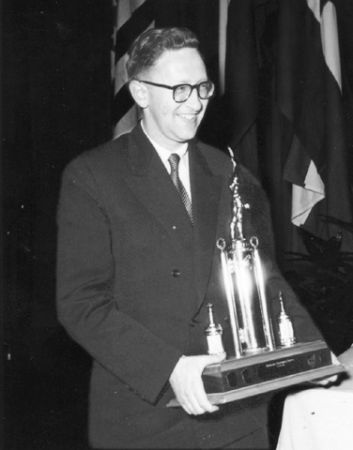 Smyslov recieves the trophy after winning the Candidates Tournament. Zurich Chess Club
Suetin in his last book revealed part of this KGB intrigue. I have decided to complete his story. If he desires, Vasily Vasilievich can add to it or correct it. lt would only please me if he were to do so, especially as personally I have no complaint about Smyslov. lt was not he, but the system itself that prevailed at that time in Soviet chess. I realise perfectly well that any one of us could have ended up in such a situation. In 1954 , during the USSR-USA match, the 'New York Times' printed a cartoon entitled 'Kremlin puppets'. At the bottom there were all of us - Smyslov, Bronstein, Keres, Averbakh, Geller, Kotov, Petrosian and Taimanov, and above - the Kremlin hierarchy, headed by Khruschev, holding us by strings. This looked insulting. But now I think that the caricaturist was essentially right: we really were puppets, only we did not realise this....
David Bronstein and Sergey Voronkov, Secret Notes, 2007
According to Bronstein, he hinted at what happened by barely putting any commentary on his games against Geller and Smyslov in the First Edition of his book.
When I returned at that time from Zurich to Moscow, already at the airport I experienced a great relief: Boris Samoilovich was alive and well and, as usual, was the first to meet me at the bottom of the ladder. Soon he conceived a strange idea: he began trying to persuade me to write a textbook on the middlegame, based on the Zurich games. Because of all these dirty goings-on, I didn't want to remember about the tournament.
But he was persuasive: ' David, soon everyone will forget about your play, but they will remember the book.' And I capitulated . But in the first edition, two games - with Geller and Smyslov - were left practically without any commentary. I thought that this would be a broad enough hint, but on this occasion too it would seem that no one guessed anything. Vainstein proved far-sighted. In chess life I have been cast by the wayside, but the book 'Zurich International Chess Tournament' lives, is republished, and comes out in different languages. And, I think, it will outlive me by a long time... P.S. This section was published in the magazine '64' (2001 No. 10).
David Bronstein and Sergey Voronkov, Secret Notes, 2007
According to Bronstein, Smylov's response to Bronstein's article in 64 Chess Magazine was only one paragraph long, didn't refute his facts and avoided talking about Keres being pressured to make a draw.
When I invited Vasily Vasilievich to 'add to or correct' my story, I never thought that in his reply (published in '64', 2001 No. 12) only one paragraph would be devoted to the tournament in Zurich, and that the main part would be taken up by various types of conjectures and even direct disinformation. By essentially not refuting any of the facts given by me, and, above all, completely avoiding the 'Keres problem'. Smyslov, in my view, merely confirmed the correctness of my account.
David Bronstein and Sergey Voronkov, Secret Notes, 2007
Bronstein quoted two sources: Suetin corrobating Keres being pressured to make a draw, and Spassky stating that the Soviets were ordered to draw in the 1953 Bucharest Tournament.
To conclude, here are two 'testimonies': Alexey Suetin: 'On the day when he was due to meet Smyslov, Keres was summoned by the leader of our delegation D. Postnikov and told that he did not have the right to play for a win. This would supposedly be to the advantage of Reshevsky. According to Keres's second, grandmaster A. Tolush, it is unlikely that Smyslov knew about this. The heated conversation continued for several hours. Keres flatly refused to betray his conscience, but he was unsettled. When he played for win it turned into a loss. (from the book 'Shakh maty skvoz prizmu vrem eni' ('Chess through the prism of time'), Moscow, 1998, p. 113).'
Boris Spassky: 'In Bucharest (in January of the same year, 1953! - D.B.) I achieved the international master norm. If is amusing, but I was helped by the Soviet authorities! The tournament began with the Soviet players taking points off each other... As a result, somewhere around the 7th round the Hungarian Laszlo Szabo took the lead. And here a telegram arrived from Moscow: "Stop this scandal, start making draws among yourselves!" Of course, it was good that I had already gained a point against Smyslov, but I think that it would not have been easy for me, given my youth and inexperience, to make draws with Boleslavsky and Petrosian. But as it was, we all submitted to the order from the Kremlin. ' (from an interview in the newspaper 'Russkaya mysl', February-March 1997).
David Bronstein and Sergey Voronkov, Secret Notes, 2007
According to Botvinnik, it was proposed the other Soviets should lose to him in the 1948 World Championship Match Tournament.
-Fischer has always claimed that the Soviet players played in combine against him. Has there ever been such a combination?
"In the case of Fischer, I cannot give a judgment on that, but I have experienced that assignments were provided. In 1948 I played with Keres, Smylov, Reshevsky and Euwe for the world title. After the first half of the tournament, which was played in the Netherlands, it became clear that I would become the new world champion. I was in the lead. During the second half in Moscow, something unpleasant happened. At a very high level, it was proposed that the other Russian players would deliberately lose against me, to make sure that there would be a Soviet world champion.
-How high?
“Stalin personally suggested that. But of course I refused! It was an intrigue towards me to belittle me. A ridiculous proposal, only made to belittle me as the future world champion. In some circles, they preferred Keres to be world champion. It was dishonorable, because I had long proven that I was stronger than Keres and Smyslov at the time.
Mikhail Botvinnik, Genna Sonsonko Interview, 1991
This was my first trip abroad to a chess tournament, and it was in Bucharest where I made the International Master’s norm. Paradoxically, it was Soviet Power that helped me win the title! The tournament started with the ‘massacre’ among the Soviet chess players. Petrosyan won against Tolush, I defeated Smyslov, and after the 7th round Laszlo Szabo was leading the field.
Suddenly there came a telegram from Moscow ordering us to stop shedding our own blood and insisting that we should draw all our games between ourselves. Luckily, I had already scored a point against Smyslov, but I think, taking into account my youth and lack of experience, that it would have been difficult for me to make draws with such grandmasters as Boleslavsky and Petrosyan. However, this order from the Kremlin helped me, everybody obeyed it and so I became an International Master.
Boris Spassky, Lev Khariton Interview, 2007
----
Conclusion
Claim 1: Keres was pressured to draw his Round 24 game against Smyslov.
- Suetin corroborated Keres being persauded to draw his game against Smyslov in Round 24.
- Smyslov did not address this claim in his 64 magazine response.
- Botvinnik stated that it was suggested at a high level that the other Soviets to lose to him in the 1948 World Championship Match Tournament.
- Spassky stated that the Soviets were ordered to draw in the 1953 Bucharest Tournament.
Claim 2: The triumvirate told Bronstein that Geller would lose to him. And that Bondarevsky ordered Geller to beat Bronstein as part of a double cross.
- Bronstein says one of the reasons he obeyed making a prearranged draw with Smyslov was because he was worried that bad things would happen to his close friend Veinstein if he didn't make the draw. "And in Moscow there will be new troubles for me. In addition – or first of all? - I was sure that Veinstein had already been arrested for his long-ago work under Beria, and my stubbornness would turn out badly for him."
- However, Bronstein tried to disobey the orders of the delegation two rounds previously, seemingly ignoring his concern about Veinstein: "You want to kill the guy [Geller] completely?" he [Bronstein] protested." "I pretended that I also agreed, but decided to use cunning" – and play for a draw, instead."
- Bronstein said that the triumvirate did not want Reshevsky to win. "all the time reminding us that on no account must Reshevsky be allowed ahead. If he had qualified for a match with Botvinnik, we would all have had to pay for it."
- Bronstein also says that he was double crossed and that's why he lost to Geller."Then they called me to the lake and said: Geller already received an order to lose to you!" "he [Geller] had received a directive from Bondarevsky to win, to punish me for my 'greed'!"
- Bronstein stated he hinted at the claim by barely annotating the game in the first edition of his book.
- Bronstein does not state why Geller was order to win against him.
- Averbakh's opinion was that he doubted this was a real story.
Claim 3: Bronstein was told [before his Round 25 game against Geller] to go to Smyslov's room and prearrange a draw for their Round 26 game.
- Smyslov corroborates that Bronstein was in his room.
- Smyslov stated Bronstein wanted a draw from him to secure second place for the next Candidates. Why did Bronstein go to his room.
- Bronstein stated he hinted that it was a forced draw by barely annotating the game in the first edition of his book.
- Before Round 25, Smyslov was leading with 14.5 points. Reshevsky had 14 points, and Bronstein 13.5
- Smyslov defeated Reshevsky in Round 25 obtaining a 1.5 point lead. On top of that, Reshevsky had 4 games left to play, while Smyslov had 5.
- Botvinnik stated that it was suggested at a high level that the other Soviets to lose to him in the 1948 World Championship Match Tournament.
- Spassky stated that the Soviets were ordered to draw in the 1953 Bucharest Tournament.
Conclusion:
Claim 1 is substantiated. Two accounts state Keres was pressured to draw his Round 24 game against Smyslov. Smyslov didn't address it. There are accounts of previous Soviet collusion/attempts at collusion.
Claim 2 is unconfirmed. Bronstein was worried about Veinstein in Round 26 when making the draw against Smyslov. But not before Round 24 when he wanted to disobey the triumvirate. Perhaps his concern increased between the rounds under the pressure. Bronstein doesn't say why they wanted Geller to beat him. At this point before Round 25, Smyslov was leading with 14.5 points. Reshevsky had 14 points, and Bronstein 13.5. Why are they trying to stop a Soviet player from contesting Reshevsky?
It could be argued that Bronstein was being betrayed as they wanted Smyslov to win. But Bronstein does not mention this as a reason as he gave no reason for Geller being ordered to beat him. Bronstein stated in other interviews that he was not a favoured player in the Soviet system as he was a Jew and his father was falsely imprisoned by the NKVD in 1937, as well as referencing a rumor that he was related to Leon Trotsky as Trotsky's original surname was Bronstein. However, Bronstein won the previous Candidates and was not ordered to lose to Botvinnik. Bronstein said there was no direct pressure on him to lose to Botvinnik. It seems incongruent to get rid of a close contender to Reshevsky when the triumvirate were very worried and made Bronstein draw against Smyslov in the next round, even though Smyslov had a large lead already. The triumvirate should prefer Bronstein over Reshevsky to win the Candidates.
Averbakh's opinion was that he doubts that this is a true story and that Bronstein is not always 100% objective. Bronstein's reason for surmising that Bondarevsky ordered Geller to win seems to be this quote: "Geller (also somewhat intoxicated) suddenly sat down beside me and with vexation in his voice asked why I hadn't spoken to him for ten days. Then I told him how they had dealt with me. He flew into a rage and began screaming so that the whole carriage could hear: 'Ah, that swine Bondarevsky!'". The question is whether 'Ah, that swine Bondarevsky!' is a shortened quote, or whether Bronstein is interpreting that Bondarevsky ordered Geller to lose on the basis of this one phrase.
Claim 3 is plausible. Bronstein and Smyslov agree they were in the same room to discuss a prearranged draw. Bronstein going to his room on his own accord is incongruent as he could easily go for a draw without asking Smyslov as Smyslov had the Black pieces and wanted to close out the tournament win as he had a large lead. Bronstein played for a win against Reshevsky, but not against Smyslov which is incongruent. There are accounts of previous Soviet collusion/attempts at collusion. The pressure against Keres to collude is substantiated.
---
Ultimately collusion plausibly took place in one game (Round 26, Bronstein-Smyslov), when Smyslov had a large lead (1.5 point lead with Reshevsky having 4 games left to play due to his bye day, while Smyslov had 5 before this game).
(Round 24, Keres-Smyslov) is an substantiated claim of Keres being pressured to collude. Keres did not obey. Bronstein claimed that Keres was so shaken up that he lost the game as a result.
(Round 25, Geller-Bronstein) is an unconfirmed claim. Bronstein does not provide a reason for why Geller was ordered to beat him.
---
- Photos: Fotograaf : Bilsen, Joop van / Anefo, alchetron.com, Zurich Chess Club, Edward Winter, Mark Taimanov Article
- David Bronstein, Zurich International Chess Tournament, 1953, Second Edition 1960 (Translated by Jim Marfia)
- Mikhail Botvinnik, Genna Sonsonko Interview, 1991
- David Bronstein & Tom Fuerstenberg, The Sorcerers Apprentice, 1995
- Andy Soltis, Treachery in Zurich, Part 1, 2002
- Andy Soltis, Treachery in Zurich, Part 2, 2002
- Yuri Averbakh, Taylor Kingston Interview, Part 1, 2002
- Yuri Averbakh, Taylor Kingston Interview, Part 2, 2002
- Vassily Smyslov, Harry Schaack and Johannes Fischer Interview, Interpreter and translator: Max Schmidt, KARL Chess Magazine, Issue 2/04, 2004
- Boris Spassky, Lev Khariton Interview, 2007
- David Bronstein and Sergey Voronkov, Secret Notes, 2007
- Johannes Fischer, Shattered illusions: "The Rise and Fall of David Bronstein", ChessBase Article, 2017
- Edward Winter, David Bronstein Article

Did the Soviets Collude Against Bobby Fischer?
Visit Blog Creators Hangout for more featured blogs.
Visit Study Creators Hangout for more featured studies.
You may also like
 ChessMonitor_Stats
Where do Grandmasters play Chess? - Lichess vs. Chess.com
This is the first large-scale analysis of Grandmaster activity across Chess.com and Lichess from 200… RuyLopez1000
Instructive Endgame: Knight vs Bishop
How to play a knight vs bishop endgame. IM datajunkie
Why you overthink in chess (and how to stop)
It took me 25 years to realise this RuyLopez1000
Fischer vs Larsen: The Rivalry
Explore one of the Greatest Rivalries in the History of Chess RuyLopez1000
AI Slop is Invading the Chess World
Claiming that AI can teach chess is the latest fad thibault