
Fair time handicaps
What time handicap gives players with different skill levels an equal chance of winning?Introduction
Nobody likes to repeatedly lose in a game. Similarly, while always winning might be fun for a while, it usually gets boring at some point, too.
As a person with interests in mathematics and game theory I am often asking myself how a game can be rebalanced so that two competitors with a different amount of experience have an equal chance of winning. This usually leads to a higher enjoyment for all participants and definitely to more excitement.
In table tennis a strong player might use his left hand or even a frying pan to give beginners a chance, and in a TV show a professional swimmer once had to carry a crate of beer so that the amateur could beat him.
Considerations for chess
Pawn or piece odds are common in chess but I’m not a fan of this concept because
- it changes the game quite a lot so that some common openings can’t be played anymore
- the weaker player might lose the piece advantage during the first few moves
- it can feel dismissive if you’re given piece odds
Instead, I think a time handicap is a clever alternative which doesn’t suffer from the drawbacks above. However, I wasn’t able to find any source of how much the initial time needs be adjusted based on the rating difference of the players.
When my friends and I met to play some chess last weekend I decided to figure out the answer to this question myself with the help of Lichess data and some mathematical modelling.
Using Lichess Data
As far as I’m aware, there are no custom time handicaps at Lichess, but we can use data involving Berserking to generate insights. When Berserking a player voluntarily halves his time before the game starts. I downloaded tens of thousands of tournament games which used the time controls 5+0, 3+0 and 1+0 and filtered for games where
- only the stronger player berserked
- the rating of both players was between 1500 and 2300 Elo
The rating restriction was introduced because it’s the range of my friends and me. I think that the results would look similar for other ranges, but I had enough data and didn’t want to risk to overlook a bias by covering all extremes of the rating range.
The next two sections describe some modelling details. Feel free to jump down to the "Results" section if these are not interesting for you.
Estimating the performance impact if berserked
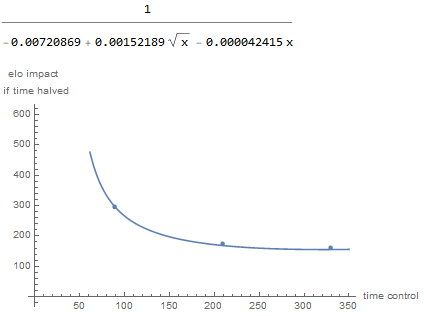
Using the game outcomes of the filtered Lichess data as described in the section above it’s quite simple to calculate the performance impact for the (stronger) player who berserked related to the definition of the Elo formula. It turned out to be:
- -155 in a 5+0 game
- -168 in a 3+0 game
- -293 in a 1+0 game
This means that a 1800 player that berserks in a 5+0 game plays like a 1645 player.
In order to derive the performance impact for an arbitrary time control we can fit a non-linear model to the three data points above:
A sidenote (online vs over-the-board)
There is a substantial difference between online and over-the-board chess that we need to consider: pre-moves are not available in over-the-board chess. As a result, a player will need an estimated total 30 seconds more to physically perform the moves during a game. This means that we slightly need to bend the data for our purposes, because a 00:30 vs 01:00 game can still resemble chess when played online, but offline the handicapped player will hardly be able to perform a reasonable number of moves within 30 seconds at all. To overcome this difference, I added a virtual 30 seconds to both players. A 3+0 berserking game is therefore corresponding to a 3:30 vs 2:00 game over the board (3:00 vs 1:30 plus an additional 30s to both players).
Estimating the performance impact based on the time difference
So far, we only know the rating impact of a fixed time reduction for different time controls, but in order to answer our original question we need to figure out the impact of any time reduction for a fixed time control.
We decided that 4+2 is a reasonable time control for over-the-board chess as it’s more pleasant to play with an increment. (The increment can be translated to a non-increment time control by estimating the average number of moves.) The weaker player will always get 4+2 and for the stronger player we will find the appropriate time handicap now.
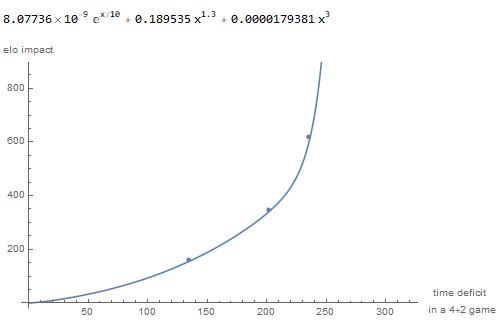
Using the derived function from above, we can create new data points for our analysis by repeatedly apply 1, 2 and 3 “berserks” on the same player. For instance, if a player berserks in a 4+2 game he is estimated to play 156 points weaker than his rating suggests (previous formula). If he decides to berserk twice, i.e. use just a quarter of his time (adjusted by the 30s bonus to physically move the pieces), the impact will be about 343 Elo points.
Now we can again plot the points and fit a function that describes the Elo impact in a 4+2 game for an arbitrary time deficit:
Results
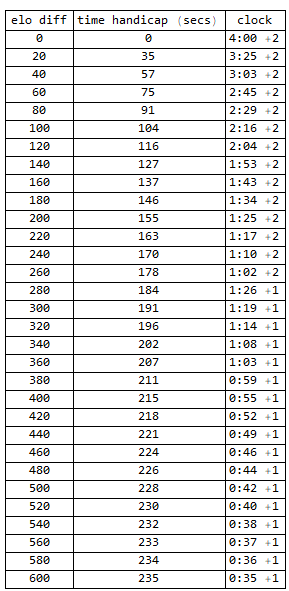
Finally, by (numerically) inverting the function we can calculate by how much we need to adjust the initial clock time of the stronger player, so that the estimated rating impact matches the rating difference. In other words, both players should have an equal chance of winning if you give the underdog 4:00+2 and adjust the clock of the favourite like this:
Field test
The required handicaps sound pretty brutal for the stronger player, but we decided to give it a try in a double round robin tournament. The average Lichess ratings over the last 6 months were:
- Player A: 2217
- Player B: 2216
- Player C: 2018
- Player D: 2010
- Player E: 1969
In addition, we added 15 rating points to the player with the White pieces to compensate the first move advantage (15 was the historic performance advantage in my Lichess dataset). This means when Player A played with White against Player E, he had to compete with 1:01+2 vs 4:00+2.
The result of the tournament was:
| Name | Rating | Points |
|---|---|---|
| Player E | 1969 | 5 1⁄2 |
| Player C | 2018 | 5 |
| Player B | 2216 | 4 1⁄2 |
| Player A | 2217 | 4 |
| Player D | 2010 | 1 |
Of course, the number of games is way too small to be statistically significant, but it was nice to see that the fight for the tournament win was very close and every player had a realistic chance to win due to the time handicaps. The player with the lowest rating had a great day (see game below) while the player with second lowest rating underperformed. He might claim that’s because he got served an anti-alcoholic beer. :-)
More stats and a selected game
- White made 10 1⁄2 out of 20 points.
- The respective rating favourites made 10 1⁄2 out of 20 points, too.
- Favourites made 6 1⁄2 out of 12 points when the time deduction was more than 2 minutes.
- Favourites made 4 out of 8 points when the time deduction was less than 2 minutes.
The last two points indicate that the calculated handicaps are reasonable across the range.
Player E played a great tournament. With the black pieces against Player A (who was handicapped at 1:01+2) he found a fantastic and sound way to sacrifice the exchange which made the game quite complicated, so that Player A eventually overlooked a tactic in time trouble:
If the concept of time handicaps is interesting to you and you decide to give it a try, I'd be curious to hear about your experiences.
You may also like
 thibault
How I started building Lichess
I get this question sometimes. How did you decide to make a chess server? The truth is, I didn't. freopen
Carlsen number for every Lichess user
Find out if you (indirectly) beat the current World Champion Lichess
What is your Rosen Score?
Oh No My Queen! jmviz
jmvizWhen should you berserk?
Should you berserk against Magnus? Who should Magnus berserk against? FM ubdip