The Elo Illusion

Every chess player knows the feeling. You've just played the best game of your life—a beautiful sacrifice, a perfectly timed endgame. You checked your rating, and it went up by four points. Four. Meanwhile, a lucky blunder into victory last week gained you twelve.
Or worse, you spend weeks studying, and you feel genuinely stronger, and your rating drops sixty points in a weekend blitz session. The number doesn't care about your growth.
The question is whether that number actually tells you anything useful. As with most things in chess, the answer depends entirely on how you're reading it.
"A rating is not a measure of your skill. It's a measure of your performance against a specific pool, at a specific time, under specific conditions."
The Math Behind the Myth
It represents the probability of one player defeating another as a simple curve in which the stronger player is more likely to win, but upsets do occur. After each game, ratings change based on the actual vs. expected results.
However, Elo has designed it for over-the-board tournament chess, which is played less than online chess, with longer time controls, and against a fixed regional pool. Lichess, with millions of daily blitz games and global matchmaking, is a completely new experience.
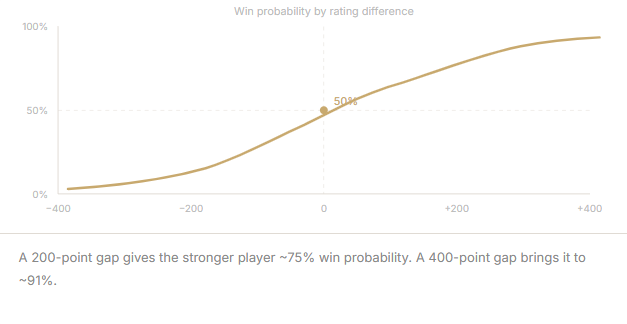
When comparing Lichess Blitz ratings to Chess.com, we use a number created for ranking inside a game as an absolute measure of chess ability. Rapid ratings, feeling crushed below round numbers, and basing our entire chess identity around a figure that resets between time controls.

Bullet vs. Classical: You're Not One Player
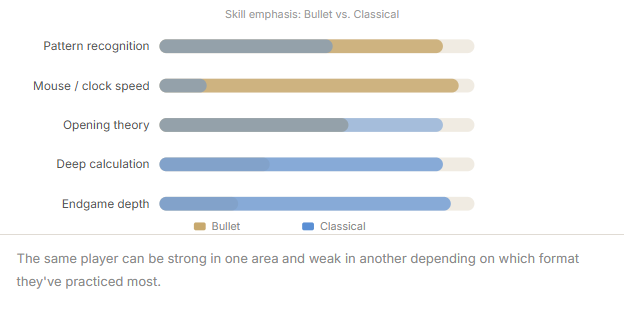
Are you the same chess player in a 1-minute bullet and a 15+10 rapid? Honestly, no. Bullet improves pattern recognition and mouse quickness. Classical rewards complex calculations and endgame theory. They are different games with the same name.
Lichess understands this, which is why it tracks seven different ratings. A 2200 Bullet player and a 2200 Classical player are not the same. They've developed whole separate skills. Neither rating is incorrect; they simply measure different things.
The Sandbagging Problem
Sandbagging is the dark side of competitive online chess, where you purposely lose to reduce your rating before beating weaker players. It's simple to accomplish, difficult to prove, and extremely detrimental to the honest players caught in this situations.
The actual victims are not the tournament organizers. They're the honest 1450-rated players who signed up expecting to face similarly talented opponents but were instead met by someone with much stronger strength. Their confidence takes a knock, their rating drops unfairly, and their experience is destroyed.
Lichess addresses this by automatic pattern recognition (searching for suspicious accuracy following a series of losses) and community reporting. However, the underlying issue is structural: any system in which a lower rating provides advantages will always draw people who try to rig it.
The Plateau Trap
The most devastating impact of concentrating on ratings is that it alters your playing style. Players who want to safeguard their rating avoid sharp, complex positions and instead stick to boring, draw-ish lines where they feel secure. They avoid endgames, stop playing rapid games in favor of blitz, and never fully test themselves.
The plateau isn't a skill ceiling. It's a behavioral issue. The player has unintentionally opted for stability over growth, and the rating is cooperating by flatlining.
"The only way to improve is to play people who beat you, in positions you don't understand. Your rating will drop. Your chess will get better."
According to performance psychology research, the key is the distinction between a performance goal orientation (avoiding loss) and a learning goal orientation (gaining understanding). The chess player who isn't afraid to lose 100 rating points while trying a fresh opening is usually the one who is still improving at age 40.
What Grandmasters Actually Think
Magnus Carlsen doesn't treat his online blitz ranking with admiration. Hikaru Nakamura, possibly the best speed-chess player of all time, freely admits that internet ratings represent little to him as a measure of chess strength, although he leads the leaderboards.
Top players follow a regular pattern: they use online chess for training rather than as a scoreboard. They test openings, play odds games, and experiment with novel systems. Their relationship with the rating is practical, not emotional, which is different from other users on these chess platforms.
Part of this is because great players are already aware of their own strength; their FIDE Classical rating, gained over years of tough tournament play, is very relevant. In comparison, online ratings are not so relevant. However, great players quickly recognized that growth and rating can sometimes diverge.
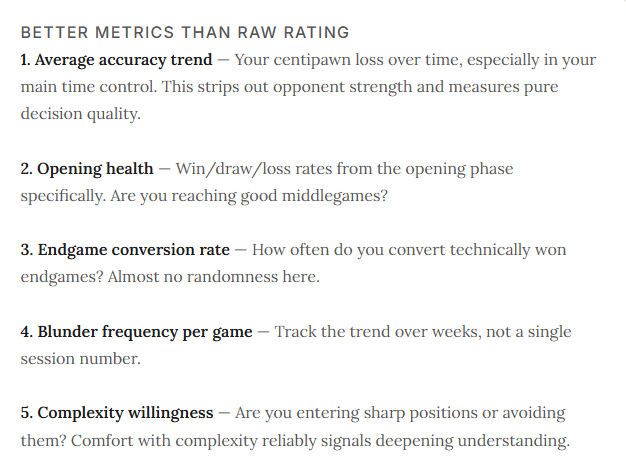
Five Better Things to Track Instead of Rating
The Number Is Not the Game
Chess doesn't care about your rating. The board does not know if you are 1200 or 2200. The pawns move in the same fashion. Your rating serves as an useful compass for finding suitable opponents and detecting long-term trends.
Play in positions that scare you. Study the endgames you consistently misplay. Accept the rating decrease if it comes from trying your best. The rating will eventually go up.
Arpad Elo invented a ranking system for a small community of tournament players. He could not have imagined it would govern the self-worth of forty million people playing blitz games at midnight. He would probably be horrified.
Just have fun and improve as you go!