
Selfmate chess: Queens vs Queen endgame: results
Chess but you try to get checkmatedSelfmate chess: chess where you try to lose (get checkmated).
In this post, I cover the extremely rare King and Queens vs King and Queen endgame. Unfortunately my wireless internet does not connect with my desktop computer so these results are condensed.
Example positions: https://lichess.org/study/knR4uLp0/
The above study is the most fun part of making this post in my opinion.
(...the last position is unsolved, but I have no doubt that it can be done)
Selfmate chess basic strategy
Let us consider three different strategies for playing Selfmate chess.
- "Stockfish" (play the best move every time)
- "Worstfish" (play the worst move every time)
- "Stockfish then Worstfish" (play the best move until you're winning, then force the opponent to checkmate you)
If this was rock-paper-scissors, the results would be
- "Stockfish then Worstfish" successfully loses to Worstfish
- Worstfish successfully loses to Stockfish
- Stockfish successfully loses to "Stockfish then Worstfish"
However, Stockfish won't lose, it will at least draw. So Stockfish is the worst strategy, and "Stockfish then Worstfish" is the best strategy. (The actual correct proof is mostly: Nash equilibrium)
How to force checkmate
Let's do this strategy! Say you're completely winning the game, half of the strategy. Everyone has done that before. Now what? How do you force the opponent to checkmate you?
The usual strategy is:
- leave just one pawn for the opponent
- force the opponent king in opposition to your own edged or cornered king
- surround your king with blocking pieces
- zugzwang the opponent and have the pawn march forward and smothered checkmate you
(A 764 rated player performing a similar idea:)
It is much harder to selfmate against any other piece, like a knight, bishop, rook, or queen, since unlike pawns they have many moves. (For non-queens, I imagine pins are quite helpful, but the fifty-move rule makes analysis hard).
Nevertheless, let us still try. Pawns technically promote, after all. So I started with: what if the opponent has a queen left? And for convenience, I'll just assume we only have queens left too. (This took days to answer. Oops!)
Lone king
Oh no! We only have a king. Wait, that just means it's impossible to checkmate the other side. And the other side isn't forced to checkmate us (except in rare situations involving the opponent's pawns trapping all the opponent's pieces) so a position with a lone king is a draw.
KQ vs KQ
All such positions are a draw unless it's checkmate in zero.
By definition, a successfully losing position means that your opponent has no good moves. But a queen has a ton of moves and can always either check (and not checkmate), sacrifice, or pin.
Maybe checking can force the opponent king somewhere, but ultimately we would need to force the opponent queen (to checkmate us). And the only way to force the queen to move is to stalemate the king or false-checkmate the opponent.
Stalemate leaves the queen with too many options, and false-checkmate means the opponent queen either blocks (failed to get checkmated) or captures.
But a false-checkmate and immediate capture return checkmate is impossible.
KQQ vs KQ
I made a tablebase. After days of effort and incorrect or slow calculation and hours of final fast correct calculation, the results are: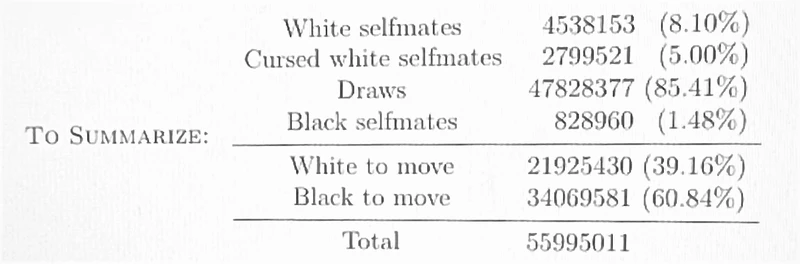
Note that white is KQQ here. The largest KQQ DTZ is 318, and the largest KQ DTZ is 6.
Naturally it takes overwhelming power to selfmate, compared to just checkmating. KQQ vs KQ is mostly a draw.
Incidentally, the hardest obstacle to overcome in this endgame is moving our king closer to the edge to be checkmated. This is because we have to basically check all the time, except for rare situations, and setting up a king discovered check takes a lot of maneuvering even when it is possible.
More queens
I imagine that KQQQ vs KQ is generally a success for KQQQ, since you have more firepower plus 50 moves to get to a winning KQQ vs KQ position, in the worst case with the move.
The key two ideas are to extract the opponent king to a bad spot away from the opponent queen, and to false-checkmate and force the queen to a bad square. If you can accomplish one, you can generally make it to both, and then start doing discovered checks to move our king closer to the edge.
The question of KQQ+ vs KQQ+ is generally unsolved, but I imagine the idea of just trading one queen basically solves most positions.