
Can my local chess club handle the big league?
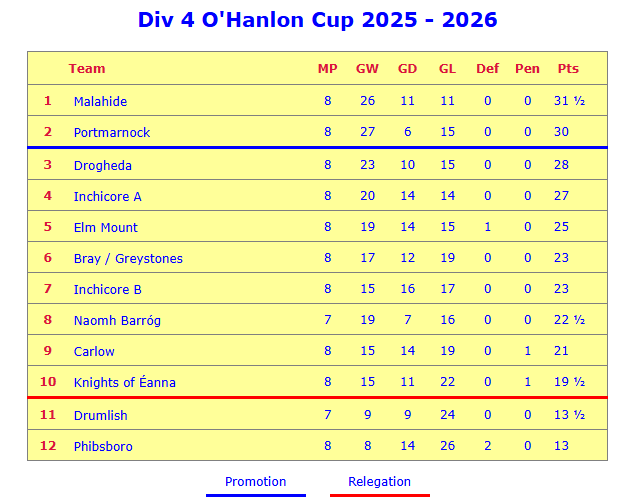
We won promotion to the next level, but can we stay there?
Last year, I wrote a series of articles about how my local chess club battled for promotion in Division 5 of the Leinster Leagues. After some tough battles and close matches, we eventually finished 2nd and won promotion. So how are we handling Division 4, the O'Hanlon Cup? Are we able to stand against the stronger opponents? Can we rise to the occasion or is this level too tough for us?
For context, my local chess club is Naomh Barróg, a small club of about 30 active players in North Dublin, Ireland. We compete against other chess clubs in the Leinster League which has 6 divisions. The matches work like this: each club picks six players who play each other in an individual 75+30 game (without help from their teammates). The scores are added up at the end and awarded as points. So if my club wins 4 games and loses 2, then we get 4 points while the opposing team gets 2 points.
From victory to defeat to victory
Unfortunately, I was away on holidays for the first match of the season against Carlow, which we lost 4-2. But I was back for our round 2 game against Bray-Greystones, a very strong team we had to beat to earn promotion last year. I opened the game by seizing space in the centre while still being aware of the dangers of Black's Bishop on b7, especially if they played f5. On move 6, I missed an obvious tactic that would have won a piece if I gave check on a4 with my Queen.
Other than that, I was comfortable with my position, I had shut down Black's Bishop and felt I had good control over the centre. By move 15, I felt ready to attack but my opponent hadn't castled yet, so in which direction should I go? I was planning to play f4, but this only worked if Black castled Kingside. So instead, I played a4 and then brought over my Rook, waiting to see where Black's King would go. I was turning my doubled c-pawns from a weakness into a strength and was ready to break open the Queenside.
To my surprise, my opponent castled directly into my attack. I was immediately tempted to sacrifice my Bishop on b6 in order to destroy the King's defences and open the file for my Rook. Two pawns for a Bishop seemed a minor price to pay for such a strong attack and it seemed likely my opponent would have to sacrifice a piece to defend themselves.
I doubled my Rooks and had a dangerous attack, but I just couldn't find the killer blow. Between my Rooks, Queen and c-pawn, I knew I was winning but I just couldn't find the right move. I spent a huge amount of time playing out various lines in my head but ended up blundering. Had I traded Rooks I move 26, I would have won the Knight but instead the opportunity slipped through my fingers. Out of all the moves, I never considered the Bishop would go forward to d3 and after some trades, I lost an exchange.
By move 32, I realised that I was losing. It seemed inevitable that Black would just pick off my pawns one-by-one and there was little I could do other than make a few vague threats. But to my surprise, my opponent proved reluctanct to take my pawns. He played overly-defensive, going to great lengths to block my attacks, even those that didn't really threaten anything. My a-pawn wasn't taken until move 40, when it could have been taken 6 moves earlier.
Around move 48, I thought I saw a slight chance for hope. I had given up on my d-pawn as lost but again my opponent didn't take it. As I studied the position, I saw that if I pushed it to d7, I could use the threat of promotion to paralyse my opponent. I could hardly believe my eyes, I felt I had pulled a rabbit out of a hat and saved myself from certain defeat. My opponent can't avoid a trade of Queens and his King is too far away to stop my pawn from promoting. By the sheer luck of where the pieces were placed, I had turned certain defeat into a winning position.
After I promoted my Queen, I picked off the pawns (unlike my opponent, I didn't hesitate) and eventually simplified by trading my Queen for the Rook, leading to a winning endgame with two extra pawns. I could hardly believe my eyes, because I had somehow pulled off an incredible comeback. My win proved crucial and we won the match 3.5-1.5.
Right idea, wrong order
Unfortunately, I missed the round 3 match as I was attending my aunt's funeral. It was a tough game against Malahide, the top team in the division and we lost 4.5-1.5. This was worrying because it meant we fell down to 11th place out of 12 and the bottom 2 teams get relegated. The round 4 game was against Inchicore B and a good result was essential after our rocky start to the season.
The game opened with a Grand Prix Sicilian where my opponent traded off his Bishop to double my c-pawns. On move 10, I thought I had gained an advantage, my Bishop threatened the Rook if the d3 pawn was ever moved and my Queen threatened the b2 pawn if the Bishop was ever moved. It seemed like I was restricting White's options, but I couldn't see any way to exploit the situation to my advantage. I planned out various winning lines if White took my Knight on e4, but if they ignored me, I didn't have any advantage.
By move 22, we had made some trades and I didn't see any easy way to advance. I was down a pawn but hopeful that I could win the isolated e5 pawn. However, I was pleasantly surprised on move 26, when I rerouted my Bishop and my opponent allowed me to trade it for the Knight. Not only did this remove a defender but it opened up the King. This would prove to be my best chance in the game but I couldn't see the line.
On move 30, I had the right idea but the wrong move order. When my opponent played b3, I thought I would keep it simple and trade the pawn before moving my Rook. This was a fatal mistake. I should have ignore my opponent's move and kept with my own plan of bringing up my Rook to pressure the e5 pawn or even threaten h2 (which was far weaker than I realised). Instead, I allowed my opponent to get a check (which didn't worry me) and then win another pawn (which did). I fought on for another 20 moves but I was too far behind and could do nothing except delay the inevitable.
Although I lost, the team won the game 4-2, bringing us up to 9th and out of the relegation zone.
Tied down with nowhere to go
Our next game was against Drogheda, a strong team who narrowly beat us for 1st place last year. My opponent surprised me by opening with the Bird Opening. There were few trades in the opening, except for when my opponent took my Knight on move 10 to double my pawns. Instead I ended up shuffling my pieces back and forth in a closed position that didn't give me any room to manoeuver or target to attack.
I doubled the d-pawns on move 21, which I figured had to be a good thing but I never managed to win the pawn. Everything was locked down until move 27, when my opponent exposed his King with g4. There was no way for me to take advantage of the King's weakness, instead my Bishop was trapped. I hoped having the Rook on the h-file might lead to some counter-play but nothing came of it. Instead my King was in danger and I could do little to block the attack from White's Queen and Rook.
By move 34, it was lost. I tried to hold on, but I had no moves left, so my opponent simply walked his King down the board until I had nowhere to go. What amazed me was the sheer level of control my opponent displayed. According to the engine, he had 0 blunders, 0 mistakes and only 1 inaccuracy. I was simply out-played.
We ended up losing the match 4-2 and fell back to 10th. As we went into the Christmas break, our position was looking shaky.
A dagger wedged into my opponent's position
For this game, I was moved up to board 2 and faced my toughest opponent of season so far. The game opened with a quiet Scandinavian with some trades and no clear options for either side. I had pawns in the centre but I decided to push them before they became a target. Most likely outcome, would just be a trade, but there was a chance my opponent would allow me to push them far enough that they become a dagger into my opponent's side of the board. Sure enough, this is what happened.
By move 14, I had a passed pawn in a dangerous position. If I can trade off into an endgame, then I'll have the advantage. I was so confident in the position that I was willing to leave the pawn on b2 undefended. The engine says it would have been a mistake for Black to take as I get counter-play and can even trap the Queen.
By move 21, I had achieved my goal of building a powerful pawn chain, which not only allowed me to say "connect four" but also gave me a positional advantage. Black is completely boxed in and has very few moves other than just shuffling their pieces around. I prepared my pieces and then launched my breakthrough on move 24 with b5. Oddly, the engine considers this an error, whereas the whole reason I built the pawn chain was to eventually use it to break Black's defences.
In any case, my opponent immediately blundered and had to sacrifice an exchange. Had he not, I would have two passed connected pawns that would have been very dangerous. Even still, I still had a passed pawn that still dominated my opponent's position. My key objective was to find a way for my Rook to get to the 7th rank, which my opponent allowed on move 31. My pawn kept advancing, my Queen and Rook kept threatening - my opponent was in grave danger and an obvious checkmate threat was not going to work. Once I traded off the Rook and used my Queen to offer a trade or promotion, it was over.
My win gave us a crucial point and helped us win 4-2. Not only did we move up to 9th but we were pulling away from the bottom 4 teams and were close behind the next 2 teams.
Double or nothing?
This game began with an Advanced French and the opening was fairly standard as we both developed our pieces. I decided my best path forward would be to push f4 on move 15 and open a line to attack his King. It would open things up before my opponent had a chance to castle and allow me to pressure the pawns in the centre. No potential for amazing tactics, but a pretty solid plan in my opinion.
To my surprise, my opponent ignored my pawn push and instead offered a trade of Bishops. I had presumed that Black was forced to take on f5 so I hadn't considered other options. After reviewing the position, I realised my opponent had blundered, I could just take the Bishop and then take the Knight. We had only just left the opening and I was already winning.
My opponent went for double-or-nothing and castled Queenside. This meant he could potentially have counter-play with a pawn storm against my King and Rooks on the h-file. However, it also meant his King was completely exposed with no pawns to defend it. I decided to bring my Bishop around to trade off Black's only defender and then bring my Knight and Queen into the attack. My opponent's position was so weak that the engine recommends sacrificing my Knight for the attack.
I didn't do that, but instead cornered the King, while making sure my opponent never got the chance for counter-play by sacrificing his Rook on the h-file. On move 32, I threatened checkmate and the only way to avoid it was to sacrifice an exchange. The engine finds a slightly different version of the same idea where my opponent would have to sacrifice their Queen or get mated.
Nevertheless, I was completely winning so my plan was to simply trade off the Rooks and deliver mate. My last concern was that my opponent might be able to give a repetition. So before I took my Rook off the back rank, I made sure my Queen was covering c1, which meant the Black Queen couldn't get to f4. So my opponent gave one check but couldn't give another and two moves later, I delivered checkmate.
I was happy with my win and even happier when I saw the other games. We ended up winning 5.5-0.5, a huge win that jumped us up into 6th place. We were no longer fighting to say in division 4, now we were proving we belonged to be here. 4 games remain in the season, but I'm confident my chess club can handle the big leagues.
You may also like
 CM HGabor
How titled players lie to you
This post is a word of warning for the average club player. As the chess world is becoming increasin… TeoKajLibroj
6 chess books I tried to read
And which ones I would recommend TeoKajLibroj
Irish chess continued to grow in 2024
Growth was especially strong for rapid and blitz tournaments TeoKajLibroj
Has the chess boom reached OTB tournaments?
Have Irish tournaments experienced the chess boom? ChessMonitor_Stats