
Gemini
From 1000 to 2000 in Just Over 1 year
This blog will outline my progression journey over the past year or so that i've played chess, and tips for how to achieve the same goal that I did
1. My Improvement Journey
I was taught the rules of chess from a very young age, and enjoyed playing casually with friends sometimes, however I always treated it as just another board game in the closet that could be brought out for a 1 on 1 game every once and a while. It was this way up until the fall of 2024, when my school started an official chess club. (there had been an extremely casual one before led by the 11th grade Spanish teacher at my school, but it became an officially listed club that fall)
The club at my school was (and still is) a very casual, laid-back club, where anyone (K-12) who wants to come after school to play chess with either their friends or other people that want to play the game. We have a large variety of ages and skill levels at the club, but the large majority are younger kids that barely know the rules. For a long time, I was just there for an afternoon to play for fun and see how I matched up against some younger kids or the occasional person in my grade level for a game. While I wasn't doing any actual improvement here, and it was only once a week, it sparked an interest for the game and is probably one of the biggest things that has led to my improvement.
The next part of my journey, is probably the most important thing that I never noticed how big it was for my improvement until I look back now on my journey. Somehow, this passive interest in the game still grabbed the attention of my mom, who when she was browsing through the school book fair that was going on in early 2025 at my school, she saw the book "Checkmate!: The Wonderful World of Chess" by John Foley and bought it for me. I first got the book and was disinterested, I read the first 15 or so pages which explained the rules of the game, and passed it off as a "beginner's book" (being completely unaware of how much of a beginner I still was) however, this book would play a large role for me a little bit later.
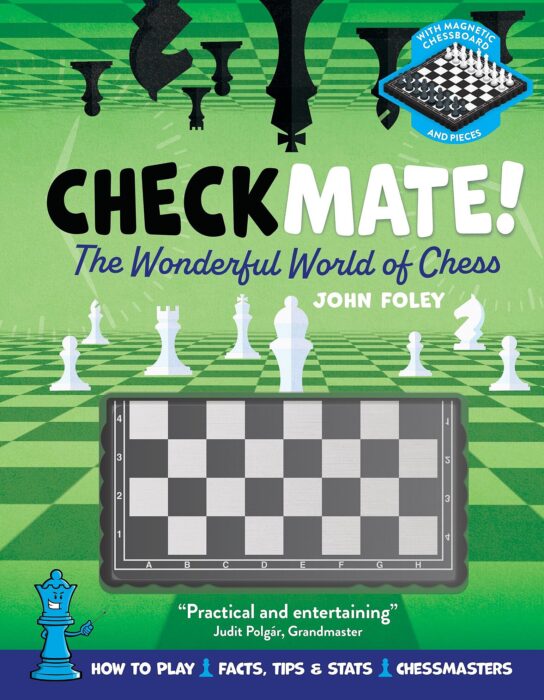 This is book I was given that really helped start my interest in chess.
My chess club continued with me playing weekly, just making it part of my weekly routine at school, until I started getting slightly better (nothing crazy, just enough to where I was past knowing the rules of the game and was starting to get a basic concept of how the pieces worked together) This led me to start playing people who were slightly better at the game, for example, people who knew what an opening was (I was completely oblivious to the concept, my opening at the time was trying to scholar's mate my opponent every time regardless of the color I was playing with.) The most hilarious version of this came against the coach of the club, who as I said is 2000 USCF, and I lost incredibly quickly after my "attack" failed. I didn't really care still, because I just thought he was pretty good (I had absolutely no clue what ratings meant at that time) though it all changed when I first opened my lichess account.
The 11th grade Spanish teacher was leading all of the less skilled kids (like me at that time) and recommended that I open a lichess account, well I did that and found myself being overly competitive all of the time, and loving the little rating number that went up or down depending on a win or loss, this sparked an interest for the game past a general. "Oh, it's a board game I play at my school on a Thursday afternoon" I still wasn't very good (It can still be argued that I'm still not very good but that's a different topic) but I had a desire to get better, which was quite important.
This new interest of the game led me to search for anything I could use to get better at the game, which led me to pick back up the book by John Foley, where I read a little bit deeper. This is where I learned my first openings, the London system as white, and caro-kann and slav defense as black. (All extremely good beginner openings by the way) This got me noticed by the better players at my club, and more importantly, the coach. He told me to go play the student leader of the chess club, who would end up becoming my rival for the rest of the year at the club. He played the ponziani as white (or some version of it considering I played the caro-kann) and would be furious whenever I played the London system against me. I played him multiple times, and we were overall fairly balanced opponents, he would win about 65% of the time I estimate, and I would win about 30%, and then we would draw about 5% of the time. If you know me from the real world, I despise losing, so this made my desire even greater to continue improving.
The two of us continued playing for a while, and we both found it quite frustrating to play with a bunch of yelling elementary school kids in the room (nothing against them, they were just being little kids) and the 11th grade Spanish teacher noticed this and told us we should move to the other room. This felt like receiving a scholarship to an ivy league school to me at the time because I had imagined the 3 or 4 kids in that room as like the "masters of the game" (who by the way were mostly around 1000 USCF or maybe up to 1350 so by no means masters)
After moving there, I first found it to be quite nice that the room was so quiet to play in, and it clearly helped my play, because I went on to start beating that opponent about 50% of the time rather than just 30% or so. The coach loved to pick on me for playing the London, which I didn't really care because it wasn't the opening I chose, it was just the one that I knew. I continued playing semi-casually throughout the rest of the spring 2025 school year, thinking I was "practicing" by just spam queuing 10+0 with no benefit just playing games, which was helping some, my online rating rose from somewhere like 870 in February, to like 920 by may (not much at all). Once we reached may, one day I was watching the 1350 USCF review tournament games with the coach and I found it fascinating, which got the attention of our coach who asked me if i was interested in playing tournaments. I said yes, but doubted I could afford it, so by a massive stroke of luck, that specific coach already hosted a monthly tournament in town, and he said that he would let me into my first tournament for free if I would just pay for my USCF membership, so I got his number, got my USCF membership that night, and asked him to put me in the tournament, where he has 3 sections K-3 under 500 (which I couldn't play in because of my age), an Under 800 section, and a Open section. He asked me which section I wanted to play in, and he recommended I play in the under section for my first tournament. I agreed with him because I figured I wanted to get a feel for the tournaments before I joined "the big leagues."
I went into that tournament feeling insanely confident (still not knowing much about the chess world thinking that being 920 online correlated to OTB) thinking that the caro-kann that I would play would be some surprise unique opening (because I just thought everyone played 1. e5) but I was sorely disappointed. I expected to win my section (yes, some extreme naievity there) and instead finished with a solid score of 3/5 having scored a 1 point bye in round 2 being the lowest rated player (unrated) with 0 points. I still got the medal at the tournament for the top provisional or unrated player under 600.
This performance was the real massive jump that propelled me to get better, I immediately checked out every library book I could find on the game (not many) begun studying the game, playing more (as summer had given me a lot more time) and most importantly, installing the app on my phone. I had only had it on my computer up until that point, and putting it on my phone made it a lot more accessible and available to me, inspiring me to keep playing it. I would often ask my "coach" (whether official or not) for advice on how to get better, and he said things like "stop playing the London" (he doesn't really like the london) or "start playing 10+5 instead of 10+0" and while this isn't in depth coaching like some people receive, it was enough that it really helped my chess journey. I had checked out MCO-15 from the library, a good opening book but definitely past my level, and for whatever reason thought it was a fantastic idea at my level to start playing the Ruy Lopez and Najdorf. Yes I can already hear everyone laughing through the screen, but I felt confident in myself, and crazily enough, as I started playing more (this likely had nothing to do with the openings) between the middle of may and about mid June, I had gone from just 980 on lichess (I rounded up to 1000 for the sake of the title of this blog) and all of the sudden went flying all the way up 1360. A gain of almost 400 rating in just a month! I'll get into the why and how this actually happened in the next section about what I believe is important for improvement, but anyways this was an incredible climb that I had made in such a short time
However, the problem was, that while on vacation, I started playing and not having time to study instead of that, so when I decided to start pushing towards 1400 towards the end of that trip, I made it up to about 1387 or so, and then immediately lost some rating, and that spiraled into a massive tilting session, where I lost about 100 rating in one day, dropping me down to a little below 1300. I was so disappointed, and my parents quickly realized this, and told me that I had been playing so much that I wasn't even enjoying or paying attention to the vacation (which was at the beach, I don't know why I wanted to spend all of this time playing chess, I love chess, but I can play it any time) and it made me realize that it was unhealthy for me to have lichess on my phone at that point in time because not only was I not enjoying the vacation (spending all my time on the beach playing chess on my phone) but also it was making me ignore my family members and be away from them for long extended periods, so I came to the conclusion that at least for that time, I was going to have to remove lichess from my phone. This ended up being a great decision, as I was able to get my mind off chess for the rest of the trip, come back refreshed, and not have as much unlimited access to the game which would keep me from that severe tilt like I experienced on that trip.
Although I lost a significant amount of rating on that trip, it was quickly gained back, and I continued to hit milestones over the next few months, I hit 1400 on August 3rd, 1500 October 14th, 1600 November 19th, and finally 1700 on January 6th.
 This is my rapid rating from when I opened my account, to hitting 2000
During that span of time, I took a relatively large break from OTB chess (mainly because I couldn't afford it) before returning in August to OTB play, at this point in time, I was 1400 lichess, so I was confident that I was better than my first tournaments, so I decided to play in the open section. This is where I got my first good OTB result in my opinion, I went into the tournament rated with a provisional 690, and in the first 2 rounds, outplayed and beat 2 1100s. They were both mad because they didn't know who I was (they were like 7 years old) and all the sudden I was 2-0 against them through 2 rounds. I felt great heading into round 3, and then I faced the final boss of the tournament, a 1350. (He's 1650 now so he's gotten better) I got completely outplayed in an English attack, to show my theoretical knowledge at this point, I didn't know f3 was a move (even though that's the literal mainline) and while I played pretty well, I still got outplayed by a stronger player, and eventually he sacrificed a rook for a knight and I couldn't take it as mate would come in 3 moves or so, and the game was over from then on out. Round 4 is where it all fell apart, my opponent played the accelerated dragon (playing the open Sicilian without having a single clue of what to do in it probably wasn't the best idea) and I randomly hung my queen on like move 15. I managed to draw round 5 and finish with a solid 2.5/5 in my first tournament in the open section and I was proud of myself.
Over the coming months after that, I played in that monthly tournament, and I was slowly gaining rating, I hit 1000 in october, and I ended off 2025 with a 1074 rating. January was my first massive performance. I started off horribly, with a draw against a 800 (who I actually coach now, but more on that later) but then after that I proceeded to win all 4 remaining rounds, and finish with 4.5/5 and win the tournament! I gained almost 150 rating, putting me at 1222 after that tournament.
My next tournament in February went well, and I scored 4/5, only losing to a 1500, gaining another 70 rating points up to 1297, and finishing 2nd. Then in march, I scored a perfect 5/5, winning the tournament, and shooting all the way up to 1398. Next was April, where there was a really strong turn out for the tournament, but unfortunately I didn't get to play many of the strong players, I only got a chance to play 1 1550 in round 4, where I was playing fantastic and was up 3 pawns, and all the sudden out of nowhere I just hung a bishop for a pawn, and lost the game soon after. I was extremely disappointed by this, because while I finished 4/5, I only really played one strong opponent and blew a win against them. I still gained rating, but only a little, putting me at 1412. May, went better, I finished 5/5 in a tournament with not quite as strong of a field as previously, and I survived a scare from a 1200 in round 2 where I was completely lost due to a really nice tactic they found but fortunately I managed to swindle them in time pressure, and I finished off at 1474. That's all of my OTB play up until this point, though I hope to continue playing in the coming weeks and months.
Back to the rapid field and my overall chess journey, while I was doing well OTB in the early months of 2026, in online rapid, I wasn't. I was doing well in January and February, gaining slowly and hitting 1800 on march 1st, but from there I stagnated for about 2 and a half months and actually lost a good amount of rating 70 or so and stayed there for a couple of months. I was so frustrated and confused, because I was spending a lot of time practicing each day, I had bought Silman's Endgame Course (great book btw) because I knew my endgames were awful at the time, but I wasn't going anywhere, and was actually overall losing rating. It took an OTB rapid tournament to realize what the problem was. I played 2 rounds out of the three in the tournament (it was quick rated, but very laid back and casual, and you can pop in for a round or 2 if you want, or play all three, it's a weekly tournament so there's not as much seriousness behind it) and while I beat a 1650 as black in game 1, I immediately lost to a 900 with white in the next round. This was where I found my problem. A couple months back I had switched to playing the English as white because it made the little kids I would play in the scholastic tournament tilt from move 1. I found however, that there were multiple problems with playing this opening for me. 1, it didn't match my aggressive, attacking, tactical playstyle, 2, I couldn't see if my online opponents were tilting when I was playing this, so the whole reason I played this opening was gone. and 3 and most importantly, I wasn't enjoying playing the game with the white pieces, and wasn't enjoying the positions I was getting. So, I made the decision to switch back to e4 and play the scotch. This helped me break out of my plateau, not only did the opening just match my playstyle which is good, but more importantly I was enjoying the game and study more, which made me more focused while playing, more determined, and more trusting in myself and abilities. I proceeded to have a massive shoot up in rating from the mid/late part of may where I started at 1800, and by the start of July make it all the way up to the 1970s. A 170 point jump in a little over a month, which from I can tell is phenomenal at my rating level.
When July hit, it was time for the final push towards 2000, and the first 2 days of July were very successful, with me netting a total of 19 points over the 2 days, setting me up on July 3rd to be sitting right at 1991, just 9 points away from 2000, about 2 good wins. The first game I got paired against a 1900, who played a really nice game overall, and I had a lot of pressure on me, but I found a really nice tactic to equalize the game and in a rook endgame, that was equal, my opponent rushed and hung a rook and immediately resigned. So it all came down to this last game. I clicked the new opponent button, and got paired with a 2080, the game will be annotated in the study below.
After a total of a little over 13 months, I had finally hit 2000, my next big goal is trying to hit NM by the end of 2027, if this blog gets 100 likes i'll start a monthly blog about my road to it, and if the blog gets 250 likes, i'll make it weekly. That's my improvement journey, now on to the part most of you probably came for, (rather than just looking at my yapping for however long that is) which is what you should do to do it yourself.
2. What you should do to do the same or similar
Since I've shot up so fast, I actually get dms from people on lichess asking me what to do to gain rating as fast as I have. For a while I didn't really know what I had done that was all that special compared to normal people's training and attempting to get it better. However, I've come to this conclusion as to the main reason. The most important thing for improvement at chess isn't knowledge, natural skill, or even luck. It's a love for the game, and a dedication to improve. If you are dedicated to improving, the other things will come from it, the largest plateau I had over my 13 month journey to 2000 was about 2 and a half months. This was because at that time I wasn't enjoying the game as much because of something as small as the opening I was playing. I was doing a good amount of studying at that point, and I had the knowledge probably even as a 1700-1800 player to be 2000, my brain just wasn't applying it because it wasn't engaged with the game. Needless to say, I will have a list below for things to try to apply in your improvement (if these go against what your coach says to do please listen to your coach, they get paid to teach people how to play the game and is likely far better than me at the game so trust them more, i'm only working with my limited one year experience. I've tried to make these things in order for how helpful I think they are.
-
Game Enjoyment: Find whatever make you enjoy the game most, if you don't have this part, improvement will feel like a chore, your brain won't be engaged with the game, and overall you won't be working as hard to improve. The most successful businessmen in the world didn't get there by being indifferent or bored with working on their companies, they were completely dedicated and devoted to growing their companies and improving either their product or marketing or whatever they were doing, because they love it. The same goes with chess, talk to 50 grandmasters, and ask them how many of them dislike playing chess, the answer will be a few if not none that say they don't like it, they've made it this far into improvement because they have a deep love for the game and desire to get better. If you don't really want to get better, and then are mad about not improving, well that just makes sense and that's fine, chess just might not be something you want to spend all your time on and therefore you won't improve as much. Game Enjoyment is like being ready for battle, which is really important heading into a war. Motivated troops perform a lot better than ones that aren't motivated.
-
Tactics: I know everyone gets it drilled into their minds from everywhere on their internet, tactics, tactics, tactics, more tactics. Though to be honest, they're right. Someone I know got carried in just 2 years from a complete beginner to 1800 USCF just from studying tactics, barely knew an opening, but it was good enough. Tactics are like ammunition for your chess, without having this, everything else you learn won't get applied practically, if you know 20 moves of theory and then don't understand the tactics that come from it, well you're loading a weapon with nothing.
-
Endgames: This is an extremely important part of improvement, and one that often gets very overlooked because the majority of people will get caught in the crowd that says "Learn this new opening! You'll never lose again!" which everyone knows isn't true, even the people that go click on or buy or whatever to the content, but our brains can't resist the allure of an instant fix. Then the people that don't get led astray, get constantly fed "Don't learn openings, do tactics!" and while tactics are great, they can only do so much if you can't convert an endgame up 2 pawns or a bishop or even a rook. Capablanca has one of my favorite chess quotes ever which is "In order to improve your game, you must study the endgame before everything else; for whereas the endings can be studied and mastered by themselves, the middle game and the opening must be studied in relation to the end game." -Jose Raul Capablanca. If tactics are ammunition, endgames are the bayonet used to run in and finish off an opponent. It's no use in firing and knocking them down if they're just going to walk out of it alive, endgames can be like sword fights too, they can be long drawn out, and lots of times the fighter with the greater endurance prevails. This part of the game takes a lot of patience, but trust me, it's an extremely important thing to learn for anyone who wants to get better at chess, because reaching the endgame and being confident in yourself helps you play the whole rest of the game more smoothly and confidently.
-
Openings: The opening phase is still a vital aspect to the game, it's like troop positioning to prepare for the coming battle. If your troops are horribly placed, then they are going to be at a significant disadvantage the rest of the game. However, falling into the trap of openings being the most important part of the game for you to learn early on is still a lie. If you have one solid opening that works for you for each color (one for e4 and one for d4 as black too) you should be set for a while. However, as I said earlier, these are listed in order of importance, so if studying a theoretically dense opening is what makes you enjoy chess because you find it fascinating, then don't force yourself to play a different opening and dislike the game because of it, because while people are saying for good reason that these openings are likely too complicated for you to understand at your level, the truth is that your opponents likely won't either and in the long run, if you understand the opening better than your opponent, you will more than likely win a majority of your games with it. A great example of this is that I've played the najdorf since I was maybe 1400 lichess, I've dedicated a decent amount of time since then to learning theory for it, and to this day, out of a total of I think 15 or 16 games i've played OTB with the najdorf, i've lost 2 and won the rest. I know a decent amount of theory for the najdorf, but more importantly I understand the middlegame ideas and where the pieces should go.
I would order the priority of importance for something you look for in an opening like this. Most importantly, is something that matches your playstyle and makes you enjoy the game more (a great example of this is a 1400 OTB in my hometown played the sicilian for a long time, and they are a very positional player so that did not match up. They switched the caro-kann and its helped their game tremendously from what I can tell.) Second, make sure its an opening you have the time to learn and understand, if you only have 20 minutes that you can spend on chess per day, you should not be playing an opening where you have to spend your time learning every line instead of practicing the other things on this list. If you have the time to go and learn the Ruy Lopez and really want to play it, by all means go ahead if you have the time and are willing to sacrifice probably a solid amount of your rating while you are learning it. If you don't have time, learn the london system or something, do whatever suits you. (By the way, if you have plenty of time I'm not saying you should automatically spend a ton of time learning a complicated opening, I'm saying you have more freedom to choose an opening to learn that suits you) If the opening you are looking to play fits into both of those categories (your play style and time constraints) then it's probably good!
There is another trap everyone can fall into with openings however. Someone will lose like 8 games in a row and immediately think "I must need to change my opening" which is the immediate response because it seems to be the easiest thing to "fix" because there's all the opening content you could probably ever want out there, and whatever is the fastest fix should be the best right? WRONG! The more time you spend on an opening, playing it, practicing it, etc. the more you will understand the concepts and the more comfortable you should feel in it. I feel extremely comfortable whenever my opponent plays the English attack against me. Why? Because I understand that opening extremely well. Guess what opening I don't feel like I understand as well, The classical scotch, and the scotch is supposed to be an extremely simple opening in comparison to a lot of other openings. This is because I haven't played this opening as long and I don't know every intricity of the opening. Though overall, don't worry too much about openings, if you've got a solid one, just spend more of your time on something else that's more important like endgames or tactics.
-
Set Goals: Setting goals is a big part of every serious improvers journey, even if you're aiming for something that seems outlandish or far off, it gives you motivation to grind towards something. A runner in a race doesn't just get into the race and be like "Hmm, I'll just go as far as my training took me" No, they (well most of them) set goals whether it's a time or distance, they want to achieve something and that helps our brains to focus on reaching that goal. My goal for the summer was to get to 2000 rapid, I started at about 1800, and literally only half way through the summer I've already hit it. Just having something you want to achieve, whether it's big or small, can really help motivate you which I've said is the most important thing overall for improvement.
-
Don't obsess over your rating or expect improvement to always mean rating gains: Having gained rating relatively quickly, I fall into this trap all of the time, I think that my rating is a label of "Oh this guy's mediocre or just a beginner" and I feel like I need to keep making it higher so I can make that label seem like a better label. This is horrible for chess improvement, because first of all it's like climbing a mountain, and if there's a stretch that isn't going straight up on the trail immediately thinking that you're on the wrong path. I thought this when I hit my big plateau earlier this year, and I can definitively say that I had not stopped improving, actually I was doing a lot of it, and sure enough the path turned and I walked straight up over the next month or so. Something I did that really helped me was just to turn my rating off, there's a setting on lichess that you can do that on and it really helped me to focus on the game rather than the rating from it. Especially as someone that struggles against weaker opponents and does better against higher rated ones, it really helps me focus more on playing good chess than "Oh, this guy's 1800, I can easily beat him" or "Oh, this guy's almost 2200, i'm done for."
Thanks so much for reading my blog (sorry that it seems endless) and if your read the whole thing I'm so thankful, and it would make me even more thankful if you would be so kind as to drop a like below, if I get 100 likes on this blog, i'll start a monthly blog outlining my road towards my new goal, NM by the end of 2027. If this blog is so fortunate as to get 250 likes, then I'll make the blog weekly. I hope to see you guys soon in a new blog if I get enough likes.
You may also like
 GM Avetik_ChessMood
10 Things to Give Up to Enjoy Chess Fully
Discover how embracing a lighter mindset can help you enjoy chess again and achieve better results. NM ZugAddict
Are you rated 1600? Good.
It's good to be 1600 and I will explain why TheCommandalorian
Road to NM: Week 3 — An Up and Down Week
Welcome back to week 3 on the Road to NM series! CM HGabor
How titled players lie to you
This post is a word of warning for the average club player. As the chess world is becoming increasin… TheCommandalorian
Road to NM: Week 1 — Fixing My Opening Repertoire
Welcome to the first post of my road to NM blog! ChessMonitor_Stats