
The Greatest Underdog Story in Chess History
The door bursts open and I wake up.The heavy lethargy of the morning after a chess game is a constant surprise.
How can sitting in a chair for 3 hours just thinking make you wake up feeling like you’ve ran a marathon only to be hit by a bus at the finish line?
I open my eyes slowly. My eldest kid's face is centimeters from my own. His eyes are wide with excitement. He is literally bouncing on the floor like it’s a trampoline.
“Papa! Papa! Wake up!”
I rub my eyes and sit up, knocking a glass of water from my sideboard across the floor.
“Papa!” He repeats as I scramble for a towel.
“Did you win?”
“What?” I ask, looking up with one open eye.
“Papa! Listen to me!” he says, throwing his hands in the air.
“Are. You. A. Chess. Champion?”
And then I remember.
Join The Online Chess Club | Adult Improver Chess Coaching | Book your Free Trial Lesson
The team captain explained we would likely be relegated. It wasn’t the best delivered team talk - but he had a point. We were significantly lower rated than the rest of the teams in the division - survival would be an achievement. We all agreed.
So we went into round 1 without much expectation. Our six-man-band was made up of two middle-aged gentlemen with the same first names and initials - HVL which almost sounds like MVL.
Unfortunately, having similar sounding initials to one of the game’s top players counts for very little.
We had two younger players in their 20’s - one whose wife (like my own) was currently pregnant and expecting a baby during the season. He had made some really decent improvement over the last period and was probably quite underrated. This maybe made us look worse on paper than we actually were. But it was a faint glimmer of hope.
Then we had myself and my good friend “Papa” Simon who were already parents to young children and were fighting against available free time for improvement hours.
It was a ragtaggle bunch. But it was my team. I felt as proud to be a part of it as I am to be a member of The Online Chess Club: my passion project in which I have attemtped to make experiences like the one I am about to recount available for everyone. Even if they can't get to an OTB club.
ROUND 1
It was a long drive. This is the evening Dutch league.
Everyone is in the same boat. A hard day at work ends. A few hours later, you’re kicking off a 90+10 classical game at approximately 8pm, with work looming again the next morning.
I deliberately make my Mondays busy, and this particular match was on a Monday evening - so I was feeling a little sympathetic towards myself.
However, I had spent the previous year working hard on my opening repertoire, and one result of that was that I was sitting down with a much smaller pit in my stomach than normally. I knew my stuff. I felt confident in that. So any start of season jitters were lessened.
A more pressing discomfort was the room temperature. We were in a drafty church hall at the end of September with no heating. I opted to keep my jacket on and made my drink a hot green tea.
After a short speech from the arbiter, we were off. King’s Indian on the board.
The King's Indian player tends - like the London aficionado - to play out their first five moves at lightning speed with their eyes closed.
My wisened opponent met my expectations. That, coupled with my well-prepared opening repertoire, meant that few brain cells were engaged as we danced to a steady percussive rhythm of wooden knocks, hit clocks and scribbling pens.
Move, click, scribble; move, click, scribble; move, click, scribble.
After about 60 seconds, we reached a position 11 moves deep that I knew a shocking amount about.
My opponent stopped and thought and, whilst he did, I recalled that I had reached this exact position in a training game against my friend Big Rick a month before. I also knew (and this was one of the reasons I had selected this line when building my opening repertoire) that this position was an absolute banana skin.
I even knew the 2 most common moves at my level in the Lichess database. In fact, I knew the four most common moves. I also knew that the main two moves were played about half of the time according to the Lichess database and the win rates for white were great. The most common move was a blunder. The other moves weren't much better. The best move is illogical-looking Rd7.
As I had these thoughts, my opponent reached out and played the erroneous and most common blunder. The exact blunder my friend Rick had made.
In my game against Rick I took a little time here to double-check everything against my memory and calculate. But having been through that, I figured I didn’t need to. I knew the move. I played it. Three minutes later, after a few more errors, compounding no doubt psychologically from the first (we’ve all been there) - my opponent resigned.
I had more time on my clock than when I started.
I got up, taking my still hot green tea with me and inspected some of the other openings. After about 15 minutes, one of my teammates assumed my opponent hadn’t actually shown up.
He didn’t even notice I had played a game.
Being an hour’s drive from home and having gotten a lift there from my teammate, I went for a two-hour evening walk and came back to find that none of the other games had finished. About two more hours later, I was on the way home. The team won 4-2.
A first step in the direction of survival in a tough league.
ROUND 2
I wanted to be on board 1. I do not know why, I was just in the mood. We were playing the opposing club’s first team and, like a lot of these small Dutch teams, they had two players who were a bit higher rated than the rest of their team. A 2100 and a 1950.
So I said to our team captain: I want to be on board 1.
He said no.
I was a bit annoyed, but not being Dutch and blunt, I buried my annoyance deep and said absolutely nothing at all.
And so, board 3 it was. As fate would have it, the 2100 did not turn up and they put their 1950 on board 3. I have seen teams do this before. The idea is that you get an easy point.
I was the easy point.
I cannot quite describe how this made me feel. I sat down at the board and adjusted my pieces feeling like I was about to go into battle. I was angry. I was so pumped I could feel my own heartbeat in my forehead.
“I am nobody’s easy point”.
Jobava on the board, I was locked in. It was one of those games where 4 hours feels like 5 minutes. I don’t think I even got up to piss.
As the game progressed, my position was fantastic. I had a 40-minute clock advantage. I felt this was my moment.
My opponent's time started to run. With 3 minutes on the clock, he attempted to relieve my queenside pressure with an unlikely looking kingside attack.
This caused me to panic, and at one point I was completely lost. Luckily, with just the increment to play on, my opponent did not take his chance. His attack fizzled out and it left his own king exposed.
With checkmate looming, he resigned.
I shook my opponent’s hand and held it together long enough to escape out a back fire exit where I proceeded to fist pump the air so hard, I think I dislocated my shoulder.
We won the match 3½ - 2½, my great underdog point had won us the match. Survival was already feeling within reach.
ROUND 3
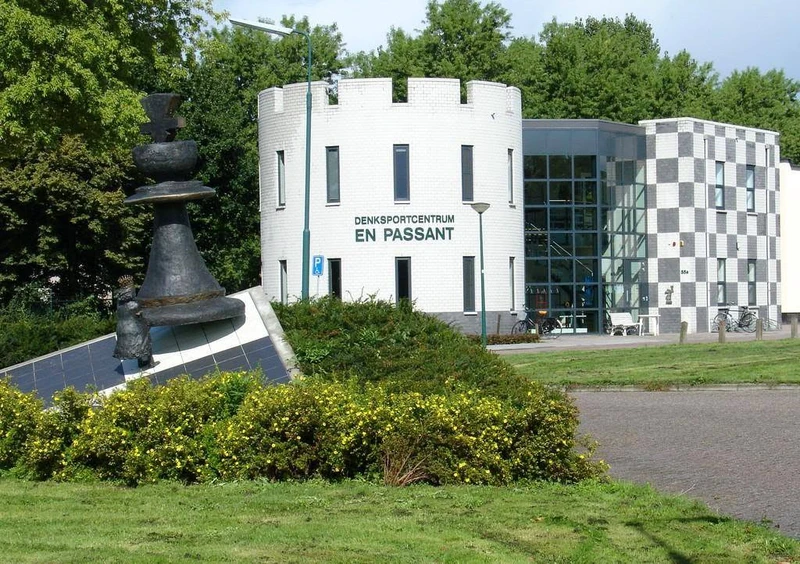
This one took us on a trip to a literal chess building. I’ve never seen anything like it. The building has a big tower shaped like a rook, at the bottom of which is the skittles room with a circular bar at the rook’s center. It was built specifically for chess and it felt good to play there.
I was significantly outrated again on board 3. We got my absolute favourite opening on the board though. I launched a successful minority attack, but was ultimately unable to break through.
I’d say I’ve never learned more from a game though.
I won’t bore you with the details of my dry chess strategy, but after this game I learnt that once you complete the minority attack and have established a weakness on c6, there is a formulaic plan to create a second weakness on the kingside with the cramping but scary looking move g4. I learnt this from Modern Chess’s Typical 1.d4 Endgame Course which I cannot recommend highly enough if you dabble with the d-pawn yourself. Not an affiliate, just a fan.
So whilst I couldn’t make progress in the game, and accepted a draw by feeble repetition in the end, our team continued our unlikely streak, winning the match 3½ - 2½, to take us to 3 out of 3. I think we were all feeling fairly confident we weren’t going to get relegated at this point.
That took some of the club pressure off, too.
These club teams aren’t fixed. Other people from our club will fill these seats next year. You want them to play in as high a league as possible.
ROUND 4
I missed the miracle of our 4th consecutive victory owing to the birth of my second child. A substitute took my place for round 4. We won the match 3½ - 2½.
Whilst following the match on the liveboards from home, as result after result went our way, I wondered for the first time: could we actually win the league?
Surely impossible, I decided. We still had to play the two highest-rated teams in the final two rounds. We had just had good fixtures and some good fortune.
There was nothing special happening here.
ROUND 5
Absolutely no-one believed me and no-one has believed me since.
In round 5, during a rook endgame, I realised in a moment of unverified clairvoyance that I was completely winning. Not because of any understanding of the position, not because I had calculated anything forcing or good. But I was winning. I knew it. And I knew exactly how to win it, because I had dreamt about that exact position the night before.
The image on the board in front of me was straight out of my dream.
All the details came flooding back.
Now, it could be argued that a month of sleep deprivation as a result of parenting a newborn had finally caught up to me, but I preferred (and still prefer) the conclusion that I had developed some kind of precognitive chess superpower.
I won the rook endgame according to my dream plan, and the team won 4½ - 1½.
ROUND 6
It was officially time to get excited.
Our form up to this point had been nothing short of miraculous. Upset after upset. Players on my team beating players 200+ points higher rated. Holding draws we had no business holding.
Coupled with some adverse results for other teams at the top of the table, we now had an actual chance to win the league with a round to spare.
If we won our next match, the title was ours.
I was nervous turning up at the club. My opponent was on 5 out of 5 and out-rated me by 100 points.
Not long out of the opening, I went to the toilet and came back to see a very surprising move on the board. My opponent had played Nc3 to Nd5.
My reaction (as it often is when surprised) was one of existential dread. Oh no! They have played a move I didn’t even consider. I must have missed something.
But as I have learnt by going through that experience time and time again, there is also a very distinct possibility (given that your opponent is often roughly the same level as you) that you haven’t missed something. Instead, the reason you didn’t consider the move, could be because it is utter trash.
As the surprise wore off and the panic subsided, as I sank into the position, I realised that this smelled quite a lot like the latter. This move was reeking. It was a stinker.
I decided I was winning the bishop on b2. I was seconds away from playing Nh5 when I stopped myself. We both still had over 70 minutes on the clock. If I go up a piece, the game is over. I sat on my hands giving into another habit formed from the scars of too many tactical “wins” put on the board too quickly. I looked at the clock. I’m not allowed to play the move for 5 minutes at least, I said to myself.
The game is over. Let me double-check everything and then I won’t need over an hour to convert.
And so I sat, and I thought.
What if he sacks the knight on e7? What if this? What if that?
And - as I went through it all - a second thought occurred to me:
I have exactly the same tactic with Ne8. Hmm. Maybe that’s even better. After all, from h5 the knight can only ever return to f6. But from e8 it has the additional square of c7. I concluded that Ne8 was a slightly more flexible move.
I felt happy. I felt calm. I played Ne8.
My opponent sat down. Wrote down my move, and instantly played Qb6.
I died inside.
The third psychological trigger that I have made part of my game, failed me here.
I have worked so hard to stop when I make a devastating mistake and to calm down. I wrote a blog about it a long time ago titled becoming unkillable.
But here, I was not unkillable.
Despite the position now just being totally even again, I played my next few moves embarrassingly fast, and made mistake after mistake. I only calmed down and slowed down when I had already reached a hopeless rook endgame down two pawns.
I defended as best as I could. And I lost.
We drew the match 3-3.
We were not champions.
I left the club feeling as if I had let everyone down. That my errors had cost us the title. I was interviewed on Chess Journeys the day after and I couldn't stop thinking about the move throughout the interview.
The next morning my kid woke me up and asked if I was a chess champion.
“No”, I replied.
“Can you still be a chess champion?”, he asked, hope glimmering in his eyes.
“Maybe,” I said. “But we have to win or draw our last match.”
ROUND 7 - The Final Round
I arrived with fire in my heart.
As the club’s only Scottish player, I felt it was my responsibility to deliver a Braveheart-esc speech before the match, reminding my teammates that this was our chance to be heroes. To write our names into the annuals of amateur Dutch chess history. Forever.
This was a shot at immortality on the 64 squares.
Rather than wallowing in my crushing defeat the round before, I saw this as my chance of redemption. To show that I could win when the stakes were high. That I could win when a win was needed.
Despite rehearsing it in my mind all day, I never got to deliver my speech. In fact, I almost missed the start of the match.
The same audacious baby that had denied me the chance to play in round 5, threw up all over me as I was leaving the house.
Side note, I have submitted a request to the KNSB demanding a 100 point rating adjustment for each fresh baby a chess player successfully creates.
Inexplicably I have thus far received no response.
So I arrived late.
I arrived smelling a little sour.
But I arrived steady.
I took in my team, already sitting in their chairs.
These babies it seemed were really conspiring against us - we were missing our best player (whose wife was busy having their first child).
I brushed aside a quickly forming mental draft of another strongly worded letter to the KNSB, and sat down.
I shook my opponent's hand.
I locked eyes with him.
I pushed my d-pawn forward.
Join The Online Chess Club | Adult Improver Chess Coaching | Book your Free Trial Lesson
“Papa! Papa! Wake up!”
I rub my eyes and sit up.
“Papa!” He repeats to my silence. “Did you win? Are you a chess champion?”
In hindsight, it was probably a parental mistake to set my kid’s expectations up like this. I love to see him excited, but I was also setting him up for a pretty big disappointment. And I’d be lying if I said I hadn’t really, really laid this one on thick.
It’s all I’d been talking about for a month.
So I took a big breath, looked into his smiling eyes and told him:
“Yes, son. Papa’s the Champion.”
We drew the match 3-3. I won my game with a satisfying grind in a bishop versus knight endgame.
And whilst I might have just one fan, and whilst winning division 3E of the Dutch Evening Chess League might not be the equivalent of scoring the winning goal in a World Cup final, I’d challenge anyone who told me that moment didn’t feel any better.
Bouncing on the foot of the bed with my kid in my arms, listening to him chanting “Papa’s the Champion”, went through me like 40,000 people singing my name in a stadium.
It was undoubtedly the greatest moment of my amateur chess career so far. But not only that, it was one of my life's greatest memories.
Now, all I can do is hope that this is not the last feeling of greatness I achieve on my path towards chess mediocracy.
What Is It All For?
We all work so hard on this game and we don’t really know why. We grind and suffer, we go through painful defeats and bad tournaments and ask why we do this.
This is why.
We will never be amongst the world's elite. We will never reach the pinnacle of our mind-sport-hobby. But chess will always provide us with moments to be proud. To connect. To be part of something greater than ourselves.
This experience, of playing amateur tournament chess with my clubmates, is one I wish I had access to when I lived on a farm in rural Spain.
I like my chess club so much that I recently brought all the best bits of my chess club experience online with the creatively named The Online Chess Club.
In terms of tournment chess, I made The TOCC Classical League the beating heart of The Online Chess Club. We play weekly 45+10 games in a 12 round recurring league. We have a great culture in the club of analysing our games together in the virtual bar (where you can also watch the games live on TOCC TV). We have a weekly analysis group you can bring your games to for peer review and I host a weekly highlights show going through all the action from the weeks rounds and looking forward to the coming fixtures. There is much more than that going on in the club with daily training, the book club, weekly hangouts, interviews and Q&A's with members - a lot of whom you probably already know - for example tomorrow I'm chatting with fellow blogger Dan Bock.
You may also like
 TheOnoZone
Chess Enlightenment
I open the door and literally fall to my knees, face in hands. TheOnoZone
Adult Chess Clock
I used to say that nobody doesn’t have the time for something, they just don’t want to prioritise it. TheOnoZone
Chess Flavoured Peanut Butter
Inspiration struck me as I gazed at a half eaten jar of peanut butter. TheOnoZone
Blundering Lunch
I completely blundered my homemade spicy bean burgers. TheOnoZone