
A wonder in chess960
Chess960
Chess is a wonderful game, with countless strategies and tactics. In Chess960, which has different starting positions than regular chess, these strategies and tactics are even more intriguing. Each game presents a new challenge, with unpredictable twists and turns. In this article, we are going to analyze a strange knot in the early stages of Chess960. In particular, we are going to examine some specific starting positions with a queen in one corner and the dangerous mechanism embedded in them. Come on, let's untie the knots of this chess puzzle!
Please excuse any minor inaccuracies that may have arisen during the translation from Tamil.
Filtering the starting positions with a queen in the corner gives us 240 positions. A piece such as a rook, knight or bishop in another corner must be adjacent to a piece that does not provide protection for it. Based on this condition, filtering the 240 positions gives us 144 positions.
For example:
A Bishop can be next to a Knight that doesn't protect it. But a King or Rook should not be next to it.
A Knight can be next to a Bishop that doesn't protect it. But a King or Rook should not be next to it.
A Rook can be next to a Knight or Bishop that doesn't protect it. But the King should not be next to it.
If a powerful Queen is in one corner and an unprotected piece is at the other end, the White player will often try to move the Queen in the first move. For this, they will open the Queen's diagonal path through the moves (b3,b4) or (g3,g4). This can generally confuse the Black player. In this situation, Black playing (g6,g5) or (b6,b5) could be a big mistake. Because the White Queen can capture the opponent's unprotected piece at the other end of the board in its first move itself.
In this case, I tried these two first moves in all 144 starting positions mentioned above. After capturing the unprotected piece, I evaluated the position by putting it in the chess engine.
The results showed that the opponent's unprotected piece captured by the queen actually acted as a trap for the queen in 10 positions. Out of 144 positions, 134 games favored the white. In the remaining 10 games, the second move was the advantage for the black.
If such a trap was revealed on the first move, white would easily notice it. So, I looked deeper into those 10 positions in chess traps. Then another surprising fact came to light.
If in all 10 positions, white realized the trap and made better moves to avoid it, the number of favorable games would be 8. The remaining 2 positions would favor black.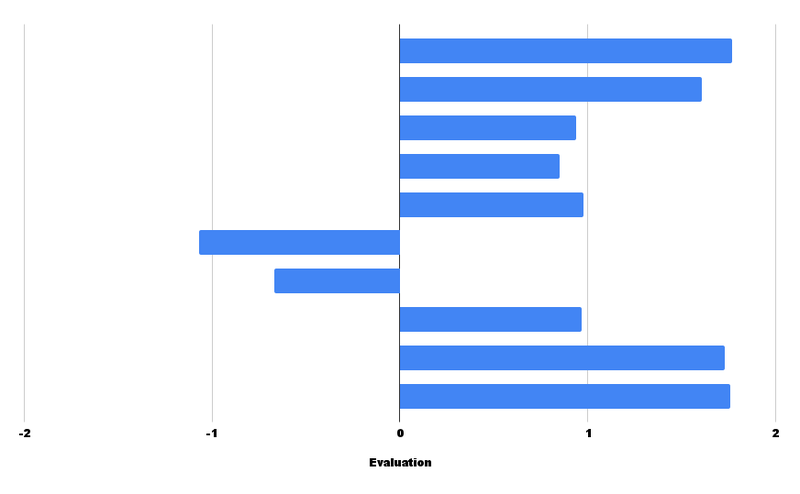
| Starting Position Number | Eval |
|---|---|
| 12 | 1.77 |
| 90 | 1.61 |
| 295 | 0.94 |
| 370 | 0.85 |
| 396 | 0.98 |
| 464 | -1.07 |
| 687 | -0.67 |
| 764 | 0.97 |
| 869 | 1.73 |
| 956 | 1.76 |
In other words, in those two initial positions, the first move of the white may be wrong.
The game below was obtained by comparing it with the world's best chess calculator @Stockfishnews. In this game, I only entered the first move in white. That is, the wrong first move that arouses desire as identified above. Black has controlled the game from the first move to the end.
In this article, we discovered a strange trap in the early stages of the game of Chess960. We saw that when there is a queen in one corner and an unprotected piece in the other, danger can lie in wait on the very first move. In particular, 10 positions filtered out of 960 early positions were surprisingly found to have a mechanism that traps the queen. Although the results of computer studies are accurate, mistakes and carelessness made by humans when playing Chess960 can change the course of the game. Therefore, it is important to think carefully about each move when playing.
I hope this article was useful to you. I look forward to your feedback!
Thank you
You may also like
 CyberShredder
How to improve at Chess960 ?
How many books should you read? ChessMonitor_Stats
Where do Grandmasters play Chess? - Lichess vs. Chess.com
This is the first large-scale analysis of Grandmaster activity across Chess.com and Lichess from 200… jk_182
Finding Traps with Stockfish
Can an engine figure out if there is a trap in a position? NM visualdennis
My Ultimate Guide to Chess960
In-Depth Guide about History, Strategies & Opening Tips, Resources for Chess960 and more Tux960