
Five Years Later: The Queen’s Gambit & My Journey Through Chaos
An emotional journey through stories that reveal themselves in the darkest of hours
The Beginning
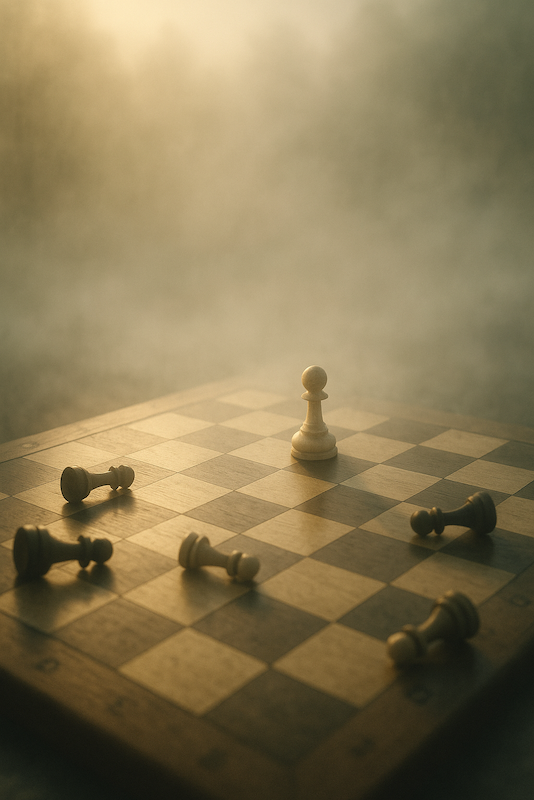 A pawn stands alone on its journey towards promotion.
Imagine a time in your life when you loved something. This could be as a young toddler, when you dream of becoming a firefighter, or as a socially awkward teenager, hoping to impress the girl who is the love of your life. For me, that love was for chess. Ever since I was young, chess was all I knew. As I continued to climb the rating ladder and garner trophy after trophy, I began to realize that chess was not just a hobby; it was my identity. Through the ups and downs of high-level competition, I continued to battle my way to the top, all while dreaming of becoming the world champion one day. That was, until 2020.
In one moment, the world stopped. The novel virus, or as the newscasters called it, "COVID-19," was ravaging across our world and taking the lives of every civilian from every continent. With it, the dreams of billions of people, including mine, were taken.
My final high school nationals? Gone. Representing my state at the National Denker Tournament of Champions? Gone. Walking down the aisle with my family for graduation? Gone. Even to this day, I struggle to comprehend the damage 2020 has inflicted on me, but I can tell you that day by day, month by month, the uncertain, unimaginable world I was about to live in became a harsh reality.
As I made my way to college and away from home for the first time, I would have to become independent during the most unprecedented times in human history. College life became lonely, isolating, and devoid of soul. For many Americans, any form of engagement was seen as uplifting, inspiring, and heartwarming, taking them out of the dark, desperate reality they lived in and into a world where dreams were possible and life, as they knew it, was normal again. This is why, as an 18-year-old kid seeking guidance from my spirits up above, I immediately awoke on October 23, 2020, the day The Queen's Gambit, a new Netflix series, was released. While this new series didn't promise me healing, comfort, or even insight into myself, I knew that any form of self-reflection was beyond valuable.
Five years have passed since then, and of course, a lot has changed. And while I'm still writing the next chapter of my life, I hope this article gives you a window into the impact that series had on me — back then, now, and in the space between.
The Release
 The quiet ray of sunshine fills the otherwise empty room, like our feelings during COVID-19.
The day that The Queen's Gambit Netflix series came out is a day I will never forget. It started slowly, with cautious optimism filling the air, as a young college kid, only 18 years old and thrust into an unimaginable world, opened his computer screen in hopes of seeing a reflection of his past and a glimpse of his future. From there, time stood still, as when he pressed play, he was opening himself up to the vulnerability of his past that he kept to himself, and no one, other than his family, could see. He was a confused kid, both clinging to his childhood and trying to make the transition to adulthood, desperately looking for signs of comfort during the worst pandemic in world history. What once was a promising beginning to his chess career turned into a dark and sad reflection of the times, as he was seemingly locked away in his prison known as his dorm room, with no escape to the outside world, and no escape from his feelings of loneliness and depression. Through this blog post, you will not just read a breakdown of the events, but a descriptive, image-filled dialogue, revealing the troubled life of Beth Harmon, a beautiful young woman whose genius masked her insecurities, and the upbringing of the man watching it, seeing a mirror into his own life, and the growth that followed. With that in mind, let us take in the film, relax, and transport ourselves back to that moment when one show on Netflix changed my life.
Episode 1 — "Openings"
You might imagine I fell for The Queen's Gambit instantly — as if we were meant for each other. But that wasn't the case. You see, when I first watched the opening scenes, I felt confused. Perhaps I didn't know who I was at the time. Still, as I witnessed the events that followed, I noticed a juxtaposition: one that depicted a young lady all grown up, ready to compete in a prestigious chess tournament halfway across the world, and one that depicted a young, innocent girl, seemingly speechless from a car crash that claimed her mother, and left her, without a father at the time, an orphan. As the state of Kentucky took her away to the Methuen Home for Christian Girls, she remained silent, lost, and afraid, a bit like me as I said goodbye to my parents for the final time before leaving for Oberlin.
 Is Beth a chess champion or a struggling orphan? In Episode 1, she's both — and neither world feels fully hers.
A New Place, a New Home
 A dimly lit hallway, signifying the unfamiliarity of Methuen. Photo Credit: Matt Benson on Unsplash
Watching Beth being pulled from the car and into her new home, I listened closely as the headmistress, Mrs. Helen Deardorff, reassured the disoriented girl that everything would be all right.
"I know, at this moment, all you're feeling is loss," she began, "but after grief brings you low, prayer and faith will lift you high." "I think, Elizabeth, that you're going to find a much different life here," she conveyed.
Those words caught me off guard. Hearing her words made me think of Oberlin, how, during my visit, every student, professor, and parent would reassure me of a better life, one that would place me in an environment where I was accepted, neurodivergent, and a chess player. Except that never happened. After hearing Mrs. Deardorff's words, my emotions shifted from confusion to worry. Would Beth face the same pain?
The episode continued, and my worries gave way to a new realization. Jolene, one of the girls in the home, jokingly asked Beth about her final interaction with her parents. Harmon felt awkward, like a deer in the headlights.
"I don't know," she mumbled. Yet she did know.
The Flashback That Changes Everything
 The vivid image depicts a man in a moment of reflection, his hands on the clock, as the Earth revolves around the Sun.
As the scene shifted from the Methuen Home, we got a glimpse back to that moment, right before the crash, and her mother, almost to the point of tears, quietly whispered, "Close your eyes, dear."
It wasn't just a goodbye — it was surrender—a mother's love, drowning under the weight of her own pain.
That moment gave me the realization I needed: Harmon's struggles went far beyond any chessboard. I couldn't help but feel the pain Beth must have experienced in that moment, lost in confusion, bewilderment, and, most of all, betrayal. Betrayal from her parents, who left her at such a young age, but also from the girls in the orphanage, none of whom could ever comprehend the degree of hurt she was feeling.
When Routine Meets Destiny
 Was it fate that led Beth to the basement of Methuen? Photo Credit: Javier Grixo on Unsplash
And life, for Beth, seemed to flatten into monotony. One day, bleeding into the next — until Miss Graham handed her a box of dusty erasers, and a door opened to the basement. There, she finds Mr. Shaibel, the school janitor, playing chess. Suddenly perked with interest, she asks Mr. Shaibel to teach her, but is met with a rebuttal: "I don't teach strangers," he replied. "You should be in the choir with the other girls."
The Janitor and the Board
 Sometimes greatness is found in the dark, as in this chess set.
Despite this rejection, her fascination with the game grows, and as she sleeps with the girls, she visualizes the chessboard on the ceiling, all with the hope of making her chess dreams a reality. Opening by opening, she finds her way, and after beating Mr. Shaibel for the first time, what was once a childhood hobby becomes a lifetime pursuit ‒ one that pushes her to do everything she can to understand the game of chess and its deeper meanings. Whether she's in class and reading a chess book under her desk, or spending her choir time downstairs in the basement with Mr. Shaibel, her life is changing right before her eyes.
As word spreads about Beth's abilities, she is summoned to play a simul against the players at the local high school. In an absolutely brutal fashion, she destroys every single one of them in an hour and twenty-five minutes.
The Collapse
 For as high as Beth reached, the collapse is just as far. Perhaps it was the pills, or something deeper she can't describe.
And when Beth seems unstoppable, she collapses. While the other kids watch a movie in the auditorium, she decides to unlock the room with the bucket of tranquilizer pills, and then, from the height of her stool, she falls to the ground.
Mrs. Deardorff watched in shock; she had no words, nor did the rest of the kids. But this made me stop and think: "Was she really that good at chess, or was it just the pills?" During a period when I questioned my own reality, the episode's intrigue kept me wanting more. It stayed with me.
The dramatic church music rang out, bringing the first episode to a close. It was then that I realized this was no ordinary series, but an absolute masterpiece, and it was just getting started.
I hope you all enjoyed this journey back in time to one of the darkest moments in human history, and that we can find peace knowing we're in a much better place now. For more heartfelt and emotional stories, feel free to follow me at @UncleRogerJr.
You may also like
 Kevin_M06
Deep Analysis of Lichess Puzzles
Ahh... Lichess puzzles. Don't we love them? CM HGabor
How titled players lie to you
This post is a word of warning for the average club player. As the chess world is becoming increasin… RuyLopez1000
The Brain Science of Chess
How does the brain play chess? NM UncleRogerJr
Chess on Mars: A Galactic Odyssey
Before computers, there were Martians, asteroids, and the Milky Way! NM UncleRogerJr
Exchanges: The Price of Becoming Someone New
Episode 2 is where childhood ends. Not just for Beth — but for anyone who’s ever tried to rebuild th… thibault