
Becoming a national champion U2000 (Part 1)
It's been 17 years, but the day has finally arrived!
Origin story
My first FIDE-rated event happened in 2008. Back then, I was a 16-year-old hobby player, and chess wasn't even considered cool, but rather an activity for nerds with little to no social skill. In my day to day life, I was best known for performances in Physics, having won the Romanian National Physics Olympiad twice, in 2008 and 2009. That remained my biggest passion for several years, having opted to pursue academic degrees in the field overseas, first at Rice University in Houston TX, where I got my Bachelor's in 2015, and later at the University of Illinois (Urbana-Champaign IL), where I got my Master's in 2017 and represented the team at the prestigious Pan-American Intercollegiate Championship in 2016 in Louisiana. There, I could finally breathe some rarefied air and met important names such as Le Quang Liem anchoring the board 1 of Webster University, as well as the legendary Susan Polgar. My teammates were fellow club players and university students Paul Graham, Shaurya Singhal (inventor of a particularly rare line in the Ruy Lopez), and Kevin Yiu.
Why academics and chess don't mix too well
Chess has always been more challenging than Physics to me. It felt like all my peers either had a background as proper club players, with access to training materials and coaches, while everything I had was a dusty collection of old periodicals and outdated opening analysis books. Starting a new hobby on the backfoot compared to one's peers could lead one to quickly abandon the challenge and focus on something more productive. Yet my love for chess kept increasing, as if with every blunder made on the board, I could learn an immutable truth about myself. My love affair with chess finally began in earnest as I was starting to lose a bit of the initial passion for research in physics. On long, sometimes sleepless nights, while my classmates were obsessing over the latest problem set in our difficult quantum mechanics class, I would be gazing over the diagrams in Jeremy Silman's iconic books...thus I learned how the knight craves advanced outposts in the enemy camp, or how the bishops have X-ray vision and hate friendly pawns obstructing their diagonals.
It wasn't long until combining an academic program in Physics and Math with chess study sessions led to intense burnout. While painful at the time, I had to abandon chess for a while and focus on my academics. I was on a full scholarship at Rice University and the walls of academic requirements were closing in on me. Looking back, that was an immensely stressful period that mostly led to a significant alteration of my sleep patterns. If I could turn back the clock, I would take fewer courses and focus more on chess.
The pandemic - an opportunity?
Fast forward to 2020. A return to Europe after 9 years in the US, a job offer in Switzerland that never materialized, and intense frustration over the ongoing Covid pandemic. These were all my emotions, which led me back to chess, first as a small-time content creator, then later as a player again. Still, my first tournament back was a disaster. -53 Elo, 3 lost games from totally winning positions. The feeling of self-doubt regarding my OTB abilities was creeping in. Why could I defeat 2400 players on Lichess and Chess.com, but I never beat a single FM in classical chess? Why was my OTB rating in the region of mid-1700, if my online blitz was hovering around 2300? Something wasn't adding up. It led to feelings of self-loathing, diminished self-worth, and a constant stream of negative thoughts. This was further amplified by Twitch chat often making sweeping remarks like "you should be at least a CM" after seeing my analysis skills on stream and ability to teach chess.
I wanted to make things right, at least towards myself. On good days, I felt confident enough to outplay people rated above 2000. On bad days, I could blunder an elementary tactic to a 1500 player. Over the next couple of years, I played chess obsessively. If there was a classical OTB tournament nearby, you'd find me there. Between 2021 and 2024, I averaged at least 100 games per year. My FIDE rating went from a low of 1740 in Feb 2021 to an all-time peak of 2020 in April 2023. In the meantime, I quit my startup job in Bucharest to pursue chess coaching as my sole income source. It was a bold decision, but one that I have come to cherish, as it shows a side of my personality (independent, risk-taker) that wasn't necessarily visible in my earlier years, when I prioritized comfort and stability over doing what I really loved.
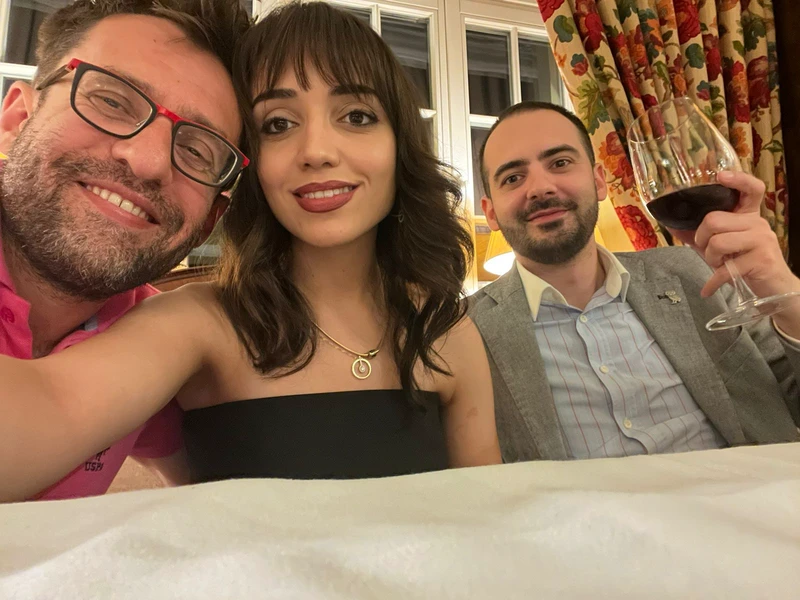
In Warsaw at the GCT on May 19th, 2023. Celebrating the birthday of Ani Aronian over some food and drinks - also known as "third wheeling" colloquially - just kidding, there were some other people sitting on the other side of the table, not pictured here.
The sudden downfall
After reaching my personal best in the spring of 2023, I wanted to travel the world and play chess. Firstly, I was invited by my friend Levon Aronian
to the Warsaw leg of the Grand Chess Tour, where I could mingle with elite players and also eat some of the delicious snacks (pictured in the cover photo of this article!) one might have at 2700+ Elo. After brief conversations with legends such as Garry Kasparov (my all-time idol in chess!) and Magnus Carlsen, I sampled some of their snacks, probably either nervous from the interactions or simply hungry from all the hectic activities in Warsaw. Thinking that those coconut protein bars were doing wonders for my chess ability, I impulsively signed up for one event after another. First, I played in Munich, then Teplice, Arad, Piacenza, and finally Bucharest. Between June and December, my rating had tanked from 2020 to 1870 and the games were chaotic, full of blunders, with me often making silly game-losing mistakes due to a lack of focus. The damage to my Elo (and ego!) was massive. Not to mention, that there were other things happening in my private life that hadn't been going particularly well...
My brain was overworked. I needed rest, yet the chess bug was still there and I thought the pain would simply go away by playing more and more games. I don't think I truly broke free from the spiral of chess addiction yet, but I am making steps in that direction. My declared goal for 2025 is to play fewer than 75 classical games, after averaging more than 100 for the past 4 years. Most people make goals of playing more, whereas I need to play less. It's also a more expensive hobby than most outsiders realize, especially when you factor in accommodation costs in foreign cities and the cost of airfare. I am fortunate enough to have a solid base of loyal students, who tolerate my frequent trips for OTB events and are willing to work on a flexible schedule.
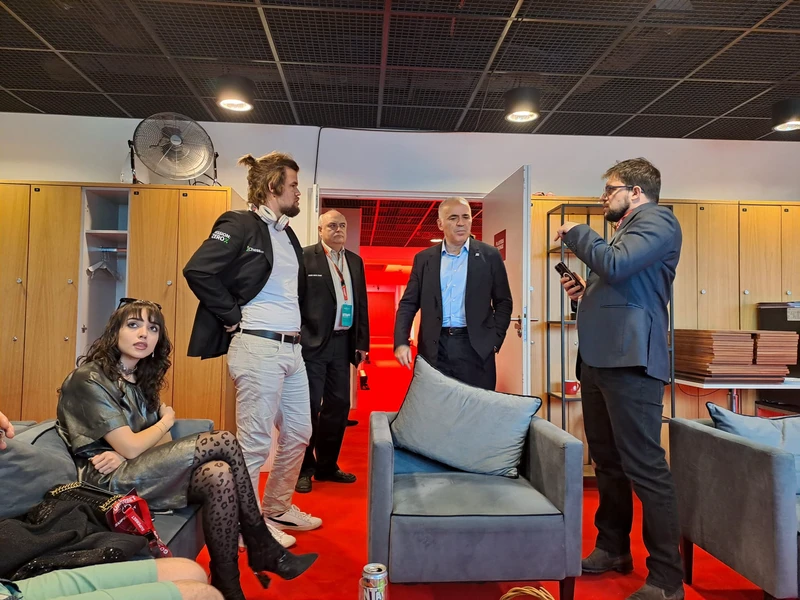
So many all-time greats in one frame. My heart was pounding from excitement, just listening to Garry and Magnus' animated conversation about a complex ending the latter had just botched against Maxime. Obviously, I understood almost nothing from their analysis, but the moment is still surreal and was even captured by Anastasiya Karlovich on video! I don't look entirely comfortable there and certainly don't belong in the same room with them.
To be continued in Part 2...
As this article is turning into a wall of text, and I didn't want to bombard you with a full novel just yet. In the next installment, I will show you the games, important moments, and my mindset going into them. Make sure to <3 the article if you enjoyed the storytelling. I can promise the next part will be more focused on chess
You may also like
 BenjiPortheault
The War on Attention
I’m done consuming chess content Vlad_G92
FIDE Ratings Revisited
Do they offer the full picture, or can improvements still be made? FM CheckRaiseMate
What Good Opening Prep Really Looks Like
There are no prizes for memorizing random moves Vlad_G92
How to Select a Chess Coach: A Complete Guide for Players at Every Level
Finding the right chess coach can accelerate your improvement dramatically. However, with hundreds o… Vlad_G92
Obituary: GM Daniel Naroditsky (1995-2025)
Daniel Naroditsky passed away at the age of 29 in Charlotte, NC, where he resided since 2020. ebk1976