
Isamel Nieto
First OTB Tournament of The Year

Hello everyone. Today I shall present the continuation of my non-official chess improvement series by showing you my run in the first OTB Tournament that I had this year. The Sevilla Open 2026 occurred from 09-17 January in Sevilla, Spain, Europe, Earth, and I was excited to show what I could do, since I'd been off the boards for a couple months now (since November).
The First Part
Let me introduce the first part of the tournament by prefacing how the Open tournaments usually work.
The way a Swiss format tournament works is it tries to pair you with players in your point group. Points in the tournament, that is. Each group of players that has the same points gets split in half, and then the highest rated player plays the (n/2)+1-th highest rated player, n being the size of that group. An example will make this clearer: in the first round, there's only one group of players (that have 0 points), so the whole list gets split in half. Say the tournament has 100 people. The first seed (highest rated player) plays the 51th seed, the second seed plays the 52th seed, and so on.
So, the higher seeded you are at the start, the more rounds you will be playing players below your rating (lower seeds). In the Open tournaments I play in, I usually end up having to play the first 3-4 rounds below to then get a game with someone higher rated than me. You might be thinking this is good, since playing lower-rated players means I have a higher chance of winning, but this is not the case. The way to improve in chess is to play strong players. Hopefully, someone slightly better than you, so that you still have a good chance of beating them. Then there's also the ELO rating considerations. If you win against someone rated 400 points below you, there are virtually no rating points to be gained whatsoever (+0.8 in my case), and stand to lose a ton shall you lose the game (-10). With this in mind, the stronger players really just want to "survive" the first couple games in the First Part of the tournament.
This I did. I survived the first 4 rounds with only one major hicccup, which we shall now see.
After getting through that nerve-wrecking game, I managed to find a nice calculative sequence in game 4 which I'm quite proud of having even considered.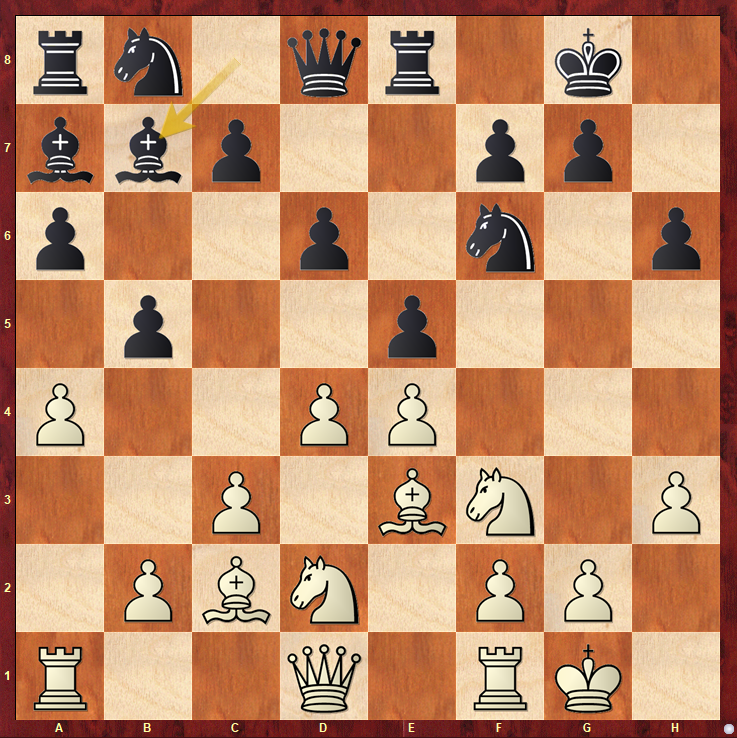 White to play and win! (no, it's not as easy as it looks).
Rounds 5 and 6
On the next game I would play IM Liam Putnam, who actually went on to win the whole thing, finishing on a whopping 8/9 (tied with someone else too!).
This game was rather unfortunate, as I was on the receiving end of a tactical blow when the game was likely heading towards a draw.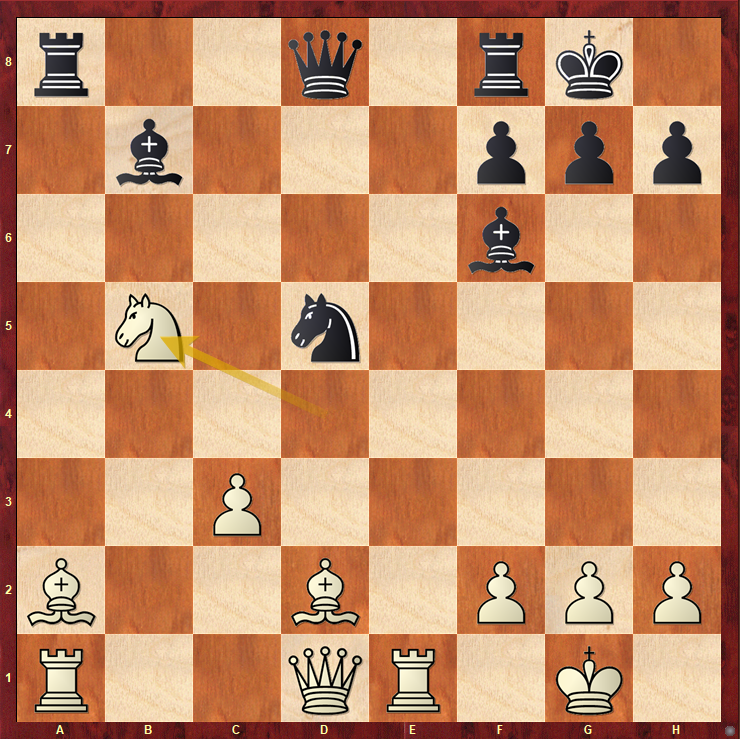 Black to play and win.
I managed to complicate matters a bit but then faultered in an extremely delicate position.
Next came the most important and instructive game of my tournament. I was playing an opponent rated 2235, and, as per usual, really didn't want to make a draw.
The Finishing Line
After these two painful losses I really needed a comeback. On the recap of game 6 that I uploaded on my Youtube channel I made it a mission to play faster in non-critical moments and I'm glad that I did manage to play faster - much faster. Ended with 30 minutes on the clock (a very rare sight for me) and gained a lot of confidence back from game 7. In round 8 I got paired against a nice lad from the UK, FM Rhys Cummings (2289). I went for the Taimanov again and the game was mostly messy and difficult to evaluate. I ended up finding a critical idea to come up with counterplay after 22.f6 and again, I believe better time management to have been a crucial factor in this. In round 9 I played against FM Vittorio Cina (2316), with a rating similar to mine, but I was really, really, hungry for a win. The game was interesting, I had some pressure on his position, but he found counterplay and after some craziness we made a draw. Not the result I wanted, but it's not too shabby either.
Aftermath
 We end up on a whopping +0.9 ELO, otherwise known as breaking even. I'm not so dissatisfied with my performance, though. I got lost positions in 3 of the 9 games and could have definitely not lost rounds 5 and 6.
I still need to analyze my games deeply, but even before that, the main takeaway I shall take from this tournament is to not spend too much time on minuscule decisions, but instead save my time and energy for when it really matters. I have come to realize that the game rarely is decided by switching up the order in which you play a sequence of positional moves, but is rather decided on who can spot the other guy's bishop is free for taking in 1 move.
P.S: I have revived my Youtube channel, so check it out if you wanna see me rant about my games (and other things to come ( ͡º ͜ ͡º) )
Hope you enjoyed this blog post :)
You may also like
 GM Avetik_ChessMood
10 Things to Give Up to Enjoy Chess Fully
Discover how embracing a lighter mindset can help you enjoy chess again and achieve better results. thibault
How I started building Lichess
I get this question sometimes. How did you decide to make a chess server? The truth is, I didn't. FrancisLudwigII
The Daily Gambit #1: The Jerome (Sorry Stockfish!)
Hey everyone! I’m Lorenzo Abing (francisludwigii), your online super-prodigy, and I’ve decided to co… ChessMonitor_Stats
Where do Grandmasters play Chess? - Lichess vs. Chess.com
This is the first large-scale analysis of Grandmaster activity across Chess.com and Lichess from 200… CM HGabor
How titled players lie to you
This post is a word of warning for the average club player. As the chess world is becoming increasin… FM Zorbos