
Revisiting the heated encounters between Magnus Carlsen & Sergey Karjakin
Here I have analyzed four intense and iconic games played between Magnus Carlsen and Sergey Karjakin
World Blitz Championship 2012 (Game)
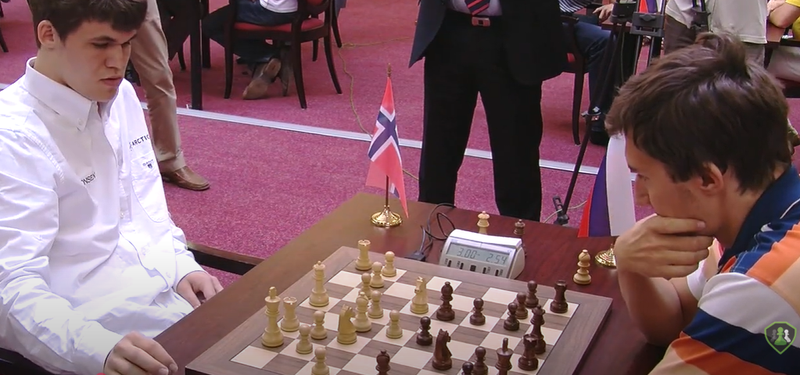
It was the Spanish opening where Magnus took on c6 (as you can see from the picture). There were a couple opening errors from both players which are not worth mentioning.
On move no.12, Karjakin played g5 — hitting Magnus' bishop on h4. Instead of retreating, Magnus played 13.g4!! that counter attack's Karjakin's bishop on h5. Black did not take on h4 and instead chose the safer path. But had the captures taken place, it would have been a unique scenario, where both kings would be wide open on the g-file and 4 pawns on the h-file.
Karjakin's 21st move was a costly mistake. He decided to simplify by taking on f5. And here is why it was wrong;
- It gave up the bishop pair advantage — Black lost the fight on the light-squares.
- Black's king had one less defender.
Instead Karjakin should have just played Bg7. The position was not so easy for black, but giving up the light-bishop was simply incorrect.
You can click on the link above to check the game!
World Blitz Championship 2015 (Game)
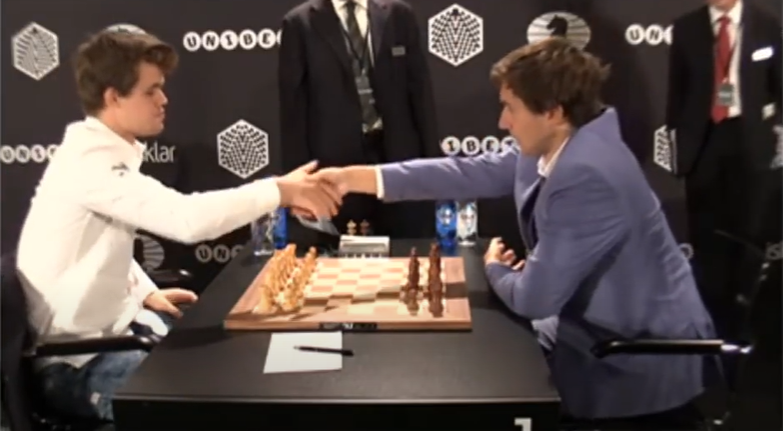
This is my favourite game of this blog. The things that I find impressive in this game were,
- Karjakin's ability to stay sharp, create chances.
- Punishing Magnus' one small inaccuracy with total control throughout the game.
Now, I will take you through the details of the game.
It was a London system by Magnus to which Karjakin replied with a symmetrical setup. At the early stage of the game Magnus gave up the bishop pair to create doubled c-pawns and to take control over the e5 square. On move 10, Black could have played a5 to activate the light-bishop via a6-f1 diagonal — Instead Qc7 was played. Soon the dark bishops were traded. White's knight was outposed on c5 while black was able to achieve the e5 break.
16th move was the turning point of the game. Magnus played the naturally looking 0-0 which turned out to be an error. Karjakin spotted Ng4! Magnus spent a lot of time and still couldn't find the only way to keep things going. Instead he settled for g3 that created light-square weaknesses around his King — Which black exploited step-by-step. Instead, Magnus should have played 17.h3 that enters a very complicated line that is not so easy to navigate and assess.
I have given the detailed analysis in the above mentioned link.
World Chess Championship 2016 (Game)
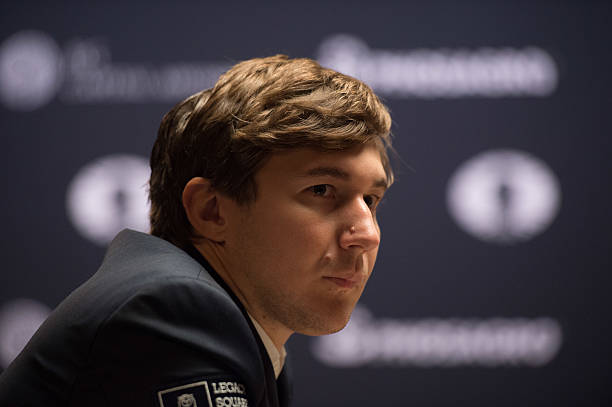
By the eighth game of the match, Magnus Carlsen had grown tired of trying to break through Sergey Karjakin’s solid 1.e4 e5. So this time, he chose to dive into d4 waters. The opening followed known theory up to move eight, after which Carlsen decided to shake things up by capturing on c5.
When Karjakin replied with 11...dxc4, the position became symmetrical and seemingly harmless. On move 13, Karjakin was forced to make a small positional concession — he played a5 to prevent Carlsen from claiming the bishop-pair advantage (with the move b4). This weakened the b5 square for black. For a while, the game looked calm, but soon the momentum started shifting.
Karjakin began to turn the tables. After calmly defusing all of Carlsen’s early pressure, he created small but steady problems for the World Champion. The tension built up slowly (psychological grind). During the middlegame-endgame transition, Carlsen eventually chose to recapture on c4 with a pawn instead of his rook, a decision that left his queenside pawns weak and isolated. Still, he pressed on, avoiding simple ways to equalize and continuing to look for chances.
Move 31 proved especially risky, allowing Karjakin to get the a4-pawn. Both players entered time trouble, and as the complications cleared, Karjakin emerged slightly better: he had a queen, knight, and four pawns (two connected passers on the queenside whereas the other two were disconnected on the kingside), while Carlsen had a queen, bishop, and four chained pawns on the kingside.
The position was dynamically balanced — Carlsen’s king was safer, but Karjakin’s pawns were marching fast. Then came a key moment on move 41: Karjakin calmly played Qd7, taking full control of the position. Carlsen’s 45.f5 was a desperate but necessary try to generate counterplay; without it, Black would have simply advanced his pawns.
Eventually, they reached an endgame with Karjakin’s dangerous a3-pawn and a beautifully placed knight on e5 anchoring his setup. Though the position was objectively close to equal, it was incredibly tough for White to defend in practice. Under pressure, Carlsen blundered and Karjakin immediately seized his chance.
First blood to Karjakin. (Wins with black and puts pressure on Carlsen)
Game mentioned in the above link.
World Chess Championship 2016 (Game)
Before we start, I would like to mention that the annotations present in this particular game's PGN (above link) is done by GM Wesley So.
I just copied and pasted the game from Chessbase. Now let's dive into this game!
Magnus tries 1.e4 again this time and of course Karjakin responded with 1.e5. Until move 17, the position was quite stable for both sides.
The game takes a different direction on move 18, where Karjakin played Be6. Magnus took on e6 and Karjakin recaptured with his f-pawn that spiced things up. This created doubled e-pawns for black (quite common in Italian structures). I would like to talk about this in detail, but first lets see what happened next. Karjakin was exerting pressure on the f-file. Magnus played 20.Nd2 stepping out of the file. Now, here Karjakin could have forced a draw with Nxf2+. But instead he played d5 that kept Magnus' chances alive. There was a second time (on the next move) where a forced draw was possible — but this time it was a hidden detail. But had Karjakin found it, Magnus could have not avoided the draw. Atleast one move earlier, Magnus had the choice of accepting a slightly worse position to avoid repetition. But ironically, Karjakin missed it - Twice. And the game continued. It appeared that the Gods too were working for Magnus apart from his team.
Jokes aside, now let us get back to the moment where black gets doubled e-pawns in this structure.
Merits of the doubled pawns
- Control of f5 & d5
- Open f-file that helps with the king-side attack
Demerits of the doubled pawns
- Long term weakness
- Strategically speaking, every endgame scenario would be worse for black (like it happened in the game)
- Black can't afford to trade queens
- Pawn mobility reduced
- Without the dark-bishop on the a7-g1 diagonal, black's kingside attack would not be that successful.
Do check the game in the above link for detailed analysis!
I hope you had a good time reading!
:)
You may also like
 jk_182
How Opening Advantages Translate into Results in Online Games
Measuring conversion rates in online blitz and bullet games for 1200 to 2400 rated players IM adapodadeiii
Rebirth: A Fresh Addition to the Game of Chess
Tired of having to march your pawns all the way to the 8th rank just to get a queen? Well, I’ve come… CM HGabor
How titled players lie to you
This post is a word of warning for the average club player. As the chess world is becoming increasin… IM adapodadeiii
Forced Checkmates That Might Just Break Your Brain
Think you’ve got it all figured out? Let’s find out. These positions feature forced checkmating sequ… IM adapodadeiii
Some more Chess Riddles
Back Again! — with some more chess problems that anyone can attempt IM adapodadeiii