
Athrye
A personal repertoire for the Scandinavian defense
My preferred way to play as black against 1. e4, illustrated with positions from my own games
These are just excerpts from my personal notes, including examples from my past games, with a summary flowchart at the end. I'm a chess novice and these are notes for myself or other novices.
The embedded games are interactive in most browsers, but it can be a bit glitchy. If the arrows or circles render in the wrong place, try refreshing.
The Scandinavian: 1. e4 d5
If white opens with 1. e4 we start the "Scandinavian" opening by striking back in the center with 1... d5.
If 2. exd5
If the pawn is taken, I like to leave it alone and bring my knight out, instead of immediately recapturing with the queen. I find the rapid development helpful, and I'll usually win that pawn back soon enough.
The main reason I prefer to play this modern variation (developing the knight with 2... Nf6) instead of the main line (recapturing immediately with 2... Qxd5) is that the main line often leads to black moving the queen multiple times while white develops naturally.
(Disclaimer: These are the moves I like to play, NOT the best moves from a purely theoretical perspective. For example, the engine rates the above position as +0.6, better for white. But I'm not playing against GMs, so I'm not limited to the handful of optimal book openings).
If (2. exd5 Nf6) 3. Nc3
Often at this point, white will play Nc3 to defend the pawn. Since the queen is also defending d5 we can go ahead and take the pawn with our knight. This equalizes material and offers up a knight exchange in the process.
White can choose whether they want to take the exchange (3. Nc3 Nxd5 4. Nxd5) or ignore it (e.g. 4. Bc4), and either option leads to positions that I like to play as black.
If white takes the knight exchange on d5...
I'm perfectly happy to exchange knights on d5 if white goes for it, by 3. Nc3 Nxd5 4. Nxd5 Qxd5.
(You might notice that the above position looks similar to the "main line" position after 1. e4 d5 2. exd5 Qxd5, however in this version white no longer has the strong developing & attacking response of Nc3 because that knight was just traded off the board!)
After the queen completes the knight exchange on d5, most of white's next moves can be answered by standard development such as Nc6, and/or Bg4 (which is especially useful in positions where the bishop would pin white's knight to their queen).
If white is playing on autopilot and tries to fianchetto queenside, note that b3 is a blunder that opens up a royal fork to win white's rook.
If white declines the knight exchange on d5...
Sometimes instead of exchanging on d5, white brings a second attacker out to pressure the knight. I used to retreat my knight back to f6 but that is inefficient (three knight moves, only to end up back on f6). Instead we can force a knight exchange on c3 (white should recapture towards the center with bxc3) or simply reinforce the knight with a quiet c6.
While Nxc3 and c6 are both acceptable responses, I currently prefer the latter. This is because the position arising from c6 has some characteristics that I like as black (pieces in the center, useful tension) and the position arising from a knight trade on c3 has some characteristics that I dislike (no developed black pieces, and white's dark-square bishop partially activated by bxc3).
If (2. exd5 Nf6) 3. Bb5+
Sometimes white will reflexively give check with their light-square bishop. I prefer to block with my own bishop (alternative options involve blocking with Nd7 or c6), which offers up a bishop trade on d7. If white initiates the trade on d7, recapturing with the queen is probably the way to go because it keeps the pressure on d5, whereas recapturing with the knight would block the queen's line of sight.
If (2. exd5 Nf6) 3. e6
Here instead of defending the pawn with Nc3, white pushed the e-turned-d pawn, surprising me enough to burn 30 seconds in a 3|5 game. I took the pawn with exd6, which is a viable option, but makes it harder to move the black bishop around. In retrospect, the better move would have been to capture with the queen... (during the game I wasn't sure whether Qxe6 would be good development or bad early queen exposure, which at times can be two sides of the same coin).
If 2. e6
Sometimes instead of 2. exd5, white instead advances the e pawn forward another square. Historically I have responded by expanding queenside with 2... c5 with the notion of following up with Nc6 at a later time.
Unfortunately I have not had much luck with that, so perhaps moving forward we try to bring the bishop out instead?
If 2. Knight move
If instead of 2. exd5 white brings out either knight, you can just push it around with a pawn move.
If white plays Nc3 we poke it with d4.
If white plays Nf3 we poke it with dxe4.
If 2. (something that doesn't defend white's e pawn or give check)
If white doesn't defend or move the e pawn, it's usually safe for black to take it with dxe4 and then defend it with Nf6.
An exciting line: the Icelandic-Palme Gambit (1.e4 d5 2.exd5 Nf6 3.c4 e6)
This is one of my favorite lines to play as either color. Black gives up a pawn in exchange for rapid development, and then must relentlessly use the advantage in deployment to apply constant pressure to white. It is a true gambit in the sense that there is no guaranteed way to win the pawn back.
Here is where a second pawn is offered:
If white takes the pawn, we recapture with the bishop, and arrive at the below position. You can see the very clear tradeoff with white being up a pawn and black having significantly more active pieces.
While the e file is open, it can be useful to play Qc7 since this sets up a discovered check and the bishop is already targeting a pawn.
If white doesn't preemptively block the discovered check, you can often snag the pawn on c4 for free (usually equalizing material, i.e. getting back the gambit pawn).
Here is a different game where that same discovered check is used to win a queen. (In this case I blundered playing white, and was on the receiving end of the attack).
Closing comments
This covers my general plans for handling the first 2-3 moves against 1. e4, after which you can just develop normally and play based on best practices and intuition. I usually end up castling short, sometimes with a kingside fianchetto, but it really varies depending on the needs of the position.
I hope this was helpful! If you have any questions or suggestions or want to play a game, shoot me a message or a challenge.
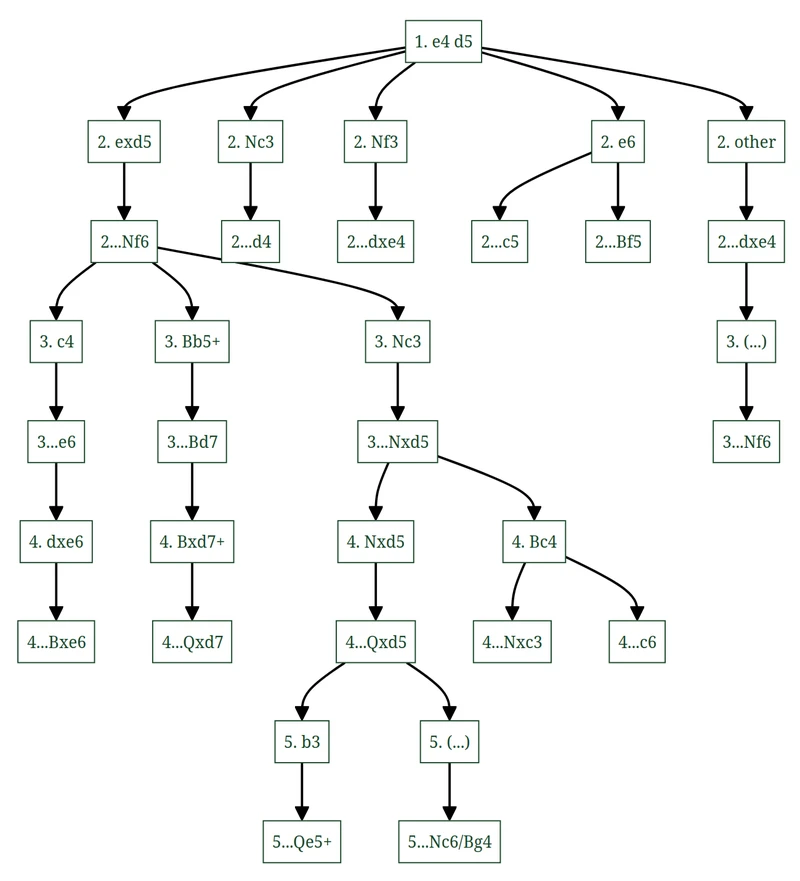
As a TL;DR, here's the flowchart for move sequences described above:
(Post cover photo is a picture that I took during a recent eclipse)
You may also like
 GM hari2209
How to Use Calculation Books Effectively!
Puzzles are the easiest source available for any chess player. They are widely used by players of al… athrye
Miscellaneous notes
A collection of general tips and practices that I've found helpful IM theScot
Life Hacks for Getting to IM
A post about the life-skills that help you in chess. GM Avetik_ChessMood
The Right (and Wrong) Way to Build Your Opening Repertoire
Here’s how to build your opening repertoire smartly and avoid 5 common mistakes. GM Avetik_ChessMood