
This new generation is terrifying....
Which generation is better at chess and why ?
Introduction
In this blog post, we are going to see which generation is the best at chess and why.
I will compare the talents and achievements of both the new and older generations.
This was originally the topic of a video I made here. The video took me a looooong time to make, so I would be glad if you took a look at it.
Context :
The 21st April 2024, the whole chess world has its eyes fixed on one young man.
This player is none other than Dommaraju Gukesh.
He just won the strongest tournament of the year and beat the world’s best players at the age of just 17 !
Gukesh will, thanks to this achievement, confront the current world champion, Ding Liren in a match to designate the next titleholder.
If he beats Ding Liren, Gukesh will be, by far, the youngest world chess champion.
Just to make you clear how significant it would be, Kasparov acquired this title at the age of 22
So, is this new generation the best ?
Before this, let me give some context :
It is a fact : the new generations are always seen as the worst.
Your grandparent said the generation of your parents is worse, and so on.
It was always better before.
But this alpha generation is particularly being destroyed by the internet and the media.
But if we look at facts, we see that somehow, this generation is making wonders.
Let me introduce you to some future chess legends :
The new generation
Oro Faustino
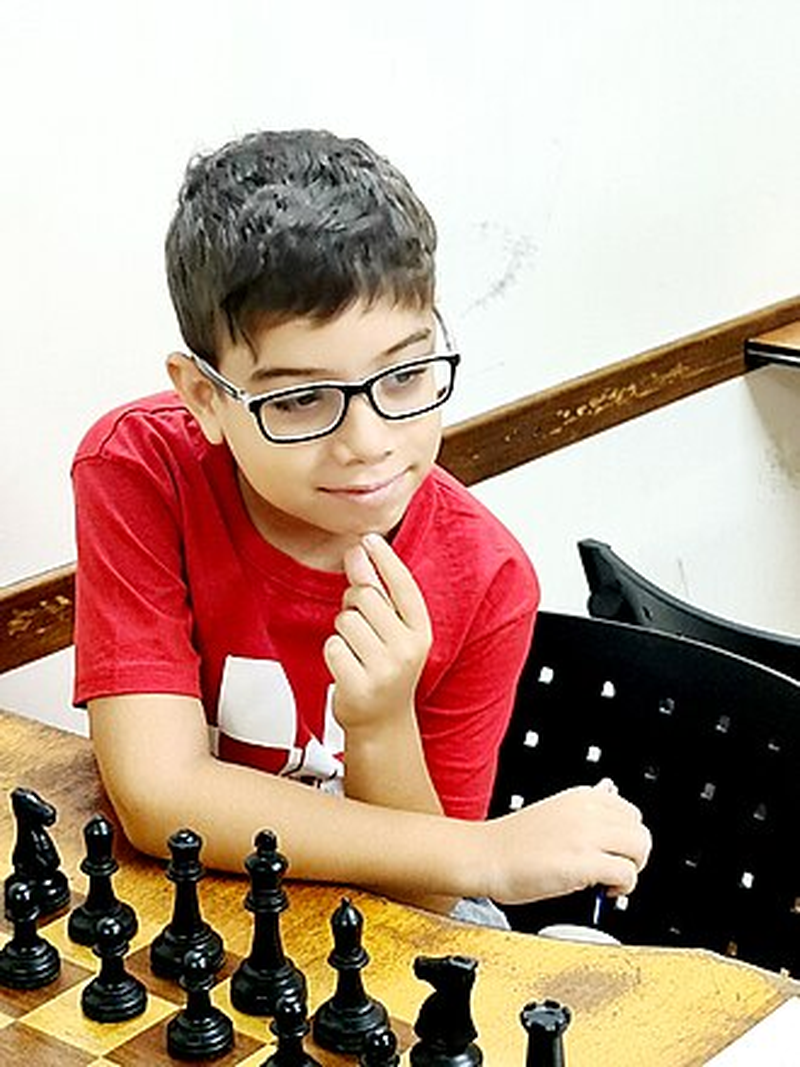
Born in Buenos Aires, 2013, Faustino Oro is only 10 years old, but his prize list is very impressive :
- Youngest Fide master at the age of 9
- Youngest International master at the age of 10 years, 8 months, and 16 days.
His tactical sharpness and knowledge in the openings are absolutely outstanding.
He beat in an online bullet game the best player of all time, Magnus Carlsen !
Of course, it was a 1 minute online game.
Of course, there were no high stakes.
But still, it’s a big performance by Oro, and it shows all his potential.
He also beat the current world number 5, Ian Nepomniatchi, but this time in a 3 minute game, so with more time, where more skill is needed to beat your opponent.
Recently, he even beat Hikaru, the best online player, in both blitz and bullet.
His chess.com rating in blitz (say july 2024) is 3055 which corresponds to the top 40 of the site.
Faustino Oro has five coaches that are helping him become the youngest world champion.
But Oro still has a long way to go to become world number one... It’s only the beginning of his journey :
Oro has achieved the international master title, but to become world champion, you need to first become a grandmaster and then defeat the strongest players in the world.
But I wish him all the luck to convert his talent into big achievements and hope that we will soon see him play against the greatest.
Mishra Abhimanyu
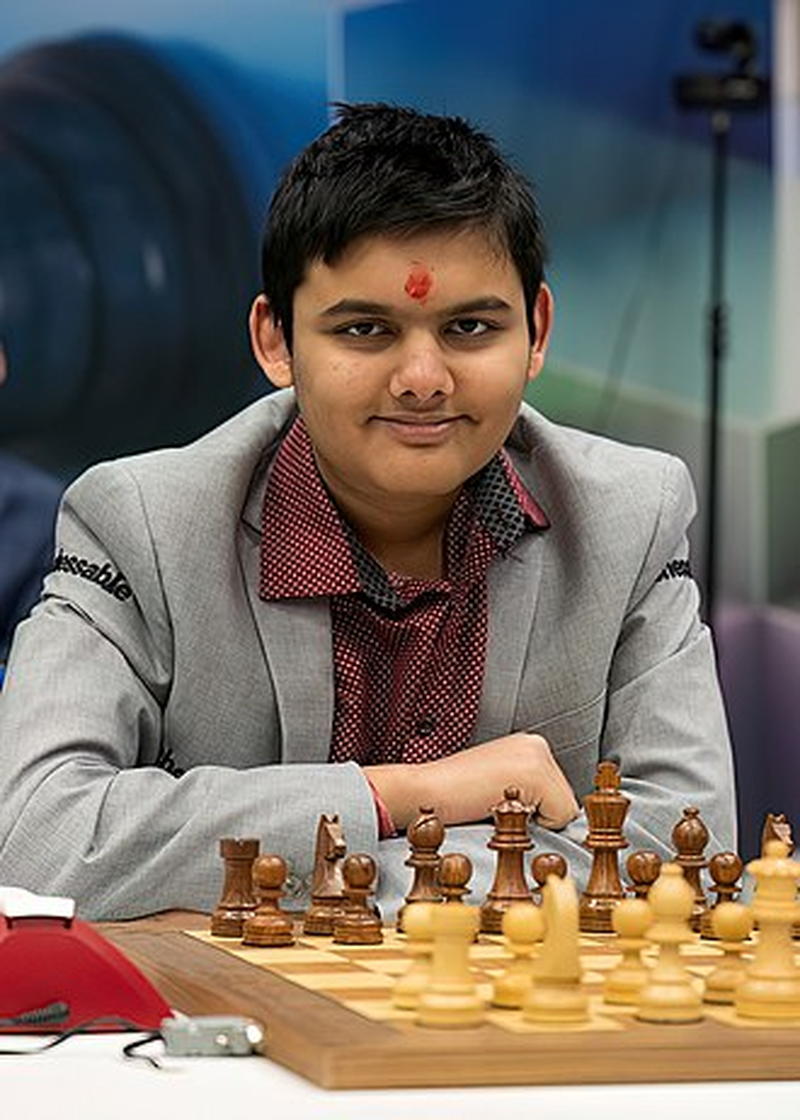
Mishra is an American chess player with Indian origins.
He was born in 2009 in New York and became the youngest grandmaster ever at the age of 12 years, 4 months, and 25 days.
Beating the previous record by over 2 months !
To become grandmaster, you not only have to reach 2500 elo, which corresponds to the top 600/700 in the world.
You also have to make 3 norms !!!
To gain one norm, you have to play a tournament in which you make a performance of 2600 elo points !
However, Mishra’s achievements have been criticized by some players because he played several months in eastern Europe to make his norms and gain points.
Why is this problematic ?
First of all, because of the sportive viewpoint :
The tournaments in eastern Europe are seen as a gold mine for making gm norms, and the opponents are often older grandmasters who are not very ambitious, which makes it easier to beat them.
Also, from a moral viewpoint, it can be criticized because he was somehow forced to play months in bad conditions just to beat this record. Just to remember, he was only 12.
He had to leave his country to play all the time chess.
But becoming world chess champion has a price, and your childhood is one of them.
In an interview, he conceded :
„I spend about 8 hours a day training chess. I like to work on my game, but it takes a long time to improve, which makes socializing difficult. It's all part of the chess adventure.“
But Mishra has quickly proven that he has the force of a gm as he achieved a peak rating of 2634 in May 2024.
He is probably one of the biggest talents in chess right now, but like Oro, he still has a long way to go.
The older generation
Now we get to put things into perspective :
In reality, the older generation also made wonders. I will now present you the greatest records and biggest talents of the older generation.
Magnus Carlsen
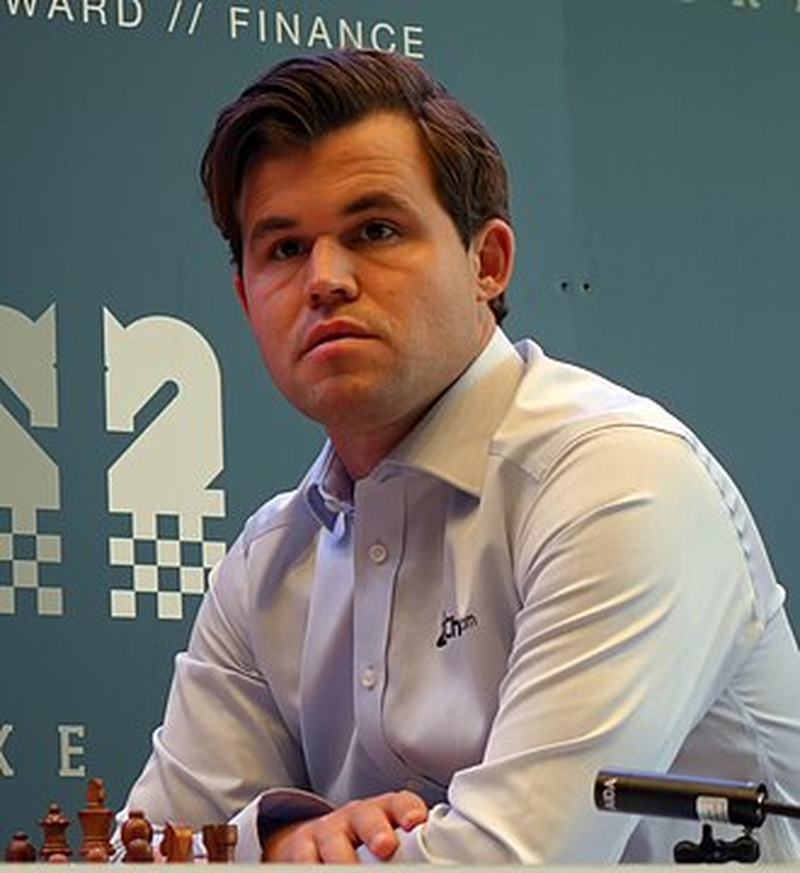
Players like Carlsen only appear once in a century. He’s truly by far the GOAT.
But he hasn’t had a lot of „precocity records“ like the youngest GM title.
Never the less, he managed some incredible performances.
In 2004 Carlsen was only 13 years old and was „still“ an IM but he was one of the best young players of his time.
This year in March, Magnus Carlsen had the luck to be invated in one of the strongest rapid tournaments of the year in Reykjavik, Iceland.
Here a few names of who participated :
- Garry Kasparov : former world champion but still in great shape and number one on the ranking list.
- Anatoly Karpov : also former world champion and chess legend.
- Nigel Short : one of the best players of his time.
And there was the little 13 year old Magnus Carlsen, a strong IM who was a few steps away from GM.
It was an over-the-board tournament with high stakes, not a one minute internet game...
Everyone thought that Magnus was going to get destroyed in this tournament...
I mean, of course, no one likes to win against children's, but no one wants to get humiliated...
Well, things not went as expected.
In the first round, Magnus is paired against Garry Kasparov, at this time, there was a 250-point difference between them, which is hudge at this level.
But Magnus Carlsen manages to get a draw against the best player of all time.
It was a sensation.
But Carlsen was not intending to stop there.
In the same tournament, he played against none other than Anatoly Karpov.
Karpov was the big favorite in the match, but Carlsen proved that he could be a danger.
Maybe he will be able to achieve another draw against a world champion at the age of 13 ?
After a tense game, Magnus Carlsen finally wins the game and proves that his generation is no joke.
A couple of days later, Magnus Carlsen became grandmaster at the age of 13 years, 4 months and 27 days. Just as a quick reminder, Mishra broke the record of Magnus by over a year, but he has not made such a performance.
I am going to introduce you to our last prodigy, but this time a player from the last century.
Bobby Fischer
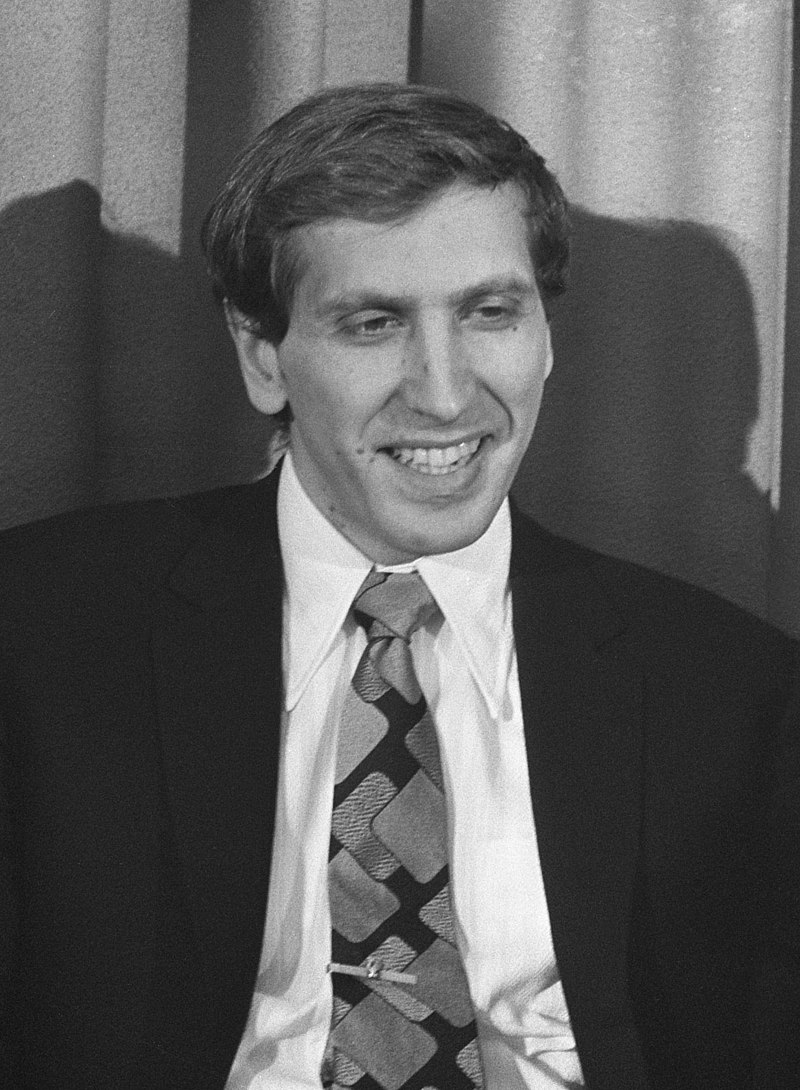
You probably already heard about Fischer, and if not, there are a lot of good documentary’s about him on youtube, but to make it short :
Bobby Fischer was born in Chicago in 1943, but spent most of his childhood/teenage years in New York.
At this time, chess was not popular in the US, but through very hard work and his whole life spent for chess, he managed to become world champion and defeat the soviet legacy.
And by the way, he eventually became anti-Semitic and was researched by the FBI.
But his biography deserves a full book.
In terms of records, Fischer has established a lot of them :
He became at the time the youngest grandmaster, at the age of 15 years, 6 months, and 1 day.
This might seem „ridiculous“ when you compare it to Mishra, but by his time, it was phenomenal.
A lot of Fischer’s records are still not beaten today.
For example, he is the youngest player ever to qualify and play the candidates.
The candidates is a tournament where the best chess players compete to get a chance to defeat the world champion in a match.
At the time, to get qualified for this tournament, Fischer had to play another tournament called „Interzonal“ in which the world elite participated. The first six of this tournament would then be allowed to play at the candidates.
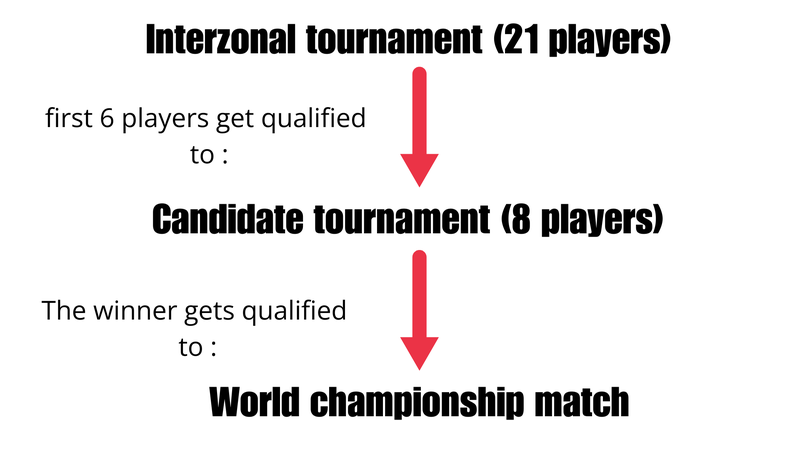
Yes, it is a very complicated system, but what do you think ? We are chess players after all.
So Fischer finished sixth in the interzonal tournament with 12 points out of 20 (6 wins, 2 losses, and 12 draws) and was therefore qualified for the candidates that took place in the same year.
Fischer finished fifth out of eight at the candidate tournament, which is an amazing performance in general and, moreover, for a 15 year old.
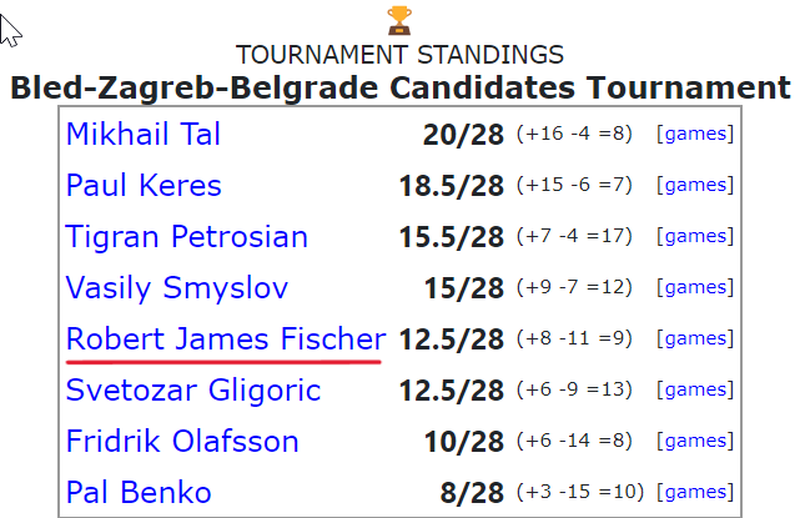
screenshot from : https://www.chessgames.com/
But if we look at the top 15 best ranked players in june 2024 in the world in classical chess we see that 5 players are under 22 years old.
And to see this phenomen at this high scale is something totally new.
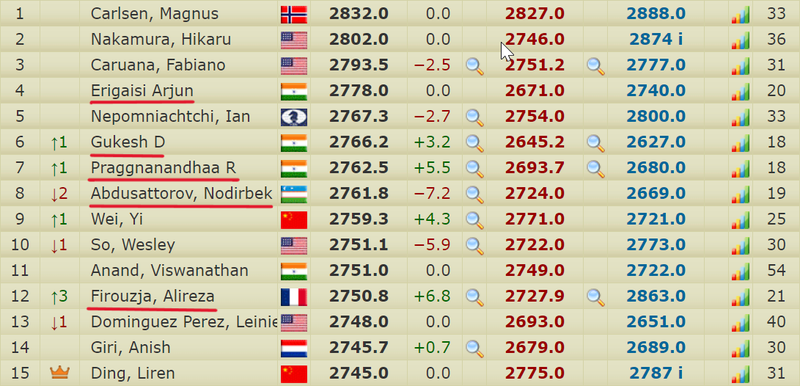
Screenshot from : https://2700chess.com/
Examples like Fischer or Carlsen were exeptions, but now we have players like Gukesh, Praggnanda, Firouzja who are all writing history.
But why is this new generation so strong ?
There is one main reason for this : the new technologies.
Nowadays, we all get tons of information on the internet.
The younger generation has played thousands of games online, which has given them a lot of experience.
At the time of Fischer or Kasparov, you could only play against the players of your town, not when you wanted or against who you wanted.
Now young players have the occasion to play the world’s best online.
The second reason is that chess has exponentially increased in popularity over the last few years.
Particularly in India.
They are investing millions in chess to form new prodigies.
They have the best coaches and structures to make new geniuses.
Now, thanks to sponsors, these young players can play everywhere and gain international competition experience, which was way harder back in the day .
With English becoming more and more an evidence for everyone, chess players can work together all over the world.
So it is not rare to see an Indian player train with a Russian coach or vice versa.
Back at Fischer’s time, players that lived outside of the Soviet Union, the global chess power at the time, had no way to access the majority of the chess material without speaking Russian.
That’s why most of the best players who didn’t speak Russian had to learn it.
But, of course, not everybody has the ability or the patience to learn a language.
Nowadays, thanks to globalization and the English language, you don’t need all this.
Just imagine Fischer’s strength if he would've at this time gotten access to all this information...
Conclusion
This generation is, of course, stronger than the last one, thanks to the chess engines that revolutionized the game of chess, but also thanks to globalization and the information that is now available everywhere.
Children’s can now play against masters on the internet and gain experience.
But there are always players that are just above and that are coming once a decade.
So even with all these new advantages of this generation, I am not sure if we will see another player like Magnus Carlsen in this decade.
Do you think that we will see a player like Magnus in this new generation ?
Write it in the comments down below.
And if you appreciated my article, make sure to smash the like and subscribe button, it helps me very much, as I am alone making all this work.
Thank you very much, and see you soon.
- ChessNews1
You may also like
 chessnews1
These chess records are CRAZY.
Millions of dollars,hours,tears just for one royal game, resumed in one blog. Live the craziest ches… Lichess