
Ondrej Supitar on Unsplash
Why most game reviews don't make you better
You finish your game, walk out of the hall and find a comfy chair to sit on. You open a chess app, turn the engine on and start entering the moves. You see the eval bar go up and down as you find inaccuracies in the opening, mistakes you made in the middlegame and a tactic you missed near the end, soon after which you made a blunder and lost. You knew you’d missed a win somewhere! You feel a little worse about yourself, close the app and move on. The next day, you’ve already forgotten most things about the game.
This is how most people review their games, and it’s exactly why all that reviewing isn’t helping you get better.
The three parts of learning from a game
Most people were never shown how to learn from their games. So they click through them quickly with the engine on and get information without direction.
It took me years to understand this difference: a mistake is not yet a lesson, and a lesson is not yet training.
- A mistake is what happened.
- A lesson is what it reveals about your chess.
- A training decision is what you’re going to do about it.
Most players stop at number one, some reach a vague version of the second and very few do the third consistently. That gap between what the game showed you and what you actually do about it is where real improvement either happens or doesn’t. Photo by Ondrej Supitar on Unsplash
Common mistakes
When players review a game and try to find a lesson, they often come to one of three conclusions. All three feel true, but none of them are specific enough to act on.
1. “I lost because I blundered.”
This is almost always true but almost never useful. Of course you blundered, everyone does. The question is what kind of blunder it was: Did you miss your opponent’s threat? Did you calculate one move too shallow? Did you rush a decision when you had time to think? Each of those is a different problem that needs different training.
“I blundered” doesn’t help you identify which one it was, so don’t stop at “I just need to blunder-check more.”
2. “I need to study the opening.”
This is another common reflex and often wrong. The opening is the easiest part of the game to blame because it seems to have a clear fix: just learn more theory. But the reason for your loss is often because you didn’t understand the resulting middlegame, misjudged a pawn structure or panicked when the position became unfamiliar.
So studying more opening theory only treats the symptom, while understanding positions treats the cause.
3. “I need to do more tactics.”
Tactics decide games. But “more tactics” isn’t usually specific enough to fix the real issue. If the problem was missing your opponent’s threat, you need threat-detection work rather than random puzzles. If the problem was miscalculating, you need to train calculation rather than pattern recognition. If you blundered in time pressure, that’s a different issue again.
“More tactics” can make you feel productive while ignoring the actual weakness.
What these three have in common is that they all feel like progress, but none of them is specific enough to train. So your training stays too random.
A better approach
Here’s what a better review looks like of one of my own games when my national rating was 1700.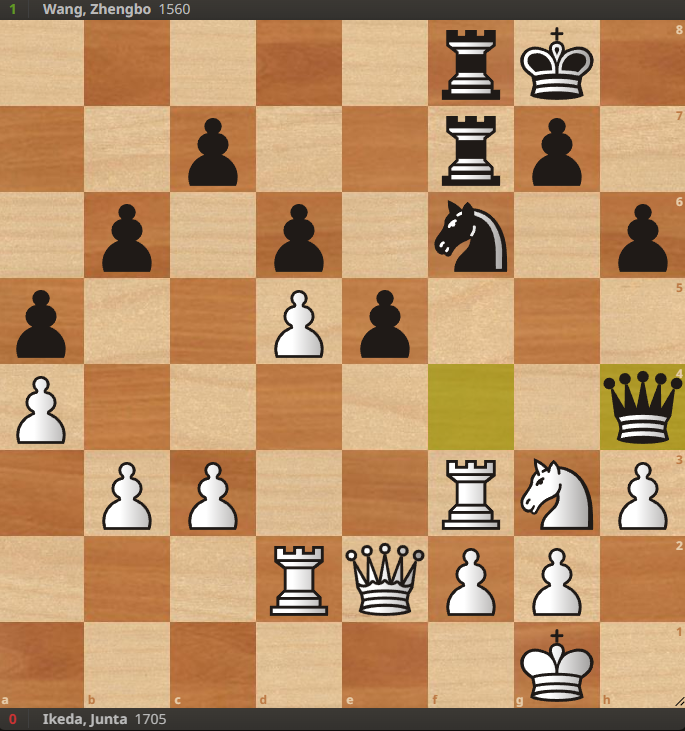
This middlegame looks fairly equal. Black has the half-open f-file with rooks doubled there but all of my pieces are on decent squares.
In the game, I played 29.Qc4 which was a positional blunder (oof, it hurts to look at). After the queens came off, I had long-term weaknesses in the form of a horrible pawn structure and my opponent converted the endgame with good play.
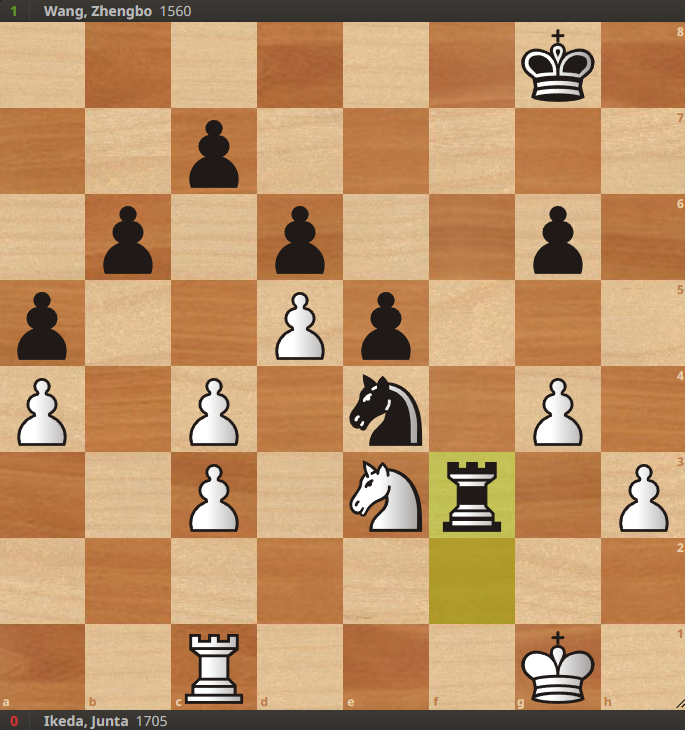
Instead of just turning the engine on and concluding that I blundered, I should ask myself: why did I play 29.Qc4? What was I thinking and what was I wrong about?
The answer was that I was worried about Black’s chances to attack on the kingside. I saw no way of actively changing the situation so I offered a queen swap to avoid being attacked, even though I’m left with horrible pawns. So I overestimated Black’s position and potential attack, and also underestimated how bad the endgame would be after 29...Qxc4 30.bxc4.
Better would have been to play a move like 29.Re3 which avoids getting hit by ...e4 as well as the potential pawn break ...g5-g4 and prepares Ne4 to alleviate the pressure.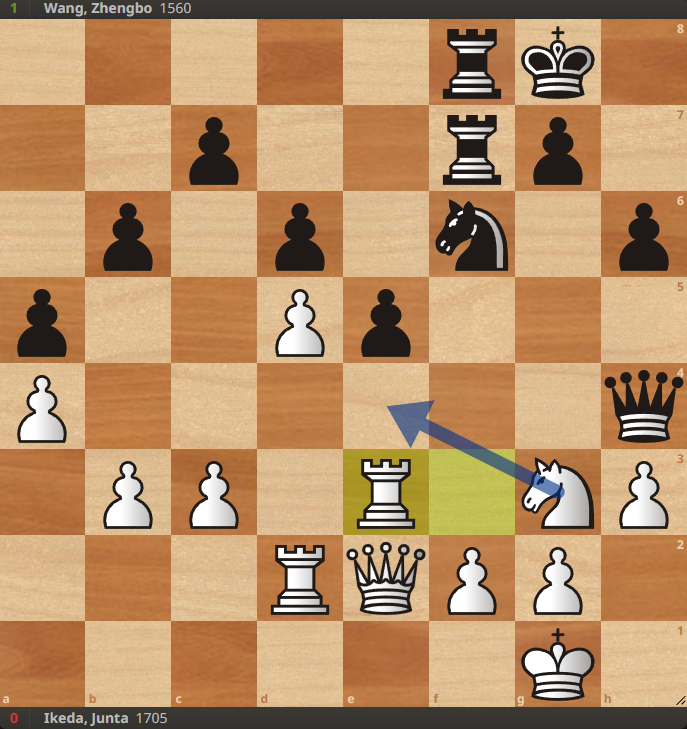 This is more specific than just saying ‘I need to stop blundering.’ I needed to ask myself what the scariest ideas from Black are and look for a healthy move that makes me better prepared for them without over-committing or worsening my position.
And from that lesson, the training becomes clear. You could play training games from this position with a training partner or an engine at the appropriate strength to see how things could have continued. That would give you a better feel and understanding for these positions where it’s hard to come up with active plans of your own. You can also study other games where you were in a similar situation or games by other players to see how they handled it.
The loop
So from one game you look at one mistake, take one specific lesson from it and find one clear thing to train.
That’s the feedback loop you want: mistake → lesson → training.
And even when a player does find a lesson, they usually let it slip away. They write down “I need to check my opponent’s threats more carefully,” feel good about the insight, then sit down for their next game where nothing has changed. The lesson stays in the game review.
So the loop has to go all the way. The lesson has to become a specific training decision, and that training has to become a focus you take into your next serious game or tournament. That’s what closes the loop and changes a dot of information into an arrow that takes you forward.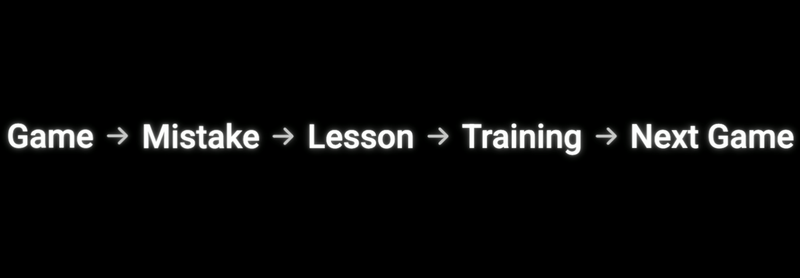 Finding one lesson from one game is something you can start doing today. But knowing how to review a game, turning each lesson into the right kind of training, carrying a focus into your next game and doing that consistently week after week is the hard part. Many players review one game properly, skip the next three and drift back to random puzzles and videos.
That’s the part that takes a system, and that system is what I’ve spent years building. I’ll be launching The 10-Habit Chess Improvement System in July. It’s a system with 10 connected habits that help you play with a clear head, learn from every game you play and build a training routine that fits your chess and your actual schedule.
If you join the waitlist (200 people have already joined), you’ll get 24 hours early access before it opens to everyone else. That means you’ll have an extra day to decide whether it’s right for you while the launch discount is still available.
Next steps
So after your next game, instead of turning the engine on, do this: go through it yourself and finish this sentence:
“This game showed me that I need to work on...”
If the sentence is vague, keep going until it becomes something you can actually train.
For example:
“I need to stop committing to the first move that comes to mind” → too vague.
“I need to come up with two or three candidate moves, compare them and decide on which one looks good for me and is most annoying for the opponent” → trainable.
That one sentence done properly is worth more than two hours of random study after a loss.
It might sound like finding the right training is the goal, but we’re doing more than that. The goal is to learn something new that helps you play better chess.
Education discovers an increasing richness in the past, because it sees what is unfinished there. Training regards the past as finished and the future as to be finished. Education leads towards a continuing self-discovery; training leads toward a final self-definition.
Training repeats a completed past in the future. Education continues an unfinished past into the future.
—James P. Carse, Finite and Infinite Games
You may also like
 IM datajunkie
40 Good (Enough) Moves
Why it can be helpful to lower the bar from 'good' to 'good enough' thibault
How I started building Lichess
I get this question sometimes. How did you decide to make a chess server? The truth is, I didn't. IM datajunkie
You’re studying chess openings the wrong way (do this instead)
If memorising opening lines made you stronger, many club players would be masters. IM datajunkie
Why your tactics aren’t improving
The 4 fixes that can help you become a tactician IM datajunkie
Igor Zaitsev's Attacking the Strongpoint
A philosophy of chess from a man who chose the shadows CM HGabor