
CoPilot
A Transitional Phase between Technical and Tactical Positions

I haven't had a chance to test the Classification Method introduced in December last year in a real tournament setting until now. I didn't have much time to practice last month, and there were some days in the weeks before the tournament when I didn't even look at chess. The algorithm had indeed made my play more consistent, and my results were quite good. But...
There was a single type of position which I couldn't quite classify using the algorithm. This made me spend a long time in these positions, but even then, I couldn't come up with the best plan in some of them. These are the transitional positions.
4T Classification
The initial classification was designed to identify the phase a player is in based on a few criteria. Simply put, if a player is engaging in a series of forced moves or mass simplifications, they are in a Tactical phase. If a player is playing out a known theoretical scheme in the opening or in a theoretical endgame, then he is in a Theoretical phase. When a player is in none of these phases, they are in a Technical phase. Improvement of piece placement and fixing defects is done in this phase.
The 4th T comes at the end of a technical phase. When a player decides that his pieces are well placed to engage and that his position is free of exploitable defects, he should try to enter a tactical phase by forcing the issue. Moreover, when a player has a static disadvantage, or when the opponent can improve the placement of their pieces faster, they should also try to enter a tactical phase by complicating matters (after improving their own pieces). In these instances where a player tries to enter a tactical phase from a technical phase, they are said to be in a Transitional phase.
Transitional phase
A player can be in a transitional phase for only a short period of time. After that, he either enters the tactical phase or falls back to the technical phase. A player in a transitional phase should try to create threats to get his opponent to make concessions, such as piece trades or pawn pushes. Then they should try to force the issue by one of the following methods.
- Pawn breaks
- Infiltration
- Sacrifice/Simplification
It is important to see these concepts in practice to understand them better. The method suited for each transitional position has to be judged by intuition or logic. Analysing games played by computers or grandmasters can help in this matter.
In practice
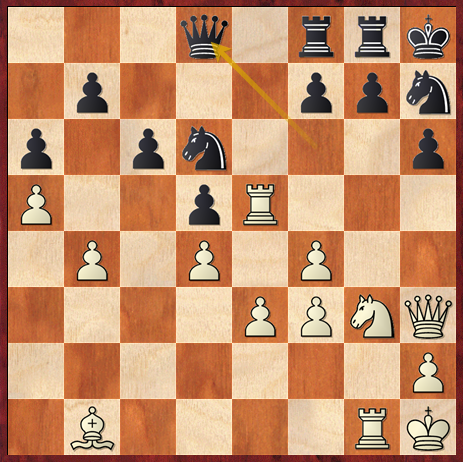
White has a beautifully placed bishop on b1, the rook on g1 is on a semi-open file, the e5 rook is a little exposed, but it can always go to h4 and be safe. The queen is eying the h6 pawn and is constantly creating threats. The knight can always go to h5 and join the attack.
So white's pieces are well placed, and his pawn structure is good. The doubled pawns aren't weak as they are not exploitable. It can be concluded that white is in a transitional phase.
Let's first look at pawn breaks. There is the pawn break e4, but it doesn't make sense to block the bishop while weakening d4 and f4. Moreover, white's pieces are placed better for a flank aggression, so e4 wouldn't be ideal, though it is still not a bad idea. There aren't any effective infiltration spots. A sacrifice might be possible on g7 or h6 after the knight gets to h5. But for it to be successful, white first needs to prepare himself by putting the rook on h4.
1. Rh5 Qf6 2. Rh4 Rd8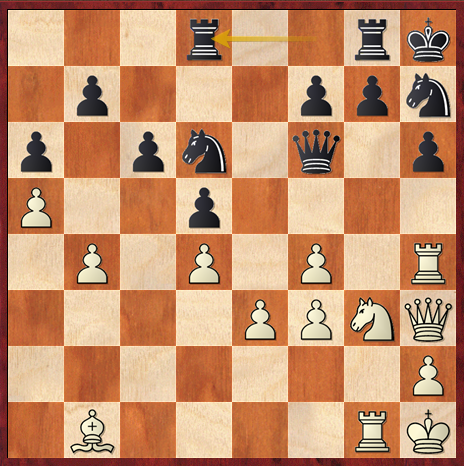
Now the rook is placed on the correct square. It's time to go for the sacrifice with Nh5. With the placement of the black queen, the move also creates a direct threat against the queen. This forces black to make a concession and open up an infiltration spot on g6.
3. Nh5 Qe6 4. Qxe6 fxe6
In the event of 3...Qe7, the sacrifice would have come into effect after 4.Bxh7 Kxh7 5.Nxg7
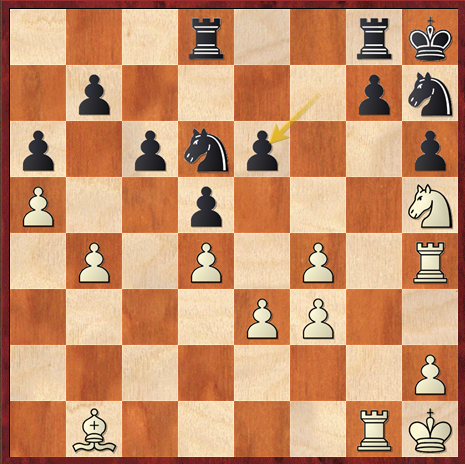
Now white creates another threat, forcing the black pieces into passivity, and infiltrates via the g6 square to win the pawn on e6. White eventually won the game after a long fight.
4. Rhg4 Ne8 5. Bxh7 Kxh7 6. Rg6 Rd7 7.Rxe6... 1-0
Effect on the type classification
Including 4 Ts as opposed to 3 does not make a huge difference for the type classification. When both players enter a transitional phase, the position should be classified as critical. The convention that the position is critical when players are in different phases still holds, with only the above exception. Players enter a transitional phase when a phase change is required, so it was kind of already known that the position is critical in a transitional phase. But because the positions where the phase change occurs are not that sharp, the initial classification didn't consider it to be tactical, which meant that it wouldn't consider the position to be critical even when it is. But now, with the introduction of the 4th T, this flaw is fixed.
Conclusion
The 4T classification is the best classification I have come up with so far, and anyone looking to try it out themselves won't be disappointed. In my opinion, it drastically reduces the effect of unstable intuition and gives room to analyse our mistakes on a deeper level. Only time will tell how effective it can be made to be. But as of now, it is clear that this classification is a useful tool for any aspiring chess player. I hope you learned something valuable today and that this was worth your time. Stay curious and keep exploring!
You may also like
 FM felew699
A Positional Checklist
The 3-question method of solving positional problems FM MathiCasa
Chess Football: A Fun and Creative Variant
Where chess pieces become "players" and the traditional chessboard turns into a soccer field GM DrAgnevstein
What I learned playing against world-class players
Over the years I had the chance to play many games against world-class players and even multiple wor… GM Avetik_ChessMood
10 Things to Give Up to Enjoy Chess Fully
Discover how embracing a lighter mindset can help you enjoy chess again and achieve better results. FM felew699
A Modern Classification of Chess Positions
A perspective on chess as a whole and a modern way of classifying positions for the ease of interpre… thibault