
Analyzing blitz ELO inflation among major chess websites
A statistical review and in-depth analysis of inflation in blitz ratings within the two largest online chess sites
I've been asked a hundred times too many about my rating on chess.com and Lichess by random beginners. When I proudly announce my hard-earned 2400 rapid, they immediately start asking me if I'm a GM. They all seem to share that same disappointed look on their faces when I burst their bubble and tell them that I'm not even close.
All these mini-conversations have raised a curiosity within me about what online ratings actually translate to in real life. In a perfect, boring ELO world, a 2400 online ELO would equal a 2400 FIDE rating, and I would be a happy IM. But this is far from a perfect ELO world—and this is mainly because of inflation.
What is rating inflation?
Rating inflation is the "devaluation" of rating points. Basically, it's a ballooning of numerical rating that does not accurately reflect a chess player's strength.
Let's take my aforementioned online rapid ELO of 2400 as an example. My rapid rating on Lichess is 2400. However, I'd be squashed by a real 2400 in a matter of seconds, and my real level lies closer to 1900 FIDE. Therefore, my Lichess rating is inflated 500 ELO beyond my skill level.
This process has occurred to a major extent throughout the online chess world, and that extent is exactly what I'm going to analyze in this blog.
Procedure/methodology
I will be using blitz data/ratings for my study on online websites, as it is the most consistently played among masters over both online and face-to-face. I would really love to use Rapid as a comparison for classical, but masters simply don't play the time control as much.
I will also be using FIDE blitz ratings as the base blitz "skill level" for a player, as FIDE ELO is the most objective/standard rating.
There are seven main steps I took to calculate and analyze rating inflation for chess.com and Lichess. If you're a statistician or good with math/data, please tell me if I did anything wrong.
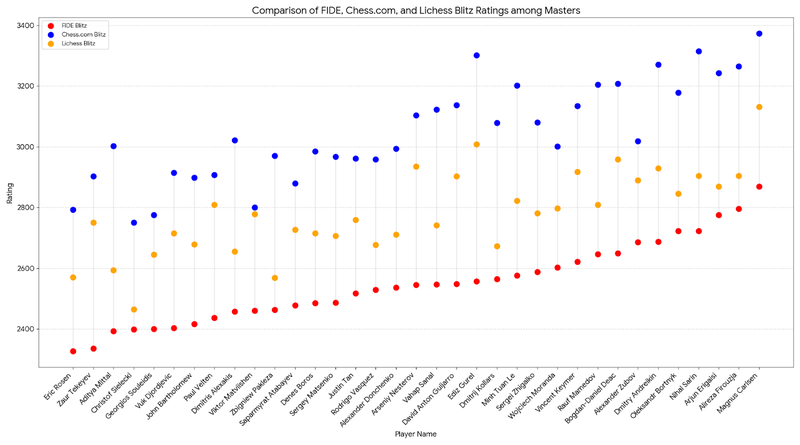
- Fetched blitz rating data for a selection of 35 masters with Lichess/chess.com accounts with roughly 1000 or more blitz games on either site. I made sure to leave out accounts not active in the past 3-4 years.
- Calculated differences between FIDE and Lichess/chess.com ratings (Website - FIDE = difference).
- Averaged these 35 differences to get a mean inflation value (MIV).
- Calculated standard deviation (SD) based on all collected data account for outliers and extremes.
- Calculated coefficient of volatility (CV) as a percentage using the formula SD ÷ MIV. The higher the CV percentage is, the more volatile the data set is.
- Calculated mean absolute deviation (MAD) to determine the average distance of each data point from the MIV.
- Analyzed and compared results.
I may do a more extensive study of inflation in the near future with many more data sets, master players, and ratings to come, but as this is my first rodeo with research, I kept the data set relatively concise.
Rating inflation within chess.com and Lichess, calculated and crunched
Tables & charts
| Website | Mean Inflation Value | S.D. | C.V. | M.A.D. |
|---|---|---|---|---|
| Chess.com | +499.6 | 88.1 | 17.6% | 67.4 |
| Lichess | +231.9 | 93.6 | 40.6% | 72.4 |
What conclusions can we derive from this data?
There's one main thing I'm sure all of us have noticed—chess.com consistently experiences higher rating inflation in blitz, with an MIV over 250 points higher than that of Lichess. However, it's important to try to analyze the "why" of this inflation, and after thinking and researching about this exact question for a bit too long, I think I've reached a conclusion.
Higher blitz rating inflation on chess.com can be attributed to two main factors: the website's much larger player base and its different systemic approach to calculating ELO.
Let's begin with the player base, which I believe is the main factor in this disparity. Chess.com attracts many more members than Lichess, and a vast majority of these members are casuals or beginners. These hordes of beginners feed tons of ELO to intermediates, who then pass it on to a small population of advanced players. All of this rating flows to the master level through a massive ELO food chain at an almost constant rate due to the sheer number of games going on at any given time, resulting in a tiny but extraordinarily highly rated blitz elite.
There's also another secondary factor that helps create this ELO gap: chess.com's different rating calculation engine. Chess.com uses Glicko; meanwhile, Lichess uses Glicko-2. These engines are similar in that they both track rating and rating deviation (RD), where this deviation rises with a player's inactivity and decreases with play. However, Glicko-2 has one key difference from Glicko; it also accounts for volatility. Volatility measures how erratically a player's rating has been changing. An improving or inconsistent player will have high volatility, and this high value translates to extreme rating gains and losses until the player's rating eventually stabilizes. Meanwhile, a consistent player will have low volatility, experiencing less rating change per match while reducing drastic ELO growth based on individual games. In practice, this makes Lichess's player ratings more accurate and controlled than those of chess.com.
Why does rating inflation even happen in the first place?
Behind this comparison lies a more interesting and foundational question—what the root cause of ELO inflation really is.
Inflation basically happens when rating points enter a pool without any form of exit. This may be a little difficult to visualize, so let me paint a picture of what this process often looks like.
A new player watches a couple of GothamChess videos and chooses to join chess.com, thinking he will easily pick up the game. He begins as a 1200, loses a couple dozen games, drops down to 800 ELO, and then indefinitely quits chess out of rage. The 400 ELO that player lost is now permanently in the chess ecosystem with no way back out.
This entrance-without-exit can happen once, twice, or even a hundred times with little effect on the overall player pool. Multiply this process by tens of thousands of beginners, however, and you have a continuous influx of rating eventually leading up to the highest level, thereby resulting in large-scale inflation. As I mentioned before, this rating injection is accelerated by a larger player base, hence the higher rates of inflation on more popular websites.
It is noteworthy that FIDE ratings have inflated considerably over time, too. As more players became attracted to chess and joined FIDE both due to chess's overall growth and the organization's changing rating policy, this same churn of upwards ELO flow has risen significantly over the last few decades, leading to a similar inflationary result.
This is demonstrated in the amount of 2700s worldwide. Five or six decades ago, long before my existence was even an idea, reaching 2700 made someone a top 10 global player or even a contender for the best in the world. Today, however, 2700-rated players are considerably higher in number, and although they are world class players in their own regard, their relative "power" is nowhere close to that of 2700s in the past.
Thanks for reading, and hope you found this post helpful or insightful!
You may also like
 flash3s
How chess engines can mislead you (and how you should stop falling for it)
One misleading thing engines tend to tell and how you can see through it ChessMonitor_Stats
Where do Grandmasters play Chess? - Lichess vs. Chess.com
This is the first large-scale analysis of Grandmaster activity across Chess.com and Lichess from 200… TotalNoob69
The REAL value of chess pieces
... according to Stockfish flash3s
How you can stop sucking at KOTH
A comprehensive guide on improving your KOTH game CM HGabor
How titled players lie to you
This post is a word of warning for the average club player. As the chess world is becoming increasin… flash3s