
https://commons.wikimedia.org/wiki/File:DGT_2010_digital_chess_clock.ajb.jpg
45+45 is a bad time control
A discussion of time controls for chess games
The point of this post is to argue that a time control like 45+45 is a poor compromise between game quality and duration. In fact the argument makes itself once you look at some simple mathematical analysis. It's more of an observation really.
I will take as axiomatic that a clock is necessary: without one, a player can simply stall indefinitely. I also consider it self-evident that the use of a non-zero increment in any reasonably serious game improves play quality by reducing the incidence of extreme time pressure and flagging. Of course people can still get in time trouble with an increment but it's less extreme. If you haven't experienced this, try playing a bit of G/60 (no increment) and see what happens when you have a long complex game.
For the sake of simplicity, I'll assume the game configuration is just a single time control with an initial base time (I'll express this in minutes) and increment (in seconds) starting from the first move. I know some pro matches have something more complex - the last FIDE WC match was 40 moves in 120 mins with zero increment, then 30 mins and 30s increment for the rest of the game - but that sort of thing is vanishingly rare at the amateur level and sites like lichess don't even support it.
For any meaningful nonzero increment, game duration is pretty much theoretically unbounded. I think an upper limit on moves has been calculated at around 8000 moves, if we have even a 10s increment then this would add up to over 40 hours. Clearly, we cannot give a strict mathematical guarantee of a game finishing in any reasonable time. We can only give a probability, which we can make higher or lower according to taste. Analysis of game databases generally finds a median game length of about 35 moves, lots of games are roughly in the 30-40 move range but a small proportion go beyond 60 and even 80 moves. I think my games are typically a bit longer than most, in my case looking at my lichess stats, I've had about 10% of my serious games go over 60 moves and 3% over 80 but none reached 100. The longest games in the 4545 league exceeded 150 moves (and more than 5h of clock time) and the longest recorded FIDE game seems to be about 270 moves.
Here's a table of how total game duration varies with time control and number of moves. And a line graph for those who prefer pictures. A large proportion of games are described by the first two columns of results (30 and 40 moves), and very few go significantly past the third column representing 60 move games. However in any large sample there will be some going past the last column for 150 moves.
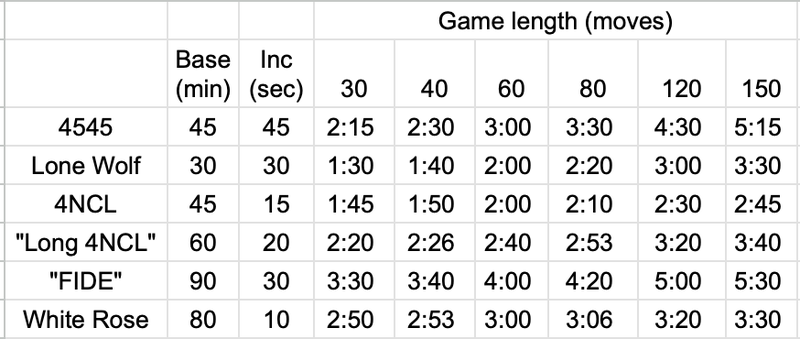
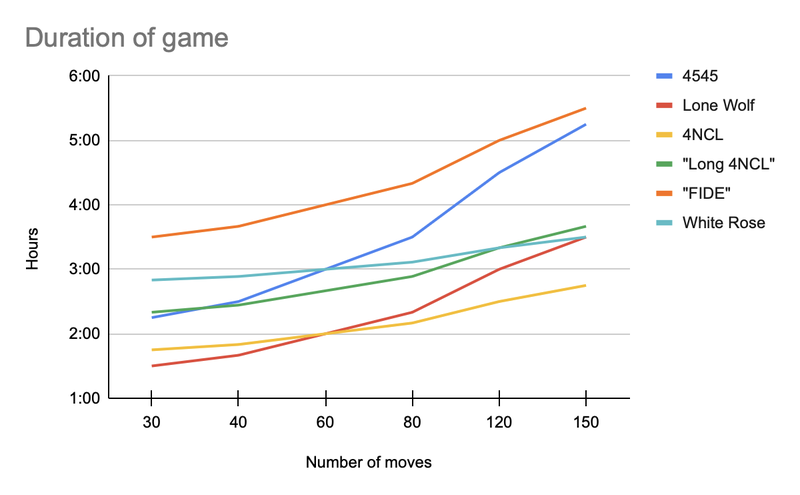
Most of the time control labels are pretty self-explanatory (I picked a fairly generic FIDE time control that's used in both pro and amateur competitions), but White Rose is a bit of a special case of OTB tournaments local to me in Yorkshire. The particular constraint here is that they fit a 5-round Swiss into a weekend without the awkward Friday evening session, so that means 3 rounds on Saturday with games starting at intervals of 3h30mins (times of 0930,1300 and 1630). Clearly game duration has to be very tightly limited to keep the schedule. In practice you get the odd game going to 3h5 or 3h10 (including one of mine) but there is very little chance of any over-run past 3h30, especially as that requires half an hour of play on a 10s increment. Yes, this does make the end of the game a bit of a time scramble, but the alternative of a slower finish would just not enable the tournament of this form to run at all. I find it a very attractive compromise compared to the old tradition of playing the first round late on Friday night with the extra travel/hotel costs etc that this implies. "Long 4NCL" 60+20 is something I just invented as a hypothetical alternative for those who think the 4NCL standard of 45+15 is a bit too short for serious chess. Note that it gives essentially the same duration as 45+45 for the large number of games in the 30-40 move range, it's just a bit snappier for 60 moves that few games exceed. However when you go out to the observed range of 150 move games, there's a stark difference. By the way, one likely reason for 4NCL using a 45+15 time control is that ECF rating rules define "classical" to be any game with a duration of at least 60 mins for 60 moves. So 60+0, 45+15, 30+30 are all possible lower limits for that. It's a good format for weekday evenings when a 2h game slot starting at 19:30 is quite reasonably achievable for many people. Obviously Lone Wolf is very similar duration for most games, but again these run out to very long games occasionally with (I think) some games exceeding 3h. That just doesn't happen in the 4NCL.
No-one goes into a 4545 game expecting to play for 5h and very few would have scheduled their game with such a duration in mind. In fact the official documentation recommends planning for a 3h game, ie 60 moves, which is a reasonable expectation of a likely game limit. Similarly, Lone Wolf recommends allowing 2h - again, that's the limit for a 60 move game. When scheduling across time zones and around other life constraints it's obviously ridiculous to expect people to only agree to play if they can both guarantee a 5h time slot. Therefore, when such games do take place, it's likely that at least one of the competitors will have to terminate the game unnaturally anyway - ie try to agree a draw and otherwise just resign regardless of board position. In fact I'm sure that such events must have happened rather more frequently in the 4545 league than the two games in the database that actually did go past 150 moves/5h. I don't think anyone can reasonably argue that such an arbitrary outcome determined by external factors is superior to having a tighter clock constraint that generates a result on the board. As for whether 20s is adequate increment for long games, once you consider that moving for online games is just the click of a mouse with no need to physically move pieces and write down moves it's pretty similar to the 30s FIDE standard for OTB chess where clock pressing and move recording is also required on top of actually making the move on the board. My own experience of playing on 10s increment in the White Rose competitions and 15s for 4NCL is that such increments are completely fine for playing out most endgames but you don't want to go there early in a complex middlegame. Well sure, but that's a time management issue rather than a time control issue.
So that's really the point. 4545 gives a game duration of about 2h30-3h for a large majority of games, sufficient for a quality classical game...but also allows for extreme outliers that are far longer than anyone can reasonably be expected to plan for - in which case an arbitrary and unsatisfactory termination is a likely result. An alternative of 60+20 would give essentially the same duration for a large majority of games - virtually identical for 30-40 moves, slightly shorter for a long game of 60 or 80 moves - but also massively reduce the likelihood of the absurdly long games that sometimes crop up. In order to exceed 5 hours (which as I said has been seen twice in 4545 over the years) a 60+20 game would have to exceed the longest ever FIDE-recorded game of 270 moves. Not impossible, but obviously much rarer than is currently the case.
You may also like
 jdannan
Yorkshire U1850 chess: the final!
Would we win or fall at the final hurdle? Read on to find out! jdannan
A pair of OTB Yorkshire games
A bonus blog to cover some recent OTB chess matches CM HGabor
How titled players lie to you
This post is a word of warning for the average club player. As the chess world is becoming increasin… thibault
How I started building Lichess
I get this question sometimes. How did you decide to make a chess server? The truth is, I didn't. Lichess
Lichess: End of Year Update 2025
Is it just us, or has this year flown by? As we say goodbye to 2025 and enter 2026, let's look back … ChessMonitor_Stats