
How to Win the Candidates Tournament
Looking at all previews editions of the current Candidates format to find out what separates the winner from the runner-upNow that the Candidates is less than a week away, I thought that it would be interesting to look at past Candidates tournaments and see if there are any trends that separate the eventual winner from the rest of the field.
I looked at all Candidates tournaments since 2013, as this was the first time the current 8-player, double round robin format was used.
Final result
For me, the most immediate question is what separates the eventual winner of the tournament from the runner-up.
Of the 7 Candidates with this format, 4 were won with 8.5 out of 14 points (+3), 2 were won with 9/14 (by Caruana in 2018 and Gukesh in 2024), and in 2022, Nepomniachtchi won with 9.5/14 (which was also the only tournament won with a margin bigger than 1 point). So we can expect the winner to score +3 or +4 (8.5 or 9 out of 14) in the event.
What I found more interesting was comparing the average score of the winners after each round to the scores of the players with the best tournament ranking at that round.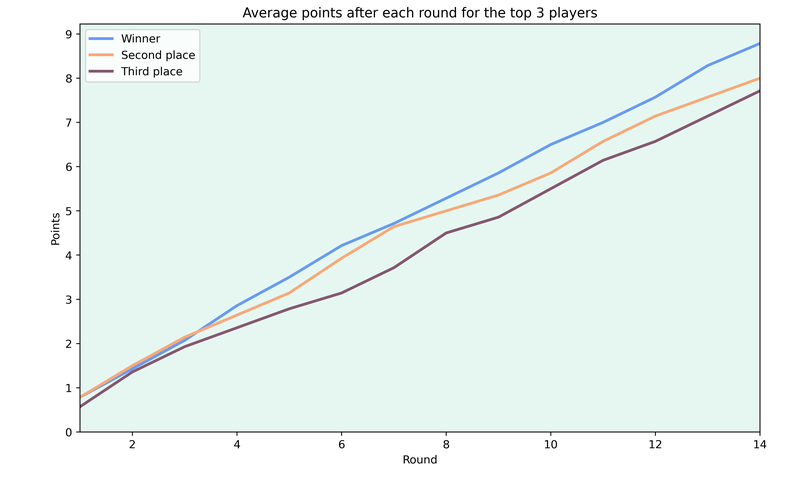
The early rounds are obviously very tight between the top 3 players, before there are only 2 players at the top after round 4. But the eventual winner separates from his closest competitor around the halfway point of the tournament
Of course, this is just an average, there have been fights for the win until the final round (the best example is 2013), and also dominating performances, as we’ve seen in 2022.
We can also see how the dynamic of the tournament changes as it goes on, by looking at the results in every round.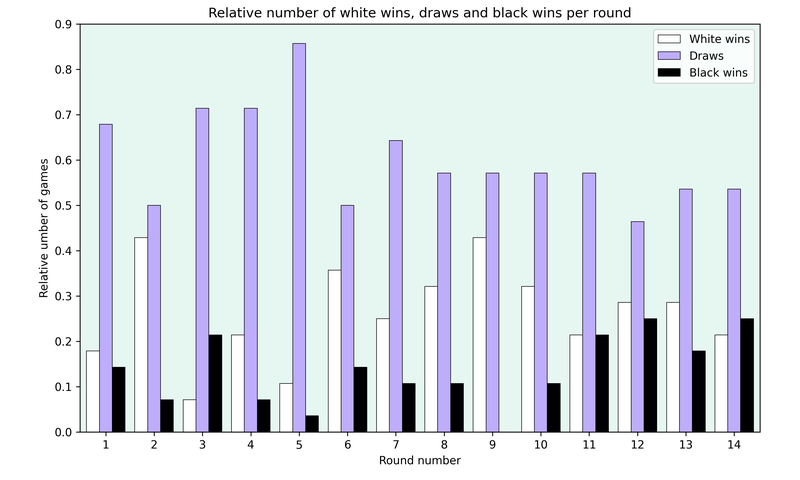
In general, it looks like there are more decisive games towards the end of the tournament, especially wins with the black pieces become more common. This is probably because players get tired and also need to take more risks to stay in contention for first place.
It’s interesting to see that there are so few decisive games in the fifth round. I briefly looked at the schedules of these tournaments to see if there is usually a rest day before or after this round. However, rest days were before round 4 and after round 6, so I don’t think that the schedule is the reason for this. Maybe it’s just random variation in the data.
One fun fact I noticed is that black has never won a game in the 9th round of the Candidates so far.
To get a better understanding of how the players end up with their scores, I also wanted to see the results of the players grouped by the final tournament standing.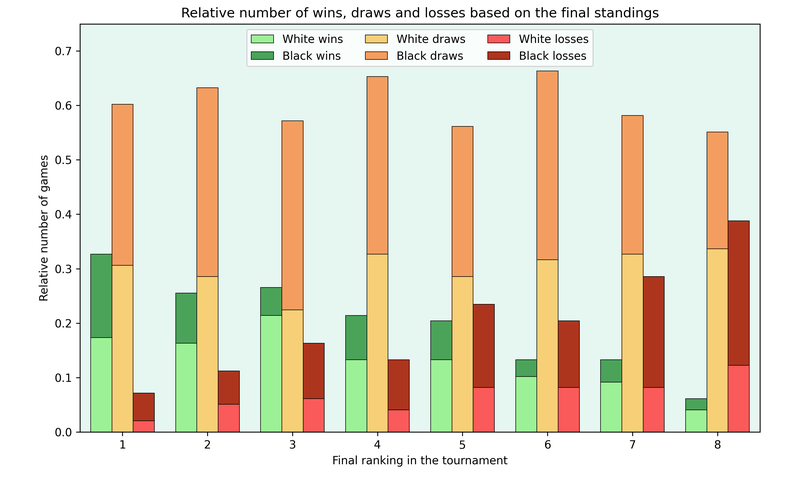
Of course, the winner of the tournament also wins more of his games. But I found it especially interesting that the difference to second place mostly came from wins with black. Similarly, while first and second place lose about the same number of games with black, the eventual winner loses fewer games with the white pieces.
Results against different seeds
When previewing the Candidates tournament, people often talk about targeting the weakest player in the field. One example of this is Gukesh, who was the only player to win both his games against the bottom seed in 2024.
So I wanted to see how the top 3 players scored against the different seeds in the tournament.
There are two different ways to group the opponents: one can either use the rating of the players before the tournament or by the final standings in the tournament.
Let’s start by looking at the points scored by the top 3 finishers against players ranked on their rating.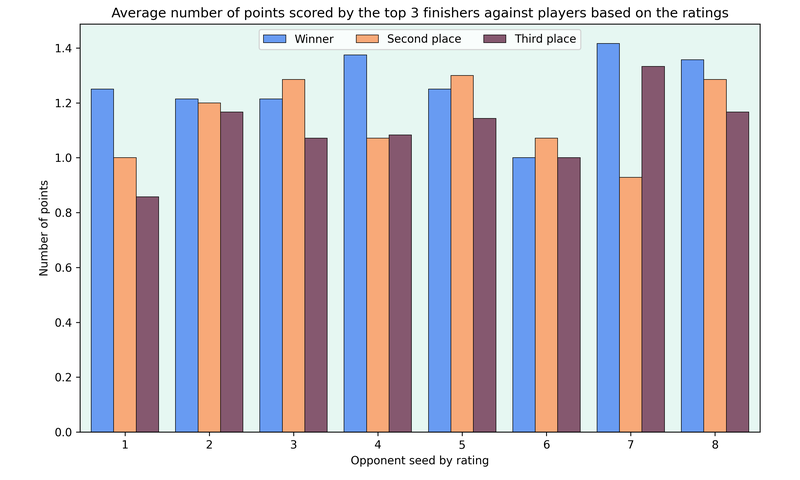
The biggest differences are the games played against the top and bottom seeds. In these games, the eventual winner performs better than second place, who in turn performs better than third place.
The results against seeds in between seem more random. There are no clear trends and also some outliers, like the poor performance of the runner-up against the second-lowest seed (this is partly because Nakamura lost both his games against Vidit in the last Candidates).
The score against players based on their final standing in the tournament shows a slightly larger trend.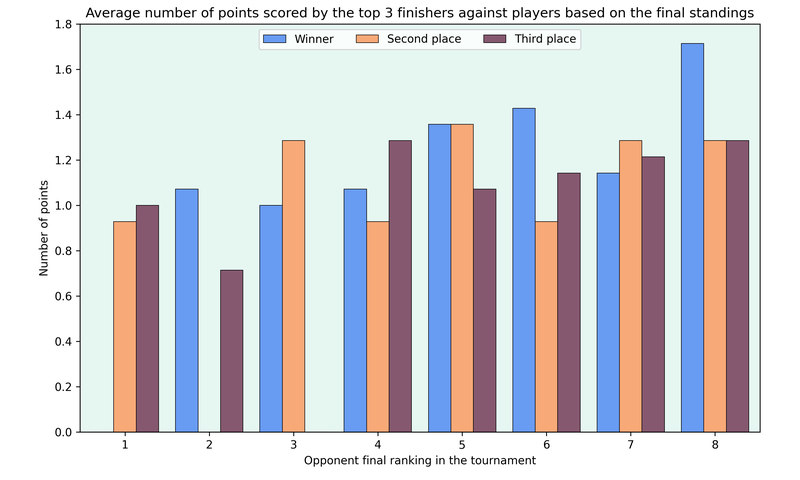
First of all, note that some bars are missing since we are now looking at the score against players ranked by their finishing position, so the eventual winner never plays against the first player on the x-axis.
The results against the top 4 are a bit of a mixed bag, but the eventual winner scores very well against the bottom half of the field. Especially against last place, the winner scores on average over 1.7 points out of 2, while second and third place score around 1.3 points, which is a big difference in a round-robin tournament.
Engine analysis
Apart from analysing the results of the games, I also wanted to take a closer look at the games with the engine.
Looking at the overall accuracy didn’t reveal anything interesting. All players played at an exceptionally high accuracy, since all players are preparing a lot for the tournament. But this also means that the difference in accuracy between first and last place is around 2-3 points.
But another thing I’m always interested in is seeing how well players are using their chances.
To do this, I compared the number of games where players got a better position (which I defined to be at an evaluation of +1 or more) to the number of wins. Similarly, I also looked at the number of games where players ended up in worse positions and at the number of losses, to see how many bad games the players could save.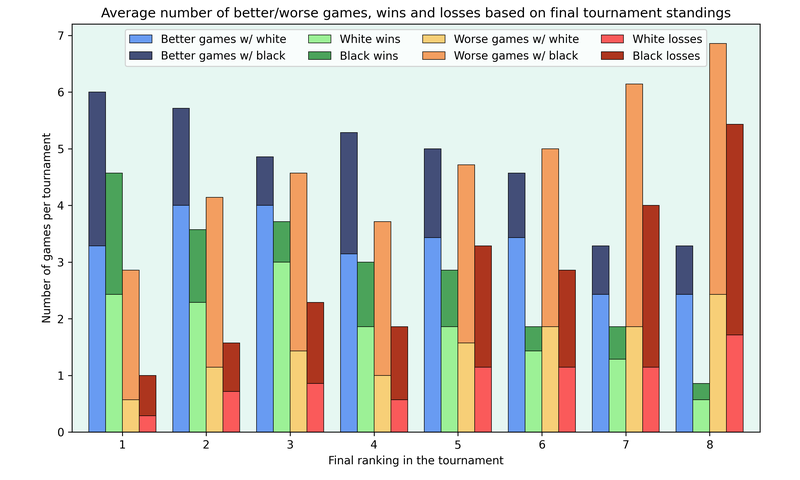
One can see that the eventual winner of the tournament reaches more good positions with black compared to the second place, and is generally better at converting promising positions into wins.
The other clear difference is that while first and second place both save around one-third of their bad positions, the eventual winner ends up in fewer bad positions, especially with the white pieces, which leads to fewer lost games overall.
Final thoughts
I really enjoyed looking at the data of past Candidates tournaments and looking for trends that separate the winner from the rest of the field. Let me know if there is anything else you’d like to see about the past tournaments.
I’ll also do a preview for the upcoming Candidates and will follow the tournament closely. If you want to follow along, check out my Substack.
You may also like
 thibault
How I started building Lichess
I get this question sometimes. How did you decide to make a chess server? The truth is, I didn't. CM HGabor
How titled players lie to you
This post is a word of warning for the average club player. As the chess world is becoming increasin… ChessMonitor_Stats
Where do Grandmasters play Chess? - Lichess vs. Chess.com
This is the first large-scale analysis of Grandmaster activity across Chess.com and Lichess from 200… jk_182
Predicting the Winner of Tournaments
Using game predictions to predict the outcome of a tournament FM MathiCasa
Chess Football: A Fun and Creative Variant
Where chess pieces become "players" and the traditional chessboard turns into a soccer field jk_182