
Aleksandar Randjelovic, Bad Bishop Chess Channel
When The Engine Makes You Worse At Chess

Not because the engines aren't useful, but because many players start using them before they actually understand what they are looking at. The evaluation bar slowly becomes more important than the position itself.
When the eval-bar takes over
"But the engine says -0.5!" - every coach who allowed the engine to be on in an online lesson has heard these words at least a couple of times in their career.
Trust is undermined and spontaneity ruined. Instead, the rigidness and robotic precision is in. From now on you can't just put pieces on one half of the board to explain the core idea in the plainest possible way. The engine can't evaluate it, therefore you may be wrong. Who knows what else wrong you have said so far in your previous lessons.
Especially in the openings, where you show only typical pawn structures, pawn breaks, possible pawn storms and ways of maneuvering pieces. "You show moves of one side, while the other is only playing something suboptimal", they say. It doesn't matter if you explain that the position serves only to demonstrate one side's main ideas. The engine saw a better move for the opponent, and suddenly Black is half a pawn better.

This is the true problem for a coach, and in my personal case - the deal breaker.
I lose confidence, and get completely confused. Cause it feels like I suddenly play against the strongest engine in the world. The point of the lesson becomes secondary. The first priority is now satisfying the evaluation bar. In the end, there is no joy in coaching like that.
Learning moves instead of ideas
But more importantly, such a student is often in a far worse situation, having no clue how one actually improves or learns chess. Almost pathologically linked to the machine's assessment, they see no patterns, no ideas - nothing is connected.
Instead, every position stands for itself, with all its exceptions and specifications. It's like saying - the King's Indian Defense is simply what happens after 1...Nf6, 2...g6, 3...Bg7, 4...d6, 5...0-0. It doesn't matter if Black later pushes ...c5, or reaches a completely different pawn structure that doesn't really align with the typical KID. The student hasn't learned the typical middlegames. They've learned a sequence of moves.
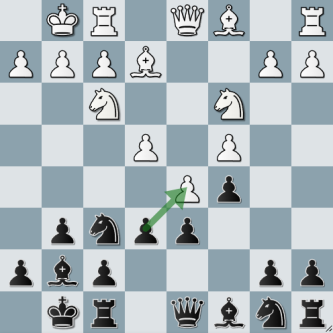
Even worse is with openings such as the Modern Defense or Réti System, which actually have no strict move order. But when an engine-student sees how the opening is presented on Chess.com, Lichess, Wikipedia, or in a chess book, they think that's it. I've seen thousands of times a student who plays the Réti, transposes into - for example - a Catalan instead, and still calls it the Réti because the first four moves happened to be Réti moves.
That's how learning chess through an engine or a silent platform, without structure and meaning behind each move - looks. And coaching those kinds of students is actually a job that means putting effort in two things: (1st) - to make them forget what they have studied or "learnt" so far, and only then (2nd) - to start teaching them real chess understanding.
The best move isn't always the best lesson
One may think the engines become more useful at a bit higher level. But there are still clear examples where the engine doesn't necessarily teach you anything. It only shows the best move.
Take the famous game Nimzowitsch-Rubinstein, Dresden 1926.
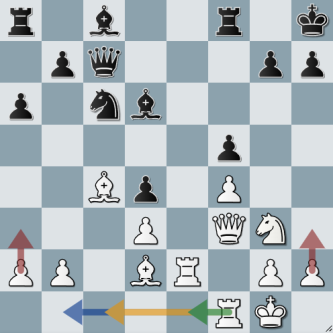
In this position Nimzowitsch played the stunning move 1.Nh1! It's super counterintuitive and quite unbelievable to even consider. The idea is: Nf2-h3-g5. From the human perspective, moves like 1.Nh1 are either terrible or brilliant. They make us think.
But from the engine's point of view, it's just another option. The engine sees that the maneuver can be partially neutralized, so it prefers a collection of ordinary-looking moves: (1) h3, (2) Rb1, (3) Rc1, (4) Rfe1 and (5) a3.
Nimzowitsch's game wouldn't be famous if he had played one of the engine's top recommended moves - 1.h3 or 1.a3 - in this position. There would have been nothing particularly memorable about it, and we probably wouldn't even know about that game today.
And that's the core of the problem, especially for beginners and intermediate players - they (would like to) learn what the best move is, without learning anything really valuable for themselves, without any takeaway. In other words, by turning the engine on - they learn moves without learning ideas. In the Nimzowitsch's game case - they'd prefer to see (and play) a dull-looking 1.a3 or 1.h3, instead of an elegant, deep and counterintuitive 1.Nh1.
It's a completely futile effort, and one of the reasons so many players get frustrated despite investing enormous amounts of time trying to improve. The first step, despite how strange it may sound, is actually to stop looking for the objectively best move and - of course - turn the engine off!
If you've ever caught yourself staring at the evaluation bar instead of the position itself, some time ago I made a video you may find useful: "Problem With Learning Chess From Engines"
You may also like
 ChessMonitor_Stats
Where do Grandmasters play Chess? - Lichess vs. Chess.com
This is the first large-scale analysis of Grandmaster activity across Chess.com and Lichess from 200… CM HGabor
How titled players lie to you
This post is a word of warning for the average club player. As the chess world is becoming increasin… TotalNoob69
The REAL value of chess pieces
... according to Stockfish FM mizant83
My Favorite Anti-London Weapon
If you’ve ever found yourself half-asleep playing against the London System, you are here for a good… Bosburp
My First Chess Composition
I’ve always been interested in chess composition, so recently I decided to challenge myself by creat… NM ZugAddict