
Woodpecker Method 2nd Cycle Complete
I go lie down now.
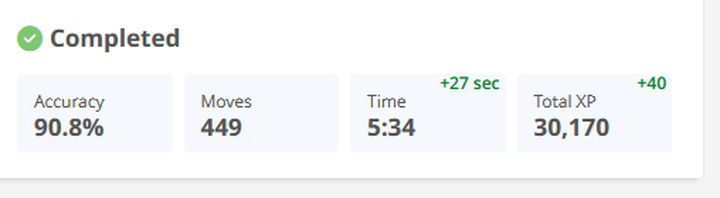
I just finished a cycle of Woodpecker Method method puzzles. The process of this training method is roughly as follows:
- As many puzzles as I can complete in 4 weeks. Those puzzles are my "set"
- Take 1 week off, then do the set of puzzles in 2 weeks
- Take another 1 week off, then do the set of puzzles in 3 days.
- Take a final 1 week off, then do all the puzzles in ONE DAY.
These puzzles are not easy, so - yes, completing them all in one day takes a number of hours. It's grueling.
As you can see from the screenshot, I only got 90% accuracy. I think 98+% accuracy is possible on the next set of Woodpecker Method puzzles that I do...but I need to select fewer puzzles on my first pass. I end up with around 130 which is too many to complete in one day without being completely exhausted.
Calculation quality over quantity, in other words.
On the other hand, being completely exhausted and still maintaining concentration and solving the puzzles successfully is probably the point. The fact that some times I selected a wrong move without checking it is indicative of losses I've had OTB recently.
For this method, you can use any puzzle set - for example CHESS by Lazlo Polgar, or Combinational Motifs by Maxim Blokh probably would work. However the authors of Woodpecker Method have compiled pretty good puzzles,all from games of world champions - so if you are short on time just using the Chessable course works fine.
Why I got puzzles wrong
During my first pass of these puzzles, I would sometimes reach the timer expiration with no idea of a solution. However, after 3 cycles, 100% accuracy on the final run is possible. However, I only got ~90% accuracy. Why?
- Several times I played a Qh4+ move that was wrong. Just like in real games, that check looks attractive but you have to calculate.
- A few times I re-captured too quickly. Again, just like my blunders in real games.
- I quickly dismiss or don't even consider captures that could be re-captured by the opponent - but lead to a winning combination. For some reason, this often was a knight capturing some non-obvious pawn (i.e. without check or itself threatening anything other than the capture).
- I don't see my opponent's counter-attacking move, i.e. they're threatening a back-rank mate if I don't get my move order correct.
Somewhat aggravating is that sometimes the Chessable authors mark certain move as "soft fails" (aka Alternative moves). This leaves you searching for the "correct" answer when the move you found is also winning. I few times I got exhausted and just tried something - that was wrong.
But most of the time, I just didn't calculate the puzzle all the way to the end - and then analyze the position (if not a checkmate). I would sort of let my visualization trail off, tell myself "it must be winning" - move - and then see that dreaded Red X ("Incorrect").
I have to remember to ask myself: "Why doesn't that work?" I when I remembered to do this, I often would prove it correct, or would find the problem and start working on a different solution (but I would have to remember to not dismiss something for "not working" too early - that is also a problem).
In short, chess is hard.
Next Steps
In few days, I'm playing in the Eastern Chess Congress in Princeton, NJ. Should I be redoubling my tactics training between now and then? I also have another weekly U1600 90+30 game at Marshall on Weds.
In the May 2023 issue of Chess Life, WGM Tatev Abrahamyan writes "solving too much right before a tournament puts me in a headspace where I think that every position has a concrete, tactical solution." I've definitely noticed this problem in my recent OTB games, where early on I spend too much time calculating instead of just playing principled, developing moves.
Time to take a bit of a break from tactics puzzles and think about my games.


