
wikicommons
Looking into top players: Daniel Naroditsky
73 bullet games played in August 2023Before reading this post
The games in this analysis were time-annotated 1+0 bullet games from August 2023. More about the data can be found at the lichess open database. The study was conducted on 1+0 games played by RebeccaHarris that had time annotations. As a big fan of Daniel Naroditsky's YouTube content and stream, I decided to look into some of his bullet games. If there are any problems with this post, please let me know and I will remove the blog post upon request. Any comments with personal attacks, bad implications, or negative connotations about the player will be removed. The positions were evaluated with Stockfish 16 with a base depth 20 and an evaluation time of 0.5 seconds.
Berserk and Time management
In these 73 games, Daniel won most of his games and usually was above the opponent's rating. The rating difference below is how much rating he was above the opponent. Some variables were formatted in mean ± std format. When he decides to go berserk, he spends 0.38 seconds per move on average. Even if you filter games such that the rating difference was less than 100, he was on the faster side.
| Berserk | Count | W-D-L | Rating diff | Player Time spent per move | Opponent time spent per move |
|---|---|---|---|---|---|
| Both | 15 | 13-1-1 | 166 ± 126 | 0.39 ± 0.57 | 0.45 ± 0.63 |
| Player | 4 | 4-0-0 | 605 ± 351 | 0.38 ± 0.50 | 1.00 ± 1.35 |
| Opponent | 7 | 5-1-1 | 99 ± 94 | 0.76 ± 0.97 | 0.52 ± 0.68 |
| None | 47 | 29-4-14 | 152 ± 135 | 0.83 ± 1.15 | 0.95 ± 1.27 |
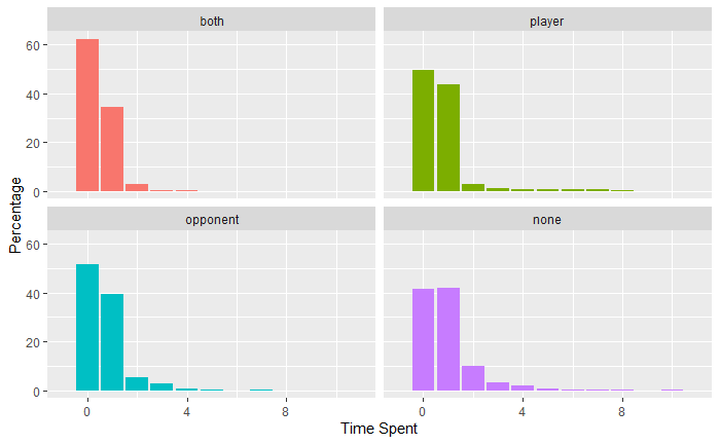
During these games, we can see how he managed his time. Shocking to me was that 80% or more of his moves were made within 1 second even in 1 + 0 games without berserk (Probably with better time measure, this could have been shorter).
Interpreting the evaluation of top N lines
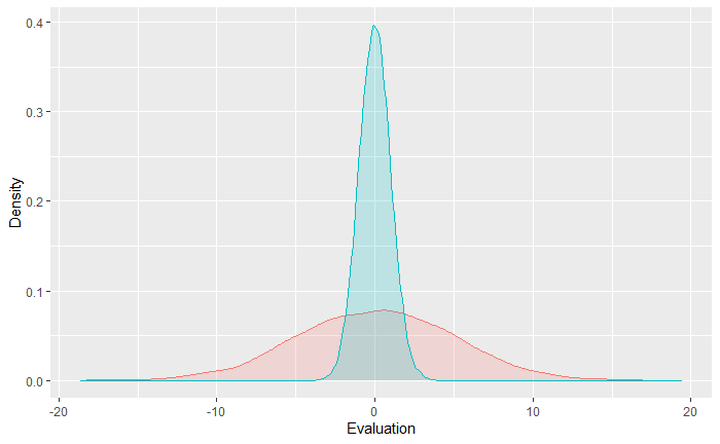
For every move, I analyzed 3 lines using stockfish. From those top 3 data points, we can come up with interpretations given a position. First is the standard deviation of the data points. If we have data points with a standard deviation of 20 centipawn, the chance is you can play whichever line you feel comfortable with. However, if the standard deviation is very large for instance 500 centipawn (5 evaluation-wise) like the red distribution, this can be considered a critical position in which you should look for a good decision.
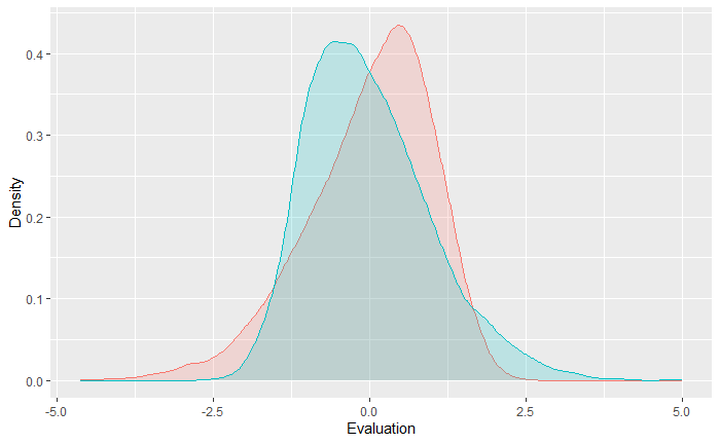
In addition, we can see the skewness of the distribution. Both red and blue distributions have the same mean. However, red is skewed to the right, blue is skewed toward the left. Given that positive evaluation is better, we can say that the red distribution has multiple good options while the blue distribution has fewer good options for the player. Probably this form of analysis can be done best when you analyze 5 or more lines but for this study, I used 3 data points.
Daniel Naroditsky's playstyle
Being Very Accurate
Daniel Naroditsky is very accurate in his playing style. The following is the percentage of engine moves he plays in his bullet games. 1, 2, and 3 correspond to the top 1, 2, and 3 recommended engine moves.
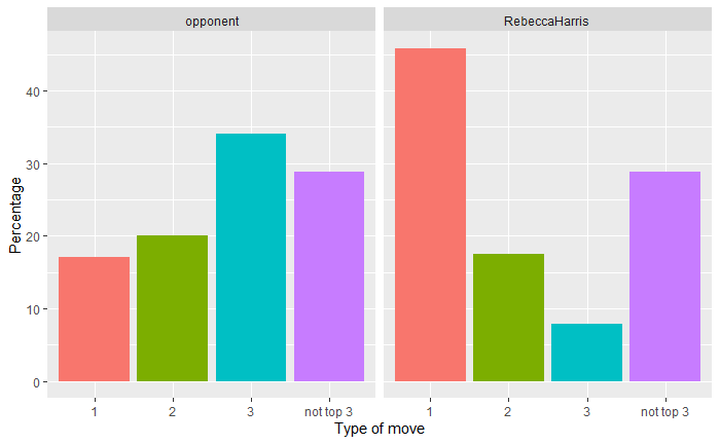
We can see that there are cases where he chooses the not top 3 engine moves, but this usually happens in situations where the standard deviation of the top 3 engine moves is lower than average which is 60 centipawn (0.6 eval). This can be implied as situations where there are multiple good moves.
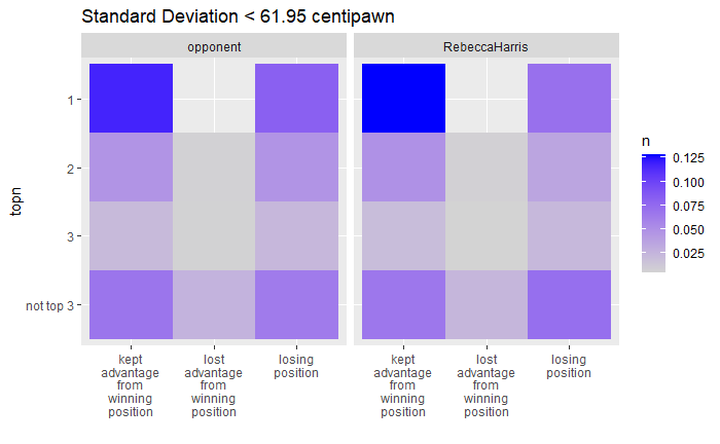
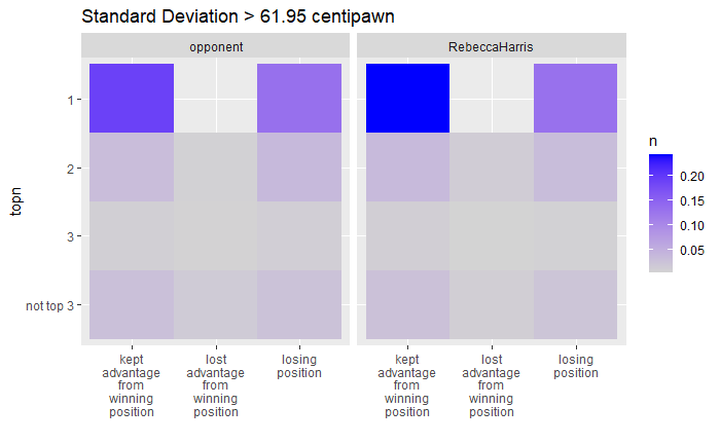
In cases where the SD of the three moves is higher than 60 centipawns, he accurately makes the best moves.
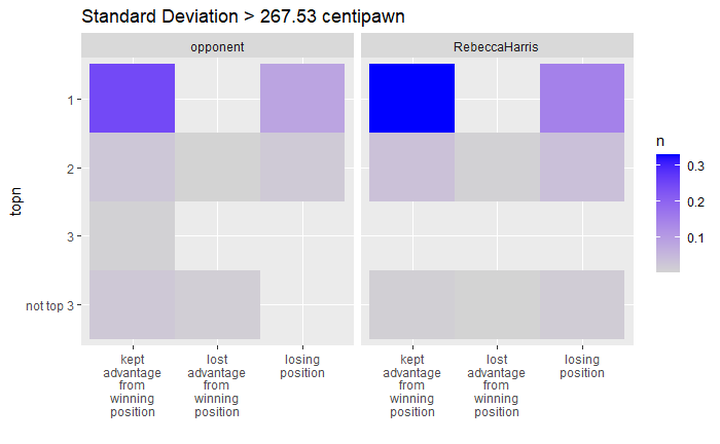
In dire situations for instance 260 centipawn standard deviation situations, he tends to be more accurate than his opponents. In losing and winning positions, he would find the best move.
When does he make not top 3 engine moves?
Digging deeper into the not top 3 engine moves he makes, around 40% of the cases, he still keeps a lead. In most cases, there are multiple good moves, and it's a matter of taste.
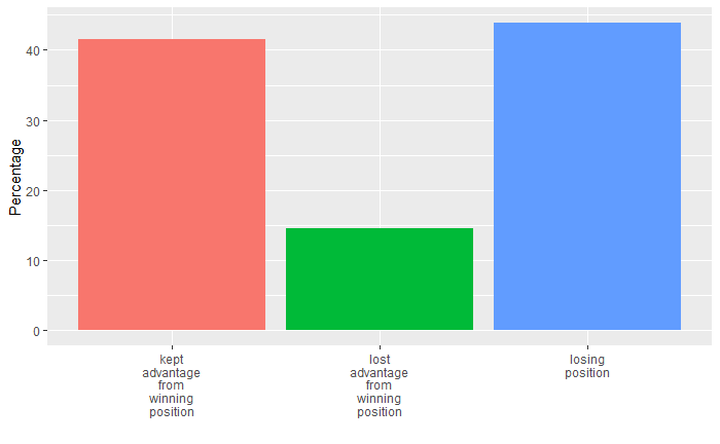
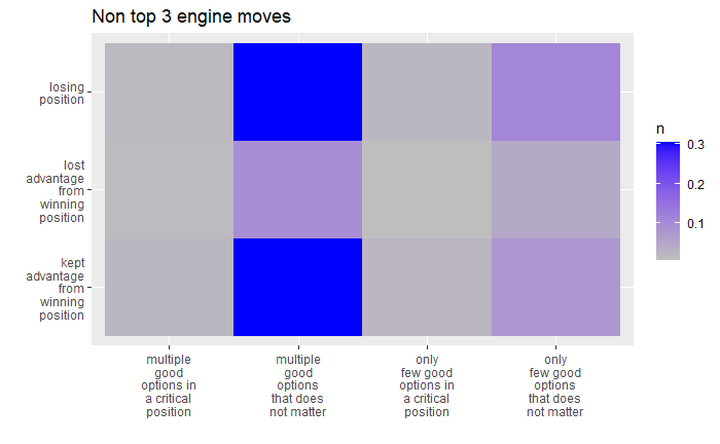
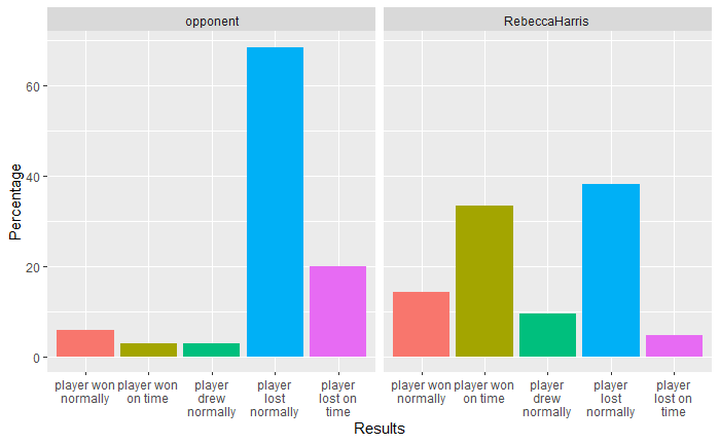
Even when he makes the non-top 3 engine moves in a critical position where the standard deviation of the top 3 engine moves is high, he is resilient and has a higher win rate compared to his opponents. This is related to his good time management.
Limitations and Regards
There are clear limitations to this post.
- These are not all the games Naroditsky has played. It is only 73 bullet games where time was recorded.
- Stockfish only analyzed 3 lines per move on low depth with low time. Maybe with deeper analysis the correspondence rate between engine lines and his move differs.
I have been careful about writing any post related to a specific player. Please be nice in the comments and discussions. After all, this is a blog post and not a scholastic paper about gameplay. Please just read for enjoyment. This analysis was done to find interesting insights from his amazing gameplay. Please do not comment on any form of accusations or negative connotations about Daniel. I am a big fan of his streams and educative content which led me to work on this project. Thanks for reading and I might keep on making a series depending on the reaction.
You may also like
 oortcloud_o
3+0 vs 3+2 the difference?
a brief time analysis oortcloud_o
Tell me the elo!
Rank the players A, B and C in the comments oortcloud_o
Which openings are related?
simulating opening connectivity graphs with known techniques GM NoelStuder
7 Reasons Why You’re Not Improving at Chess
You aren’t improving at Chess despite your best efforts? You are not alone! Plateaus are a normal pa… oortcloud_o
Linking top players based on openings
Using relatedness network on opening choices of top grandmasters oortcloud_o