
Mate in X statistics in 1+0 bullet games
Evaluations and material imbalances in "mate in X" positionsBefore reading this post
The games in this analysis were lichess-annotated 1+0 bullet games from April 2023. More about the data can be found at the lichess open database. Lichess does not annotate all their games in the database file, only a few games are annotated. Especially, 1+0 games with annotations compose less than 5% of the total 1+0 games. Annotations are done using Stockfish according to lichess. The analysis will not dig deeper into questioning the authenticity of the analysis. I wanted to show some visualizations that are not readily available in lichess. This post may be followed up by a deeper analysis later on. Enjoy :)
Simple statistics about 1+0 bullet games
Before we dig deeper, I just wanted to provide some simple statistics about 1+0 bullet games. Most games are decisive in 1+0 bullet games (this includes time forfeit) composing 97% of the games.
| Result | Percentage |
|---|---|
| White won | 50.18% |
| Black won | 47.15% |
| Draw | 2.66% |
Mate in X situations does not happen as often. Around 60% of our bullet games have a mate in X situation.
| Games that include | Percentage |
|---|---|
| Mate in X | 60.99% |
| No mate in X | 39.01% |
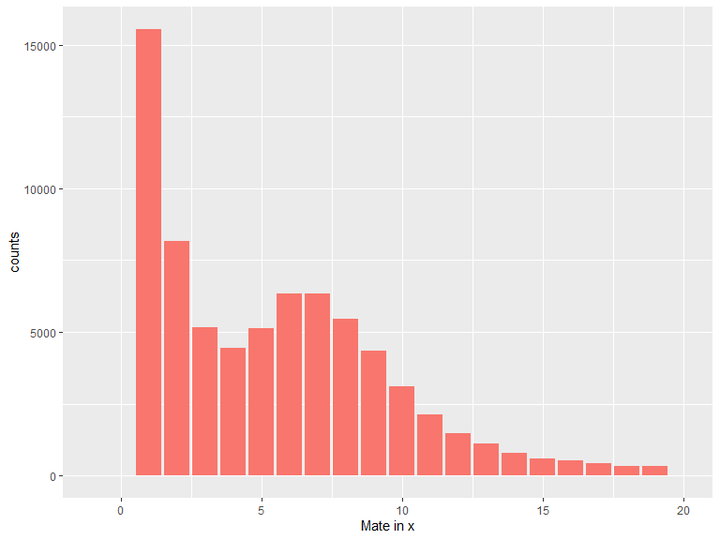
So now we are somewhat curious about the X. This is the distribution of the first occurrence of mate in X in games that had a mate in X position (If there was #3 to #2 into #1, it only accounts for #3).
Evaluations before the "Mate in X"?
We all know that the evaluation after the blunder before the "mate in X" situation would be #X. However, what is the evaluation before the move?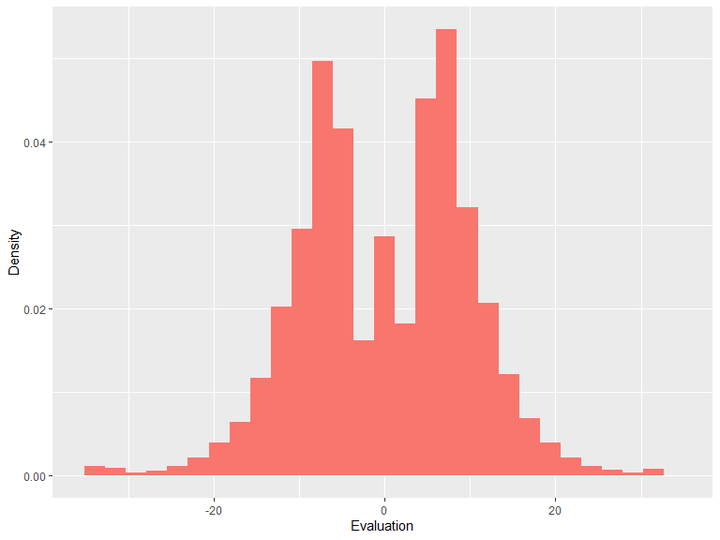
It seems that the evaluation is already biased toward one side when these situations occur. Since this evaluation is not normalized, we can normalize the data from the winning side (the color that has the mate in X).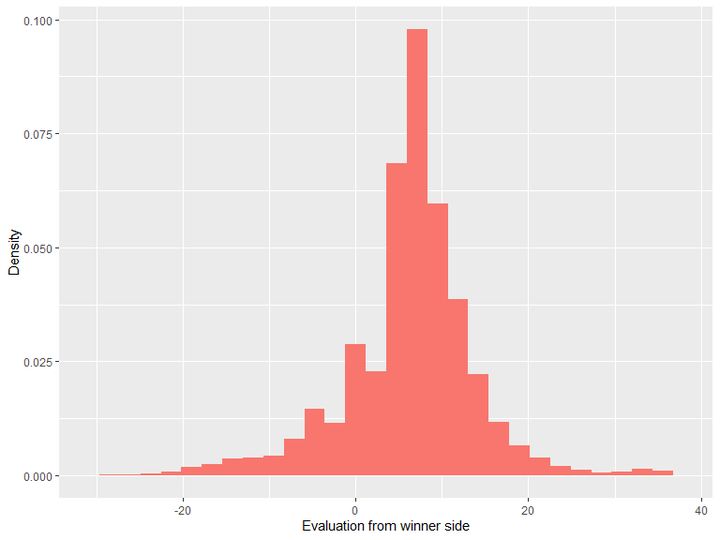 Evaluation distribution from the winning side
As expected, the winning side has a good amount of evaluation advantage when the "mate in X" situation happens.
Material Imbalances in "Mate in X" situations
This data was hard to extract since I have to track material exchanges in every game. This is a statistic gathered from 5000 random games from games that included a "Mate in X" situation. I totally understand that random sampling can result in skewed and incorrect data but there were limits to running this on large amounts of data. So please don't focus too much on the specific numbers but see the general trend.
The Pawn Advantage +1 means the winning side who had the "mate in X" had a pawn advantage. -1 would mean they were down a pawn.
| Pawn Advantage | KB advantage | Rook Advantage | Queen Advantage | Count |
|---|---|---|---|---|
| 0 | 0 | 0 | 0 | 362 (7.28%) |
| 1 | 0 | 0 | 0 | 262 (5.27%) |
| -1 | 0 | 0 | 0 | 207 (3.26%) |
| 0 | 1 | 0 | 0 | 162 (3.26%) |
| 2 | 0 | 0 | 0 | 124 (2.49%) |
| 1 | 1 | 0 | 0 | 122 (2.45%) |
| -1 | 1 | 0 | 0 | 113 (2.27%) |
| -2 | 0 | 0 | 0 | 87 (1.75%) |
| 0 | -1 | 0 | 0 | 83 (1.67%) |
Limitations and future posts
The biggest limit of this whole analysis is the 5000 samples from 72000 games that were decisive and had a "mate in X" position. I will try to analyze the full dataset in later posts. I will take about the proportions of people who win given the situation and people who recover from their blunders. I will stay on 1+0 bullet games for a while so if there are any topics you wish me to dig into, I would love to know.
You may also like
 oortcloud_o
Decisive Advantage but Lost on Time?
Losing on time in mate in X scenarios in 1+0 bullet games marcusbuffett
Which openings lead to the shortest games? What about the longest games?
I thought it would be sort of interesting to see which openings lead to the shortest games and which… oortcloud_o
A short literature review
chess opening similarity and more oortcloud_o
Chess with some data visualization
Focused on premoves in 1+0 bullet games GM NoelStuder
Why You Should Never Offer A Draw
Offering a draw is the fastest way to lose the possibility to learn. You rate the result higher than… FM CheckRaiseMate