
Mark A. Taff @ Wikimedia Commons, cropped, https://creativecommons.org/licenses/by-sa/3.0/us/deed.en
Another wild way to do Lichess puzzles
How big does a set of forks have to be?
Hi everyone!
The efforts to improve my tactical skills have brought me to a number of odd ideas in the area of puzzle training. Well, thoughts and ideas are one thing, while efforts are another. We can all advise and suggest, but doing it is . . . . . well, different.
Your feedback on the Bruce Lee puzzle style was encouraging. It seems we really should repeat puzzles and patterns until we get them down really well.
So here is the Thursday evening invention: Take a pattern, do like 100 puzzles on that pattern – and save them to your collection somehow, then repeat and review until you really and actually memorize the patterns!
Smells of fanaticism? Might be, but you can abandon the set once you've become a master at them. Yet imagine your practical results once you start seeing this pattern in a fraction of a second.
I probably should not cite a specific set of puzzles this time. One can pick something like Forks – and set them to your level (Normal). This is best because easier patterns you will probably know anyway (so that's a different style, more like pattern recognition), and as to very hard puzzles, you may not be able to memorize patterns soon because they are complicated for you.
So let's say 2100 (or your level) and Forks. These are good for pattern building, better than some others.
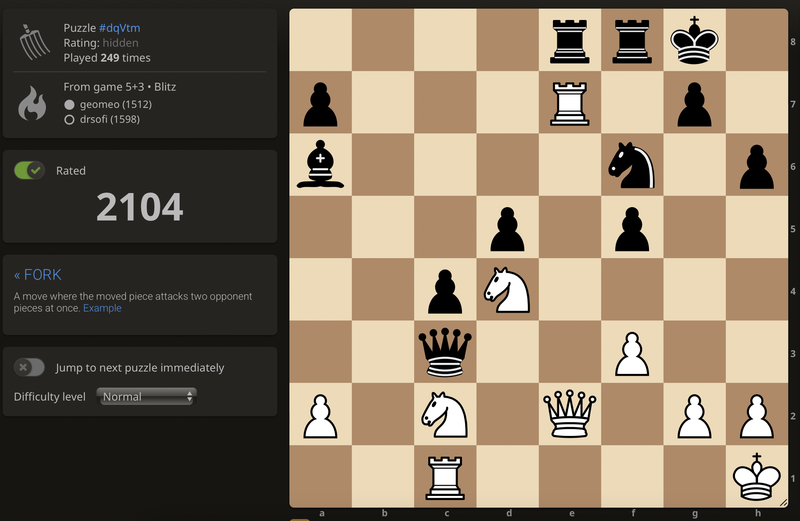
The Normal puzzle level means you will get about 50% of the puzzles right, so a good potential for improvement.
Now play 100 puzzles of moderate strength and save each one. Whether you find the correct solutions this first time is irrelevant.
Then ideally, I would save them and repeat this set 100 times. Incidentally, this would result in the Bruce Lee number, 10,000!
The technical questions are:
- How do you store the puzzles? (Maybe export each one as an image and place into a folder?)
- How do you technically review them? (Maybe run a slide show with random order? From your mobile phone when you are traveling?)
Also:
What would one be willing to give or donate for a good prepared set of puzzles like this?
Your input would be interesting, as always!
You may also like
 paunchypawn
A tactical jewel of a game in the French
You've never seen so many pins at once CM HGabor
How titled players lie to you
This post is a word of warning for the average club player. As the chess world is becoming increasin… paunchypawn
Luckier against 2233 – or tougher?
For some reason, it's crushing the Pirc again paunchypawn