
Mussklprozz, Wikimedia Commons
The Thrill, Excitement, and Enduring Dilemma of Classical Chess
Spoiler: It's still very much thriving!
Let's begin by painting a picture...
It's round 6 of 2025 Norway Chess
Gukesh Dommaraju and Magnus Carlsen have been battling it out for over 4 hours, and at one point what seemed like a near-guaranteed win for the latter has deteriorated into only a marginally better position due to both Gukesh's incredible resilience and a slew of inaccuracies and mistakes by Carlsen. It's an incredibly tense scene - both player's time are dwindling dangerous close to nil, and a win could stretch or catapult either player towards the front-end of the standings.
With under a minute on the clock, only a 10 second increment, and all the psychological pressure on the World Number One, he plays a fatal mistake: 52... Ne2+??
Gukesh appears to react with shock - he leans in and his eyes slightly widen. It's not clear if he had calculated the line, but he immediately plays the only viable move in the position, capturing the rook with 53. Rxe2. Carlsen doesn't seem to have recognized his error, and immediately captures back as well and follows that up with 54... d4. In his eyes, his pawns are fast enough, and he even believes he may have a chance to win.
Alas, after some accurate play from Gukesh, we reach the final critical position. The frame of mind of the players hasn't changed during this series of 8 moves - both are still incredibly nervous and each feel they have a chance to emerge victorious. However, that notion immediately changes with move 62.
If you haven't seen the game yet already, try to find it yourself for White: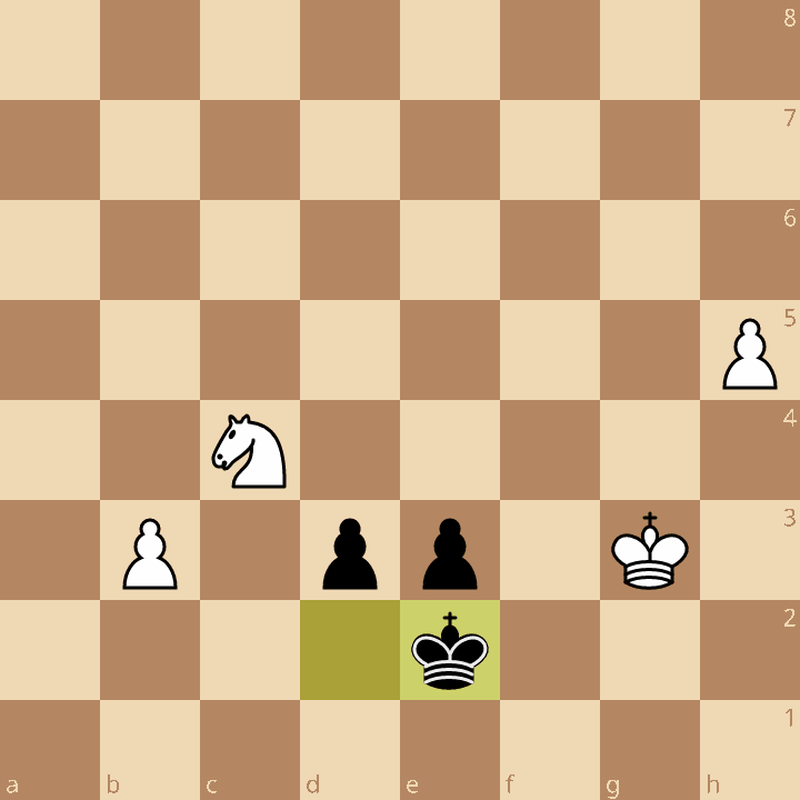
Did you see the move the five-time world champion missed?
62. Kf4!
All of a sudden Gukesh freezes the passed black pawns. White has the direct threat of Nxe3, and black has no way to stop it. If black continues to push their pawns with 62... d2, 63. Nxe3 would defend the d1 promotion square and white's Barry and Harry would be more than enough to wrap the game up.
In many ways, this is the moment us as fans live for: the breaking of tension, and the crowning of a victor. Carlsen recognizes the gravity of the situation almost instantly. He slams the table (and causes the clock to malfunction!), shakes a befuddled Gukesh's hand, and paces about for a brief moment. As he leaves, he shows his sportsmanship and respect to the World Champion, giving him a congratulatory pat on the back on the way out. Gukesh stands still, processing the stunning result in shock at the swindle and reaction of Carlsen.
This singular clip of the game's ending quickly went viral across practically every social media platform, amassing hundreds of thousands of likes and views. It even made it onto live television, being aired on ESPN's Sportscenter. The internet was swift to poke fun and jest, with commenters humorously comparing chess as more violent than MMA, and recognizing the universal response towards a tough loss - anger and respect.
The world might not know it, but it's celebrating not just any type of chess. It's celebrating specifically what some might call the most boring and dull form: classical chess.
The Constant Debate
Gukesh - Carlsen is a great example of the culmination of classical chess over generations, but why has the attitude towards the subject had a recent dynamic shift?
At its core, the fundamentals of classical chess have changed little since the Cold War era. After all, it is the most widely used time control for serious events, it is the longest time control, and it is the only time control that FIDE and USCF offer titles for. However, there are a few notable factors that have caused a rapid shift in the way it has been perceived within the last few decades.
-
The creation of chess engines - most notably Deep Blue in the late 90's - allowed for the unprecedented ability for quite literally anyone to analyze positions and develop opening lines stronger than a human ever can. This usage of engines has led to ever-extending lines of theory (e.g Sicilian Dragon) that have been "studied to death", as some might say.
-
The quickening pace and instantly-gratifying technology of the modern world has led to a larger interest for games of speed, tactics and thrill. Needless to say, classical games are long and don't follow this algorithmic formula. *
-
The self-stated lack of engagement with classical chess by top players, such as Magnus Carlsen. **
To an extent, Norway Chess has risen above every single one of these points. Despite the heavy opening preparation, nearly all of the games were extremely interesting and there were very few quick draws. The Gukesh - Magnus game in the 6th round and the nail-biting final round featuring two games finishing moments apart show that classical chess CAN be fast, tactical, and thrilling. Regardless of whether the players feel engaged to classical chess or not, there's no doubt that every single one of the individuals - even Magnus - truly cared about each game.
Norway Chess is a unique event compared to other top-tier tournaments. The armageddon system disincentivizes draws, allowing some faster paced chess to take place and give the sense that there is always a decisive result. Some players excelled in the quicker time format, such as Wei Yi and Ju Wenjun. Others struggled, such as Carlsen and Khademalsharieh. As it turned out in the final standings, every single one of those half-points mattered greatly in both sections.
All that being said, the largest reason the tournament was so successful was not because of the format. It was because the players came ready to play, because they really did care, and because classical chess just raises the stakes and tension that much more.
In that way, Norway Chess represents a victory for us chess fans and the future of standard chess ahead.
*There are attempts to make the game more algorithmic and appealing to the youth, such as chess.com's edits of tense moments with quick cuts, freezes, and intense background music on social media platforms.
** I can't recall the exact tournament (it may have been Tata Steel), but Giri half-jokingly stated that it takes half-an-hour for each move to be played.
This post is in part inspired by @BenjiPortheault's blog post "The War on Attention" https://lichess.org/@/BenjiPortheault/blog/the-war-on-attention/zhrVS53D


