
Photo by Frames for Your Heart
Slow. Down.
It's very strong to be fast, but here is a case for being slow.
2320 update
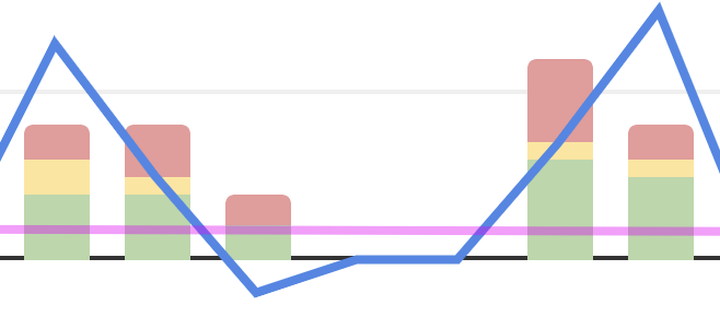
- Played 40 games (21 wins, 14 losses, 5 draws, for a total ΔELO of +38)
- Weekend break with no games
- Comparable results on a rival platform
I still underperform against opponents 50+ ELO above me or 150+ ELO below me. Nerves are a real thing.
Slow. Down.
It's a common theme across different media. In the online era, we are expected to be faster, better, first. Quality is desirable, speed is preferable. It's just how things started to turn out. The first news outlet to publish gets the spoils. The fewer words, the better. We're all too busy to worry about nuance or accuracy. Even in Chess, the most sought after form is the Arena, where your goal is to play the most games possible. You can lose over half of your games in an arena and still come out on top. Because a quick win, is better than a long draw. Not to mention the berserkers.
Don't get me wrong, I am in awe of players speed, and their high accuracy, when you factor in such speed.
So if the input we get 90% of the day is that faster is better than accurate, how are we supposed to appreciate the ability of slowing down?
Why would I even want to slow down?
On average, I take about 30 seconds to understand where all the pieces are in a middle game position. It takes me another 30 seconds to understand the obvious 1 or 2 move mating threats. However, to trully understand a position, it can take me up to 6 minutes. In fact, that's the time I use when I'm playing classical games and I have an easy critical moment position. So if I want really grasp my opponents threats, plans, and ideas, how can I play within a couple of seconds?
Well, obviously I cannot. And that's why I need to slow down.
It's kind of an investment. I'm banking on the idea that if I take a long time now, even if I get low on time, my understanding of the position will be superior to my opponents, if they continue to play quickly. Eventually, they will either have to stop, and spend a considerable amount of their clock, or I will have a better and better position, until my opponents position finally collapses.
This doesn't always happen. Sometimes my opponent is simply just better, faster, stronger. I can live with that. What it's harder for me to accept is to find out later that when I made a fast move, thinking it was the only (or the best) move, I actually could've seen a different path, if only I could have stopped and wondered a little bit more.
How does that translate to Blitz chess?
Well, if I take 6 minutes to move in a Blitz game... I mean we all know that's not an option.
What I can do, however, is to use 1 minute. Maybe 1.5 minutes.
I have followed this "strategy" of sorts, whenever I get an extremely unbalanced position, or I'm either completely winning/losing (admittedly, the latter happens far more often). The reason for this is to avoid falling into traps my opponent might have in store. This is not to say that I haven't invested such time, only to continue not to understand the position well enough. It's also not uncommon to be completely winning, but getting flagged, or eroding due to time constraints. But I can say with confidence that over time, with enough games, I noticed that it takes better players to pull one over me that it used to before.
Here is an example
It took me a full minute to understand that I'm at a disadvantage here and find a proper response: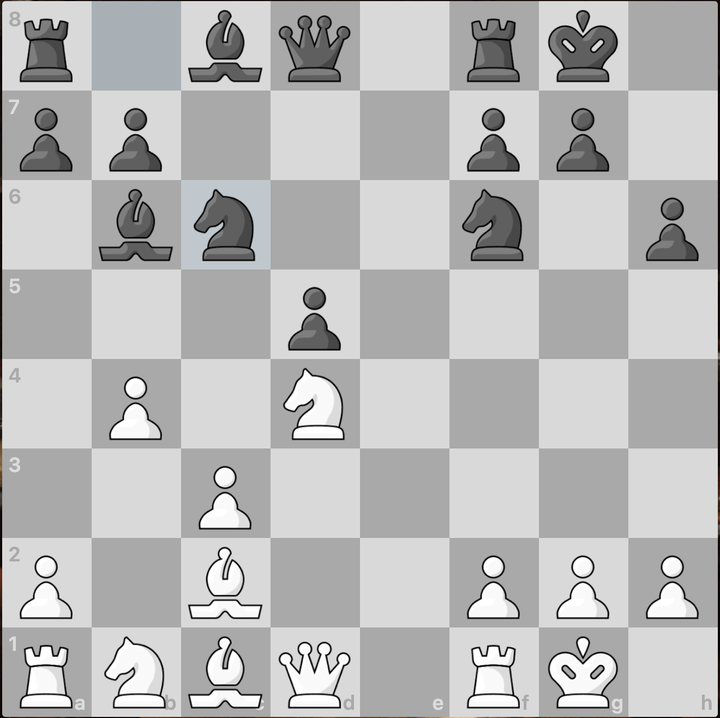
That dark squared bishop on b6 is fierce. Black has all 4 minor pieces either playing or ready to play. The rooks will be connected in no time. I, however, have all my pieces on the queen side, not doing much of anything. In addition, the center is about to be blown wide open. I had to find a way to delay that, and coordinate my army. Be3 trying to hold the position together.
My opponent quickly went about the business of consolidating the advantage and trading off all my better pieces, gaining the bishop pair. As for me, I was able at least not open up the board, which would make his bishop pair almost unstoppable.
We continued to maneuver until we reached the position below.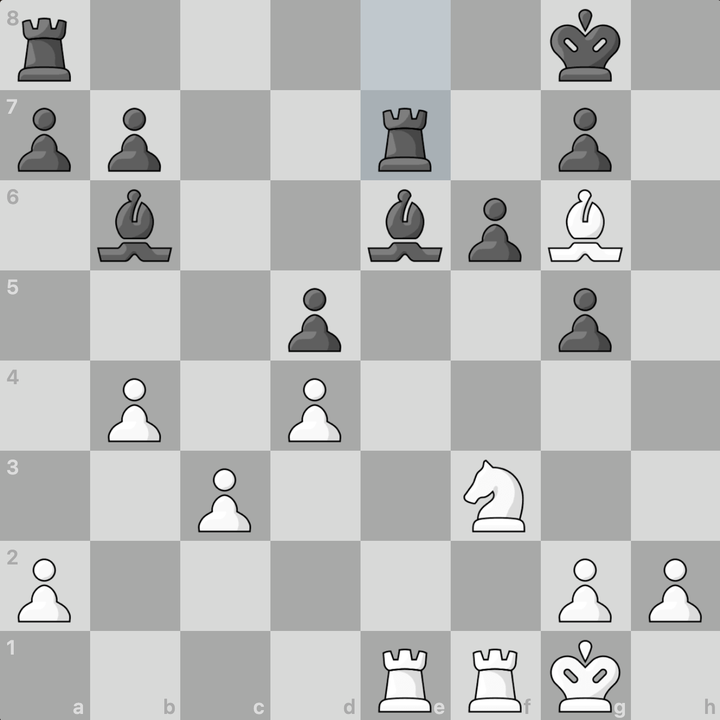
Black's dark squared bishop is not going to be doing much, but my knight has no squares to play. If I had only a couple seconds to move, I would have most likely maneuvered my horse back to the queen side, hoping my opponent makes a mistake as well.
However, there's something that wasn't quite right to me in the position, so I invested almost a minute here, and found a nice idea get rid of the bishop pair, get my rook in play, and exert pressure on the queen side, and even get a pawn in the mean time. Rxg5!
This is the power of slowing down!

