The classification is the name of the opening, followed by the specific line. If that gets too long, invent a name. For example, 1.e4 c5 2.Nf3 d6 3.d4 cxd4 4.Nxd4 Nf6 5.Nc3 g6 6.Be3 Bg7 7.f3 O-O 8.Qd2 Nc6 9.Bc4 Bd7 10.O-O-O Rc8 11.Bb3 Ne5 12.Kb1 Re8 13.h4 h5 14.g4 hxg4 15.h5 Nxh5 16.Bh6 Kh7 17.Bxg7 Kxg7 18.fxg4 Bxg4 19.Nf5+ Bxf5 20.exf5 Rh8 21.fxg6 Nxg6 may be "Dragon: Kasimdzhanov". Thats a smooth and memorizable categorization, and it scales, no need for numbers.
The classification is the name of the opening, followed by the specific line. If that gets too long, invent a name. For example, 1.e4 c5 2.Nf3 d6 3.d4 cxd4 4.Nxd4 Nf6 5.Nc3 g6 6.Be3 Bg7 7.f3 O-O 8.Qd2 Nc6 9.Bc4 Bd7 10.O-O-O Rc8 11.Bb3 Ne5 12.Kb1 Re8 13.h4 h5 14.g4 hxg4 15.h5 Nxh5 16.Bh6 Kh7 17.Bxg7 Kxg7 18.fxg4 Bxg4 19.Nf5+ Bxf5 20.exf5 Rh8 21.fxg6 Nxg6 may be "Dragon: Kasimdzhanov". Thats a smooth and memorizable categorization, and it scales, no need for numbers.
I'd like to preface this by saying that my coach used these systems in practice for me in the past and I know other players who did as well. This is because, back then, a powerful home computer wasn't a given at chess clubs, and the print editions of the books mentioned below were usually a joint club investment.
In this context, I'm constantly struck by the fact that players talk about times they simply don't know. If I ask a 20-year-old streamer about the Chess Informants, they usually have no idea what it is or how important it was for the development of chess. Therefore, focusing solely on the encyclopedias and the ECO key is perhaps a bit of an oversimplification.
It starts with the fact that an important task back then was publishing the Chess Informants with current game analyses. You can imagine it like this: the Chess Informants referenced previous game analyses within their own analyses. It's a system familiar from academic publications where references to previous publications are made. The goal was to extract every last bit of insight from openings. Besides the Chess Informants, there were also special editions for specifid openings.
The printed chess encyclopedias, on the other hand, were always a kind of summary work, but they didn't present the complete theory. Instead, they offered a very large, evaluated selection of moves by competent authors. They were always published with considerable intervals between volumes. Incidentally, apart from Volume B, there haven't been any new editions for almost 20 years, because the databases have eliminated the need for them.
I highly recommend taking a look at these books. You'll find that the subcategorization makes finding variations much easier, even if you don't know the key! Once you've gone through the main categories in the ECO key, you'll find further subdivisions within the book for readability, which also include footnotes where necessary.
To put it mildly, even today you could look up your own OTB game extremely quickly if you had all five volumes, even if they come from different generations. In some cases, perhaps even faster than someone has pulled out their smartphone.
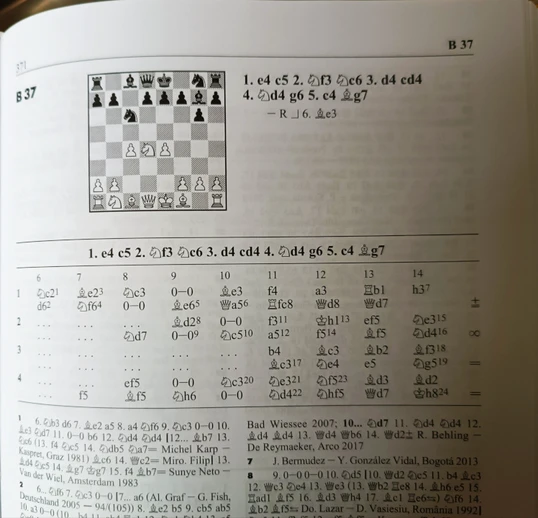
The ECO key naturally has a certain weighting that arose from the situation at the time. However, that doesn't mean it's now unusable. Constantly tinkering with it for the next ten years would only make both newer and older chess equipment less usable in combination.
Allow me one more small comment: Of course, one can criticize the work of the developers back then from today's perspective. But they did a great job at the time. It's easy to say in 2026 that things could have been done better back then. Thanks to fast computers and databases, we naturally have completely different possibilities open to us today. However, we simply use them, just as we use the master database and the chess computer on the free Lichess platform.
I'd like to preface this by saying that my coach used these systems in practice for me in the past and I know other players who did as well. This is because, back then, a powerful home computer wasn't a given at chess clubs, and the print editions of the books mentioned below were usually a joint club investment.
In this context, I'm constantly struck by the fact that players talk about times they simply don't know. If I ask a 20-year-old streamer about the Chess Informants, they usually have no idea what it is or how important it was for the development of chess. Therefore, focusing solely on the encyclopedias and the ECO key is perhaps a bit of an oversimplification.
It starts with the fact that an important task back then was publishing the Chess Informants with current game analyses. You can imagine it like this: the Chess Informants referenced previous game analyses within their own analyses. It's a system familiar from academic publications where references to previous publications are made. The goal was to extract every last bit of insight from openings. Besides the Chess Informants, there were also special editions for specifid openings.
The printed chess encyclopedias, on the other hand, were always a kind of summary work, but they didn't present the complete theory. Instead, they offered a very large, evaluated selection of moves by competent authors. They were always published with considerable intervals between volumes. Incidentally, apart from Volume B, there haven't been any new editions for almost 20 years, because the databases have eliminated the need for them.
I highly recommend taking a look at these books. You'll find that the subcategorization makes finding variations much easier, even if you don't know the key! Once you've gone through the main categories in the ECO key, you'll find further subdivisions within the book for readability, which also include footnotes where necessary.
To put it mildly, even today you could look up your own OTB game extremely quickly if you had all five volumes, even if they come from different generations. In some cases, perhaps even faster than someone has pulled out their smartphone.

The ECO key naturally has a certain weighting that arose from the situation at the time. However, that doesn't mean it's now unusable. Constantly tinkering with it for the next ten years would only make both newer and older chess equipment less usable in combination.
Allow me one more small comment: Of course, one can criticize the work of the developers back then from today's perspective. But they did a great job at the time. It's easy to say in 2026 that things could have been done better back then. Thanks to fast computers and databases, we naturally have completely different possibilities open to us today. However, we simply use them, just as we use the master database and the chess computer on the free Lichess platform.
@DerReelle said in #12:
I'd like to preface this by saying that my coach used these systems in practice for me in the past and I know other players who did as well. This is because, back then, a powerful home computer wasn't a given at chess clubs, and the print editions of the books mentioned below were usually a joint club investment.
[...]
The ECO key naturally has a certain weighting that arose from the situation at the time. However, that doesn't mean it's now unusable. Constantly tinkering with it for the next ten years would only make both newer and older chess equipment less usable in combination.
Allow me one more small comment: Of course, one can criticize the work of the developers back then from today's perspective. But they did a great job at the time. It's easy to say in 2026 that things could have been done better back then. Thanks to fast computers and databases, we naturally have completely different possibilities open to us today. However, we simply use them, just as we use the master database and the chess computer on the free Lichess platform.
Thank you for this insight, I've never actually heard of anyone's experiences using these so it's very interesting to read yours. I would agree that my lack of knowledge of how this system would have been used has colored my impressions of its utility in the past, and it's very interesting to look at the system as a summary of more extensive deep dives into individual lines. This makes a lot of sense, and I'll definitely keep this in mind as my understanding of the ECO grows.
The thing that really confuses me about the system, even for the time, are some of the puzzling decisions surrounding volume organization and the seemingly ridiculous specificity of some of the codes. Not that I can't see a use of a static lookup even, I absolutely can appreciate the utility there, but the exact implementation seems a long ways from ideal, even in the context of the time the ECO was compiled and the way it was meant to be used. I would think that the publishers would want this summary of their hard work to be relatively systematic and elegant is all, and I just can't wrap my head around some of the execution.
@DerReelle said in #12:
> I'd like to preface this by saying that my coach used these systems in practice for me in the past and I know other players who did as well. This is because, back then, a powerful home computer wasn't a given at chess clubs, and the print editions of the books mentioned below were usually a joint club investment.
>
[...]
>
> The ECO key naturally has a certain weighting that arose from the situation at the time. However, that doesn't mean it's now unusable. Constantly tinkering with it for the next ten years would only make both newer and older chess equipment less usable in combination.
>
> Allow me one more small comment: Of course, one can criticize the work of the developers back then from today's perspective. But they did a great job at the time. It's easy to say in 2026 that things could have been done better back then. Thanks to fast computers and databases, we naturally have completely different possibilities open to us today. However, we simply use them, just as we use the master database and the chess computer on the free Lichess platform.
Thank you for this insight, I've never actually heard of anyone's experiences using these so it's very interesting to read yours. I would agree that my lack of knowledge of how this system would have been used has colored my impressions of its utility in the past, and it's very interesting to look at the system as a summary of more extensive deep dives into individual lines. This makes a lot of sense, and I'll definitely keep this in mind as my understanding of the ECO grows.
The thing that really confuses me about the system, even for the time, are some of the puzzling decisions surrounding volume organization and the seemingly ridiculous specificity of some of the codes. Not that I can't see a use of a static lookup even, I absolutely can appreciate the utility there, but the exact implementation seems a long ways from ideal, even in the context of the time the ECO was compiled and the way it was meant to be used. I would think that the publishers would want this summary of their hard work to be relatively systematic and elegant is all, and I just can't wrap my head around some of the execution.
With the advent of databases the ECO itself has become kind of obsolete.
With the advent of databases the ECO itself has become kind of obsolete.
@Toadofsky said in #14:
https://xkcd.com/927/
Thanks, we needed that one. Of course there is a fitting xkcd for everything
@Toadofsky said in #14:
> https://xkcd.com/927/
Thanks, we needed that one. Of course there is a fitting xkcd for everything
Interesting post.
I have noticed these codes of openings long time ago when analyzing my games, but didn't pay them attention ... since they are useless in terms of analyzing games and improving (at least at my level)
And this is the first time I read about the ECO system, but I can understand the issues presented in this post, and it makes sense that the static ECO can't fully/accurately represent the relatively dynamic chess opening theory ....
These issues remind me of the similar issue I have in my own opening "plan/repertoire", I also try the give codes to them, W for white, B for black (obviously), and then assign numbers (or a letter and numbers) to different lines and variations I play ...
And I still can't come up with a final "code system" for my stuff because of things mentioned in this post (the popularity of responses, how deep we are in theory, etc)
So, I can see now how this ECO system has the same exact problem by on a much higher scale ...
But it is interesting and thought provoking.
Interesting post.
I have noticed these codes of openings long time ago when analyzing my games, but didn't pay them attention ... since they are useless in terms of analyzing games and improving (at least at my level)
And this is the first time I read about the ECO system, but I can understand the issues presented in this post, and it makes sense that the static ECO can't fully/accurately represent the relatively dynamic chess opening theory ....
These issues remind me of the similar issue I have in my own opening "plan/repertoire", I also try the give codes to them, W for white, B for black (obviously), and then assign numbers (or a letter and numbers) to different lines and variations I play ...
And I still can't come up with a final "code system" for my stuff because of things mentioned in this post (the popularity of responses, how deep we are in theory, etc)
So, I can see now how this ECO system has the same exact problem by on a much higher scale ...
But it is interesting and thought provoking.
[Don't you know The Dewey Decimal System!?](https://www.youtube.com/watch?v=mZHoHaAYHq8)
Relavent to the blog? I think so, but it all depends on your reading skills.
https://search.brave.com/search?q=Dewey+Decimal+system&source=newtab&summary=1&conversation=08ad8b2dcb24c0f47ce82e193aba63a905af
https://www.chessroots.com/
https://isbndb.com/blog/dewey-decimal-system/
https://www.eurekalert.org/news-releases/984893
https://towardsdatascience.com/python-meets-pawn-2-clustering-chess-grandmasters-based-on-their-openings-68440fc9f9b1/
https://www.sciencedaily.com/releases/2023/04/230404114307.htm
https://techxplore.com/news/2023-04-classification-chess.html
<Comment deleted by user>


