Well done for creating this
Well done for creating this
<Comment deleted by user>
What is considered a blunder? I faced the position on White's move 28 from the game
https://lichess.org/SM6Atmu3/white#54
in 1800 segment and I (circa 2000 fide) can't tell certainly without engine or long deliberation why Ne7, which wins a pawn is a blunder, while Nf4 is the best move (and winning one apparently). You can tell that's skill issue but I think that a blunder is a move that 1) changes evaluation drastically (to be fair, this criterion is met in our case); 2) negative effect of the move should be clear (there may be a sequence of moves that leads to clarification, yes but the less forced lines are, the shorter sequence should be). In human's perception White's knight was attacked and 1) it was saved; 2) White additionally wins a pawn without obvious drawbacks. I believe that not all mathematically sub optimal moves are blunders, they may be mistakes and inaccuracies.
P.S. Do your puzzles in general have one or multiple correct inputs where there is more than one good move?
Anti-blunder trainer is an interesting idea though, keep going!
What is considered a blunder? I faced the position on White's move 28 from the game https://lichess.org/SM6Atmu3/white#54 in 1800 segment and I (circa 2000 fide) can't tell certainly without engine or long deliberation why Ne7, which wins a pawn is a blunder, while Nf4 is the best move (and winning one apparently). You can tell that's skill issue but I think that a blunder is a move that 1) changes evaluation drastically (to be fair, this criterion is met in our case); 2) negative effect of the move should be clear (there may be a sequence of moves that leads to clarification, yes but the less forced lines are, the shorter sequence should be). In human's perception White's knight was attacked and 1) it was saved; 2) White additionally wins a pawn without obvious drawbacks. I believe that not all mathematically sub optimal moves are blunders, they may be mistakes and inaccuracies.
P.S. Do your puzzles in general have one or multiple correct inputs where there is more than one good move?
Anti-blunder trainer is an interesting idea though, keep going!
@GennadyBukin said ^
What is considered a blunder? I faced the position on White's move 28 from the game
https://lichess.org/SM6Atmu3/white#54
in 1800 segment and I (circa 2000 fide) can't tell certainly without engine or long deliberation why Ne7, which wins a pawn is a blunder, while Nf4 is the best move (and winning one apparently). You can tell that's skill issue but I think that a blunder is a move that 1) changes evaluation drastically (to be fair, this criterion is met in our case); 2) negative effect of the move should be clear (there may be a sequence of moves that leads to clarification, yes but the less forced lines are, the shorter sequence should be). In human's perception White's knight was attacked and 1) it was saved; 2) White additionally wins a pawn without obvious drawbacks. I believe that not all mathematically sub optimal moves are blunders, they may be mistakes and inaccuracies.
Hmm, yes this is a really tough one. It is true that case 1) is satisfied, but case 2) really isn't in this puzzle and in general is very hard to verify. I will work on a few more heuristics regarding it though (i.e., material capture needs to be within 2 moves or something like that). Thanks for the note!
P.S. Do your puzzles in general have one or multiple correct inputs where there is more than one good move?
Yes, we have a threshold for "nearly as good as the best move" and any moves that reach this are allowed. These show up in the move analysis box (on the right) as moves with a green background.
The exact threshold for counting these is that making the move shouldn't decrease the likelihood of winning by more than 4%, according to Stockfish. This doesn't correspond to an exact centipawn value though, since it scales exponentially with the evaluation.
There are positions in the database now that can accept up to 4 different moves as correct. I capped it at this value so I could use a trick to save computational resources (it takes a long time to evaluate all these games!). Basically, for each position, I compute the top 5 moves. Then, I make sure that the number of moves that are "nearly as good as the best one" is at most 4, and filter out any positions that don't satisfy this. The reason is that, if I accepted positions where all of the top 5 moves were as good as the best move, then we aren't sure if there is a 6th/7th/8th... move that is also ok (like if there are a bunch of drawing moves, this can happen). So then it would be possible for someone to make a move that is as good as the best move, but just wasn't in our top 5 list by random chance, and they would erroneously be marked wrong.
By verifying that only at most 4 are as good as the best move, we know that the 5th one isn't as good as the best move and then the 6th/7th... moves must be worse than the 5th best move, so they also can't be nearly as good as the best move.
If we evaluated positions on the fly, we could increase this threshold, but that is much more work (implementation and computation).
Anti-blunder trainer is an interesting idea though, keep going!
Thank you! And don't blunder!
@GennadyBukin said [^](/forum/redirect/post/zEWiejo0)
> What is considered a blunder? I faced the position on White's move 28 from the game https://lichess.org/SM6Atmu3/white#54 in 1800 segment and I (circa 2000 fide) can't tell certainly without engine or long deliberation why Ne7, which wins a pawn is a blunder, while Nf4 is the best move (and winning one apparently). You can tell that's skill issue but I think that a blunder is a move that 1) changes evaluation drastically (to be fair, this criterion is met in our case); 2) negative effect of the move should be clear (there may be a sequence of moves that leads to clarification, yes but the less forced lines are, the shorter sequence should be). In human's perception White's knight was attacked and 1) it was saved; 2) White additionally wins a pawn without obvious drawbacks. I believe that not all mathematically sub optimal moves are blunders, they may be mistakes and inaccuracies.
Hmm, yes this is a really tough one. It is true that case 1) is satisfied, but case 2) really isn't in this puzzle and in general is very hard to verify. I will work on a few more heuristics regarding it though (i.e., material capture needs to be within 2 moves or something like that). Thanks for the note!
> P.S. Do your puzzles in general have one or multiple correct inputs where there is more than one good move?
Yes, we have a threshold for "nearly as good as the best move" and any moves that reach this are allowed. These show up in the move analysis box (on the right) as moves with a green background.
The exact threshold for counting these is that making the move shouldn't decrease the likelihood of winning by more than 4%, according to Stockfish. This doesn't correspond to an exact centipawn value though, since it scales exponentially with the evaluation.
There are positions in the database now that can accept up to 4 different moves as correct. I capped it at this value so I could use a trick to save computational resources (it takes a long time to evaluate all these games!). Basically, for each position, I compute the top 5 moves. Then, I make sure that the number of moves that are "nearly as good as the best one" is at most 4, and filter out any positions that don't satisfy this. The reason is that, if I accepted positions where all of the top 5 moves were as good as the best move, then we aren't sure if there is a 6th/7th/8th... move that is also ok (like if there are a bunch of drawing moves, this can happen). So then it would be possible for someone to make a move that is as good as the best move, but just wasn't in our top 5 list by random chance, and they would erroneously be marked wrong.
By verifying that only at most 4 are as good as the best move, we know that the 5th one isn't as good as the best move and then the 6th/7th... moves must be worse than the 5th best move, so they also can't be nearly as good as the best move.
If we evaluated positions on the fly, we could increase this threshold, but that is much more work (implementation and computation).
> Anti-blunder trainer is an interesting idea though, keep going!
Thank you! And don't blunder!
Pretty interesting. Instead of practicing tactics with a winning gain – like the usual chess problem does –, you have to think more in a 'real game' mindset, trying to keep your advantage or simply not losing.
I hope they'll be more difficulties in the future, but for now, handsome work !
Pretty interesting. Instead of practicing tactics with a winning gain – like the usual chess problem does –, you have to think more in a 'real game' mindset, trying to keep your advantage or simply not losing.
I hope they'll be more difficulties in the future, but for now, handsome work !
Works really well. Of course I got my easy ones wrong and the rest of them right.
Works really well. Of course I got my easy ones wrong and the rest of them right.
I like the example shown, as it shows that a blunder could be missing a win (allowing the opponent a draw), or missing a draw (allowing the opponent to win), and since the user doesn't know which one it is makes it a bit more gamelike. This example is understandable: in the starting position white is a piece up, and the sequence gives white another piece + rook for Q + P. Weird that the future of the game and coaching was brought up, anyway the solutions are: freestyle to become default, rapid to become default, rating not to carry any benefits e.g. qualifying by rating, and hybrid tournaments to make the game affordable beyond tourists. The app looks great BUT I would prefer to run it on PC e.g. via lichess?
I like the example shown, as it shows that a blunder could be missing a win (allowing the opponent a draw), or missing a draw (allowing the opponent to win), and since the user doesn't know which one it is makes it a bit more gamelike. This example is understandable: in the starting position white is a piece up, and the sequence gives white another piece + rook for Q + P. Weird that the future of the game and coaching was brought up, anyway the solutions are: freestyle to become default, rapid to become default, rating not to carry any benefits e.g. qualifying by rating, and hybrid tournaments to make the game affordable beyond tourists. The app looks great BUT I would prefer to run it on PC e.g. via lichess?
The other example mentioned as "not clear why it is a blunder", that's the point, for you to study and understand. In this case the c6 pawn is doomed anyway and all the tension is released.
The other example mentioned as "not clear why it is a blunder", that's the point, for you to study and understand. In this case the c6 pawn is doomed anyway and all the tension is released.
@fruitdealer2002 I like your implementation.
Small improvement idea: There is no reference to the previously selected rating on the results page , perhaps you could add it, so that I know, with other rating I should try out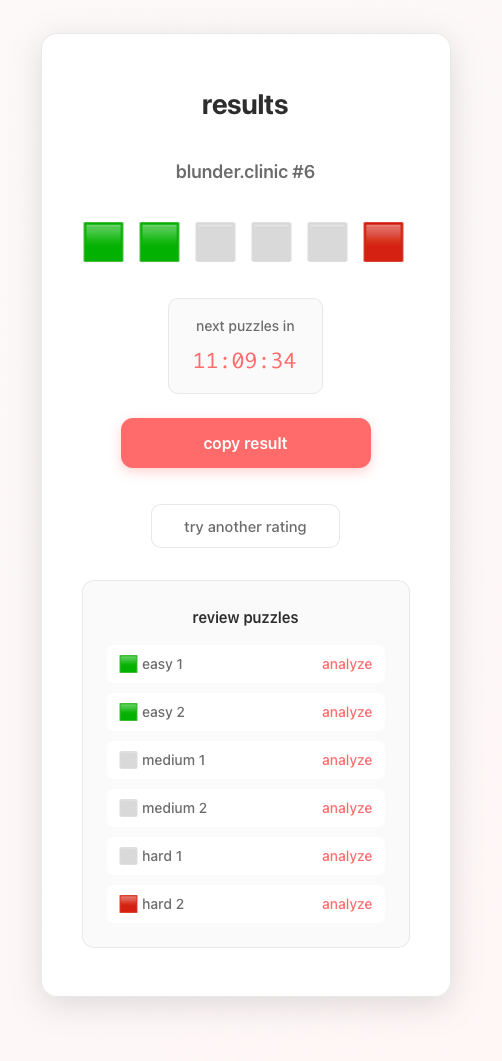
@fruitdealer2002 I like your implementation.
Small improvement idea: There is no reference to the previously selected rating on the results page , perhaps you could add it, so that I know, with other rating I should try out


