
Horde Chess - How to approach strategy in Horde?
Why play the Horde Chess Variant? One of the most unique and imaginative chess variants.
Horde chess is unique among all the variants on Lichess; it is the only variant where both sides get different pieces. Although many other interesting variants exist, most have the essential chess starting position, or at least Black and White get the same starting position. Horde chess presses the issue that many might have asked: what if the normal chess army is pitted against an army of only pawns? Black gets the standard pieces, and White gets 36 pawns. White wins by checkmate, and Black wins by capturing all of White's material; the rest is the same as chess.
Horde has become one of the more popular variants on the server, warranting a world championship, opening theory, AI engines determining the best lines, occasional play by Grandmasters and chess streamers, and many enthusiasts you can find in regular arenas. Although anyone can jump in and enjoy Horde, the question of the right strategy and how to view the game is perplexing. Almost none of the top players are titled, and many players well under 2000 have a chance to defeat a Grandmaster who might wander in and try Horde.
Like most variants, Horde is top-heavy; a handful of players are addicted to the game and constantly play, competing to be the best. New players in arenas can immediately play the top players, often losing quickly and not understanding the strategy used against them. Some training material exists, such as studies, videos, and articles on Horde, primarily geared toward competitive expert play. Often, the top variant players are anonymous, constantly creating new accounts, and involved in ego clashes with the other top anonymous players, which can distract them from enjoying the game and expanding to new players. Someone new to Horde is greeted in an arena by getting bezerked by a top player fighting for a top spot. However, plenty of Horde regulars are happy to chat, explain the game and basic strategy, and where to find resources.
I streamed the Horde World Championships in previous years, of which we are in another current cycle.
https://www.youtube.com/watch?v=QECH_qsE_XM
https://www.youtube.com/watch?v=D3zzw21jHxc
My enjoyment of Horde was so immense that I even wanted to write a book on the subject geared toward beginners. However, writing is time-consuming, and I could not find others with whom to collaborate. But here I am submitting my first blog post on Horde Chess, attempting to explain the basic strategy. One reason the Horde strategy remains elusive even to top chess players is that the basic techniques are not similar to standard chess or other variants. I lean towards the 'Breakout' (old Atari game) explanation for Horde's strategy.
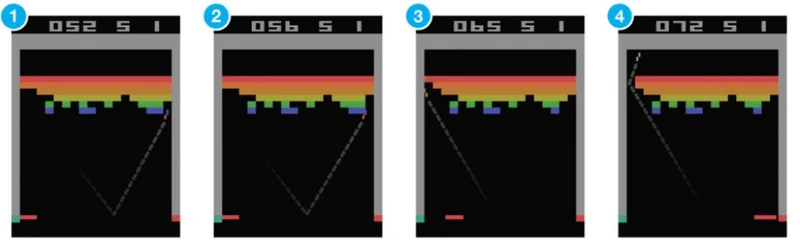
In the old Atari paddle game, the path towards victory (hitting pieces with the ball, which disappears when struck) is to clear a path on the side and get the ball on top, where the ball will hit the pieces from behind without the danger of getting past your paddle. The path to victory for the Black pieces is the same as in Breakout, where you clear out the pawns on the a or h file, usually by sacrificing two to three pieces and getting your Queen behind the pawns to capture them quickly with little risk. The advanced strategies of the 'Rook Shuffle' or 'Holding Patterns' through zugzwang aims to clear out a file and get the Queen behind the pawns, allowing them to be quickly and safely captured.
The strategy for White and the pawns is more complicated, often just trying to prevent Black from opening the a or h file or sometimes a center file. The a-file is the simplest file to open; it only has four pawns, and not five; the Knight can aim to go from b8 to d7 to b6 (or c5) and sacrifice on a4,
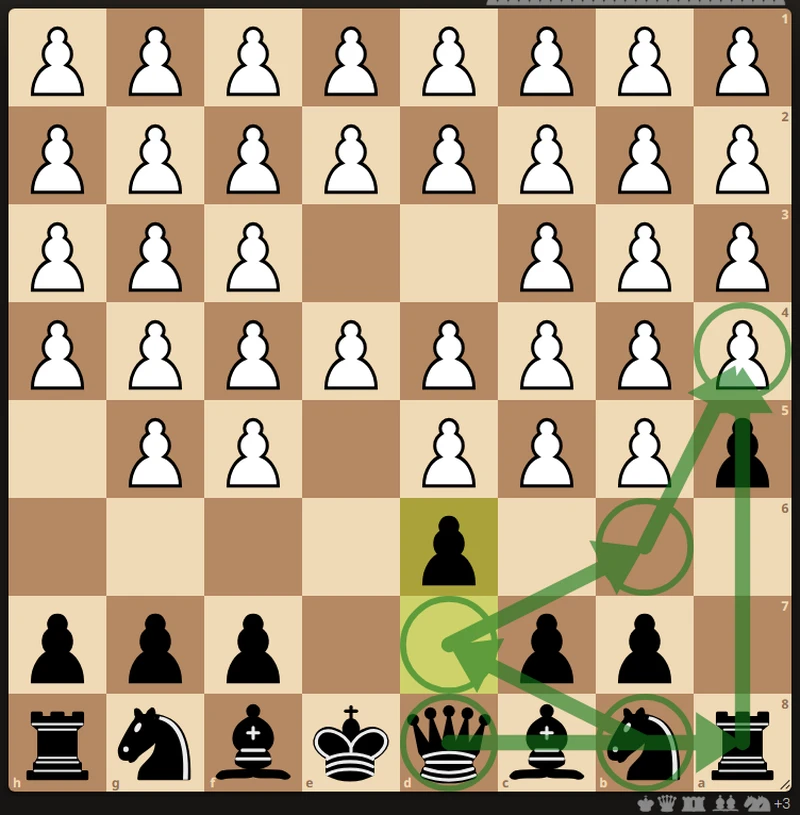
And then make a battery with the Queen behind the Rook and sacrifice on a2 or a3, leading to a break-through.
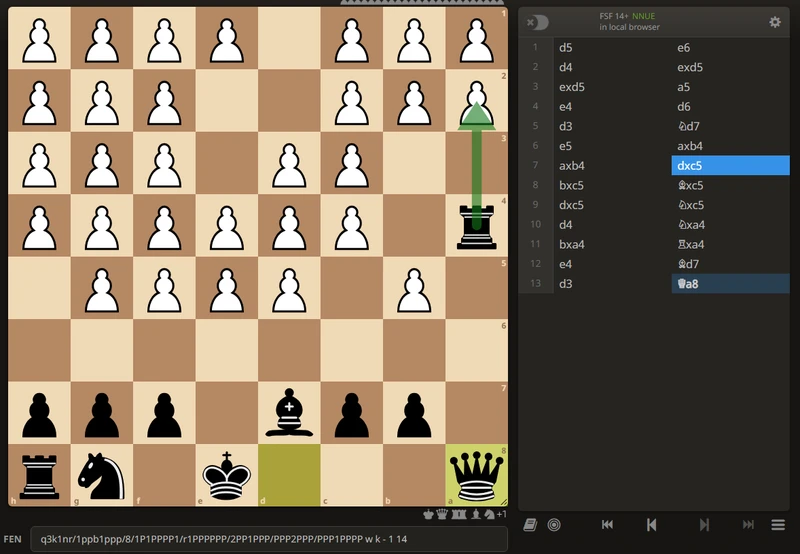
The same strategy works on the h-file but is less efficient as the Queen needs to get around the King to make a battery behind Rook on the h-file. Often, the sacrifice on a4 requires first sacrificing the f8 Bishop on c5 and the b8 Knight reaching a4 through the path b8-d7-c5-a4. To prevent this strategy, White can play 1. a5 to prevent Black from playing a5 or try to solidify the c5 square to stop the Black Knight's path. Often, Black will win if they can open the a-file and get the Queen behind the pawns to start picking them off, even if it costs the a-Rook, both Bishops and the Queen Knight, as White's counter-play on the Kingside is very slow.
White can create a Queen and win if White can prevent Black from opening a file and overwhelm the center and one side of the board with pawns. To prevent Black from opening a file, White must stop Black from sacrificing a piece for two pawns on the same file twice or more. As Black sacrificing two pieces for a pawn is a good trade, only if it is done multiple times on the same file, opening it for penetration, otherwise white can retain at least two pawns on each file and eventually overwhelm Black, trading Black's pawns off, forcing sacrifices and eventually queening. Most competitive games are dynamic, where Black eventually breaks through a file and starts capturing the pawns from behind, while White clears out a section of the board and tries to Queen. In most games, Black will break through on the a-file, and White will try to overwhelm Black on the King Side. The second most common is breaking through on the h-file, with White trying to overwhelm on the Queenside. While some variations where Black breaks through in the center, White still has counter-play shifting back and forth between Kingside and Queenside.
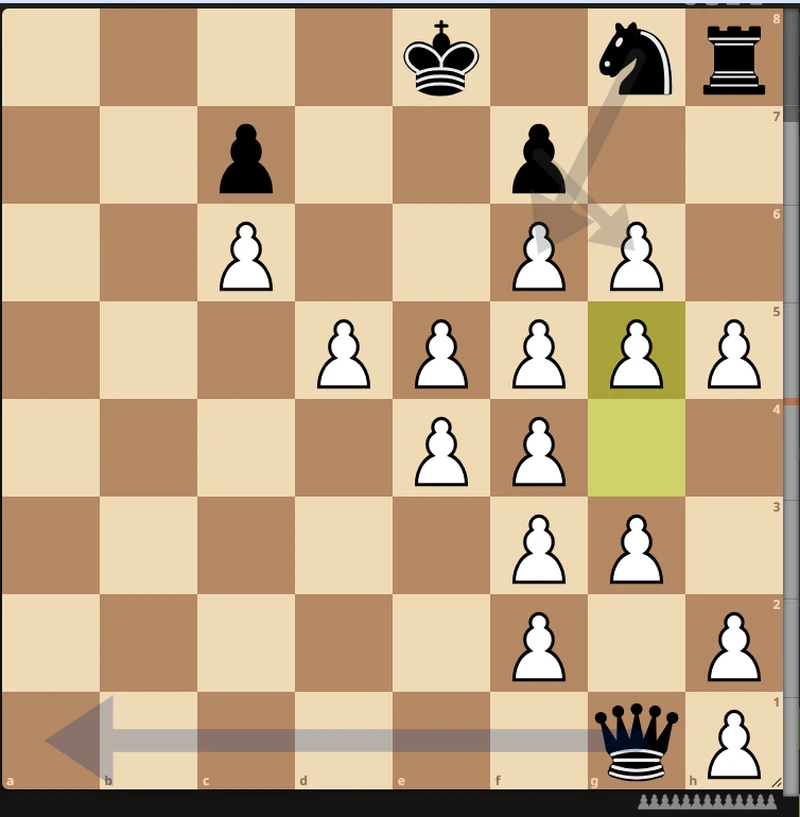
A typical dynamic position where Black has already captured the Queenside pawns and is starting to pick off the Kingside, while White is nearly forcing through on the Kingside against a Rook and Knight.
Horde strategy can be immense, with countless fine points in the opening, opening preparation that can last 40 moves, preventing a breakthrough, counterintuitive strategies, and sacrifices to boggle the mind. The Horde Variant team page links to studies that review strategies, opening theory, unique endgame ideas for Horde, and more. I hope to do a series of blog posts on Horde and other variants, namely Crazy House (maybe Bughouse) and Racing Kings, which I play and have developed some theories on.
A last note on the imaginative aspects of Horde. As I explain at the Detroit Institute of Arts Chess Club, museum patrons often ask why an art museum has a chess club. The symbolic nature of chess lends itself to artistic interpretation. Chess has just six different pieces that move according to simple geometric patterns and a few rules. Horde is no different, besides Black winning by capturing all White's material and not checkmate. What the pieces represent or mean is not part of the rules. Each player is free to imagine what the pieces represent or to not think about chess representing anything more significant. However, expert play usually requires looking at the pieces as a united force, controlling space, hence conducive to artistic imagination.
Horde presses questions that standard chess does not. With the classical military or national representation of chess, where each side represents an army or a Nation, chess presumes both sides are equally matched, with the same faculties, only giving White the advantage of the first move. In life, this is usually not the case; most struggles are not evenly matched, and the concept of 'elites' versus the masses is common. Consider Horde as a 'Peasant revolt', 'riot police against protestors', 'cabal of satanic elites against the masses', 'asymmetrical warfare', or other scenarios. Horde chess creates an even match between the standard chess forces against a Horde of 36 pawns, with equal prospects for both sides. This difference makes Horde unique among the chess variants and creates a world of imagination not available to regular chess. Horde can also provide analogies to world affairs and politics where asymmetrical conflict is more common than equal conflict.
Enjoy Horde. I hope to provide commentary on the upcoming Horde World Championship finals and to see you in the arena!
You may also like
 DIAChessClubStudies
Mystical Approaches to the Meaning of Chess
Know Thyself by Playing Chess! - Alternative Spiritual Reasons to Play Chess DIAChessClubStudies
Chess as a Pedagogical Tool – Four Basic Concepts
How to use Chess to teach children basic thinking skills! DIAChessClubStudies
3D Printing & Additive Manufacturing
A History and Overview of 3D Printers WFM fla2021
The Power of the Fixed Center
In this blog you will learn some tips of what you need to do in fixed center positions, take a look … GM NoelStuder
I won 200 rating points with a simple challenge
At the end of July, I set myself a challenge: 30 days, each day 6 games of 3+2 Blitz with full focus. WFM fla2021