
Chess Batteries
What are they? How to use them and/or defend against them.This blog is intended for beginner through intermediate players.
I hate to say it, but I succumb to my opponent’s ‘batteries’ more often than I care to admit. It’s not that I don’t know what they are, or how they’re created. I’m just oblivious to their formation or just react to them too slowly. Why? Because I’m usually “Dancing with myself”. If you’re not familiar with that expression in chess, please check out my recent blog:https://lichess.org/@/mullerrj/blog/dancing-with-myself/Ka20nRVd#0
What are batteries in chess?
In chess, a battery is a formation of two or more pieces lined up on the same file, rank or diagonal aiming at a target. That target could be an enemy’s queen or king. A battery could also target other important squares or pieces. It could also be used to apply devastating pressure on your opponent’s position leading to future attacks or material gains. The most famous example of a battery (utilizing 2 rooks and 1 queen) along a file is “Alekhine’s Gun”. More on Alekhine’s Gun later.
Not all batteries are formed on files with 2 rooks, a rook and queen, or 2 rooks and a queen however. They can form on diagonals utilizing a queen and bishop. They can also form on ranks with rooks or rooks and a queen- although not as common as on files.
Batteries create immense pressure on a file, rank or diagonal. They’re used for checkmates, breaking down defenses and creating pins.
Alekhine’s Gun
As aforementioned, one of the most famous battery formations in chess is known as “Alekhine’s Gun”. The name originates from a game played by former World Champion Alexander Alekhine against Aron Nimzowitsch in San Remo (1930). Alekhine’s precise handling of this formation demonstrated its destructive power, leading to a decisive breakthrough against Nimzowitsch’s position.
Here is the position after Alekhine’s 26th move: 26. Qc1
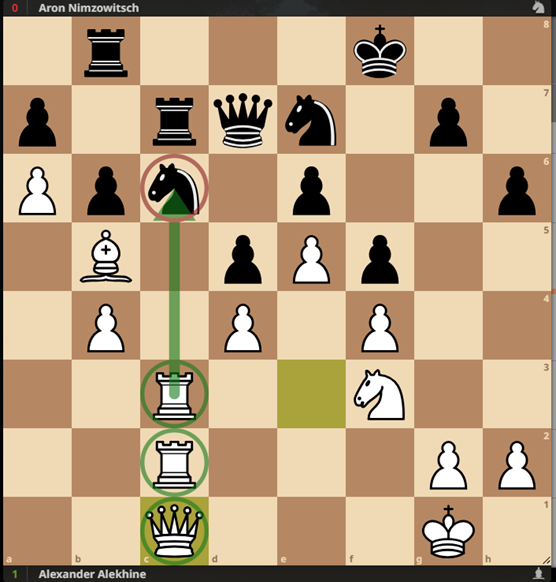
Notice Alekhine’s rooks lined up on the c-file with the white queen behind them targeting the black knight which is actually pinned to the black queen by the white bishop.
It’s black’s move. Play around with different moves for black. You’ll see that black is in a world of hurt with no good moves. Alekhine’s gun is creating immense pressure on Nimzowitsch’s position. Here’s the game:
The immense pressure is why Nimzowitsch resigned after Alekhine’s 30th move: 30. h4.
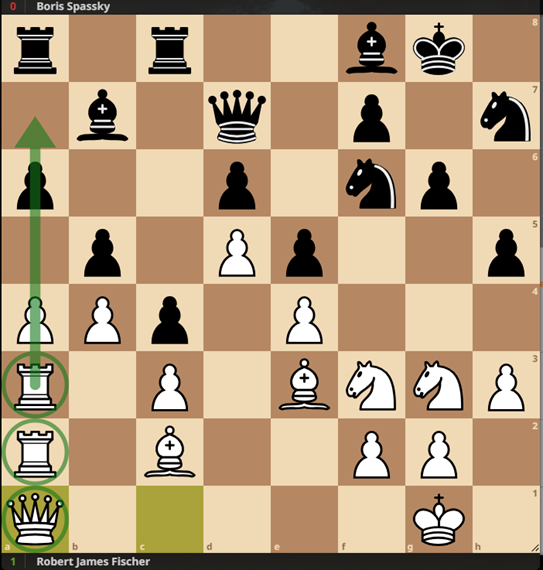
Here’s another example of Alekhine’s Gun, where Bobby Fischer used it in a game against Boris Spassky on his 26th move: 26. Qa1. You can see Bobby set it up (the Gun) on a closed file with the plan (obviously) of opening up the a-file on a future move with axb5. What I find interesting (or rather fascinating) is that it took Bobby 7 moves to set up the Gun. I believe the idea came to him on his 20th move: 20. Be3. Check it out, here’s the game:
Why you should know Alekhine’s Gun?
Alekhine’s Gun focuses immense pressure onto a single file often overwhelming defenses and creating decisive threats. It’s also great for attacking pinned pieces- as we just saw. It’s also great for targeting your opponent’s back ranks, especially the 7th rank as Alekhine eventually does in his game against Nimzowitsch.
Alekhine’s Gun highlights how to coordinate heavy pieces for maximum impact. It also encourages active, aggressive play and how to dominate files- even if they’re not open (as shown in the Fischer-Spassky game).
Even if Alekhine’s Gun doesn’t create an immediate attack, it’s a powerful tactic or idea that transitions well into endgames, often leading to a decisive advantage.
The bishop-queen battery
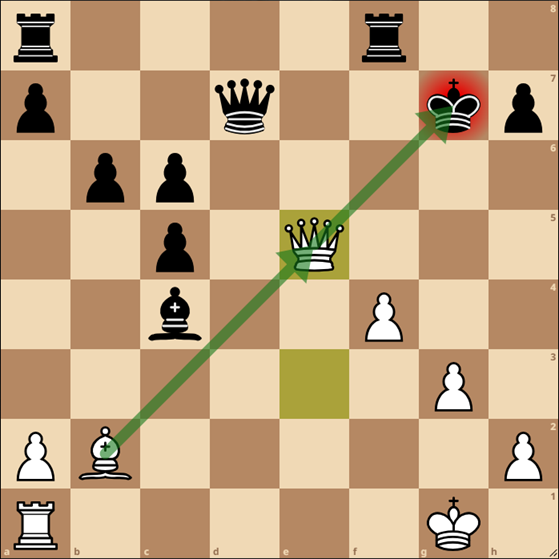
Here’s an example of a battery along a diagonal utilizing a queen and bishop. In this example, the white queen is directly attacking the black king. One bad move by the black king (in this position), such as Kf7, will put black in an even worse position.
How to defend against batteries?
Equally important as knowing how to set up or form batteries is knowing how to defend against them. Defending against a battery requires neutralizing the cumulative pressure aimed at a specific target.
Here’s 6 ways you can defend against batteries:
Block the Line of Attack: Interpose a piece of lower value, such as a pawn, between the battery and its target. In the queen-bishop battery example above, however, there is no lower value piece to interpose. The black rook could interpose, but it’s too high a value and the white queen would just capture it.
Over-Defend the Target: Add more defenders to the square being attacked. If you have an equal or greater number of defenders, the exchange is often unfavorable for the attacker. In the Alekhine v Nimzowitsch game, Nimzowitsch actually added more defenders, to his knight being attacked, bringing his other rook and his king into the fight/defense.
Challenge the Line: Occupy the same line with your own pieces to force an exchange. For instance, if your opponent has rooks doubled on an open file, placing your own rook on that file forces them to trade or retreat. Nimzowitch did this in his game against Alekhine.
Counter-Attack: Launch a threat against a higher-value piece in the battery, especially the queen if you can. This usually forces the battery to "break up" as the queen must move to safety.
Neutralize the "Front" Piece: Use a minor piece to trade off the leading (or front) piece of the battery. Removing the front piece (often a bishop in a queen-bishop battery) effectively "defuses" the threat.
Proactive Prevention: Be proactive. Avoid letting the battery form by contesting critical diagonals or files early in the game.
You may also like
 CM HGabor
How titled players lie to you
This post is a word of warning for the average club player. As the chess world is becoming increasin… mullerrj
Avoid burnout- play Chess960!
Are you burning out in standard chess? If so, have you played Chess960? RuyLopez1000
Why Are People Good At Chess?
The Rise and Fall of Chunks mullerrj
3 easy steps to help analyze your games
Playing without reviewing and analyzing your games is the slowest path to improvement. WFM fla2021
6 Tips to Stop Throwing Won Positions in Chess
We’ve all been there: a winning position... and somehow it slips away. Chess is cruel, but the lesso… thibault