
Why Engine Analysis Doesn’t Actually Teach You Chess
And what helped me actually break the plateauIf you play online chess long enough, something annoying almost always happens.
At first, your rating climbs. You learn a couple openings, stop hanging pieces, pick up a few tactical patterns. Improvement feels steady and rewarding.
Then one day, it stops.
You’re playing just as much. You might even be studying more. But your rating barely moves. Wins and losses cancel out, and every session feels like a grind. It’s not that you’re getting worse. It’s that you’ve hit a plateau.
Out of frustration, most of us turn to post-game engine analysis. It feels logical. If a machine can see everything, surely it can tell you how to improve.
But instead of clarity, you usually get a wall of evaluations, arrows, and “best move” lines... with almost no explanation for why you keep losing the same way.
The uncomfortable truth about engine analysis
Let’s be honest about what engines are good at.
They are exceptional at:
- finding the strongest move
- punishing tactical mistakes
- showing precise evaluations
They are terrible at:
- explaining decision-making
- identifying recurring habits
- teaching transferable judgment
An engine will happily tell you: “Nh7 loses 3.2 pawns.”
What it won’t tell you is: “You tend to retreat pieces instead of playing central counterplay when under pressure.”
But that second sentence is the real reason you lost.
Most losses don’t come from random blunders. They come from predictable decision patterns that show up across many games:
- attacking too early
- ignoring checks and captures
- playing passively when under pressure
- choosing flashy tactics instead of consolidation
Engines see moves. Humans repeat behaviors.
Why knowing the “best move” doesn’t change your results
This is where plateaued players get stuck.
You analyze a game.
You understand the mistake afterward.
You tell yourself, “Next time I’ll do it differently.”
And then, under time pressure, uncertainty, or emotion, you do the exact same thing again.
That’s not a lack of effort. It’s a mismatch between how engines explain chess and how humans actually learn.
Chess improvement doesn’t come from memorizing better moves. It comes from changing how you evaluate positions and make decisions in familiar situations.
If you don’t identify the type of mistake you’re prone to, you can’t interrupt it during a game. And if you can’t interrupt it, post-game analysis becomes a passive autopsy.
That’s the core reason engine analysis alone often fails to break rating plateaus.
What finally felt different: patterns, not just moves
Recently I found a tool called ChessLogix that approaches analysis differently. Instead of treating every game as an isolated story, it tries to answer questions like:
- Where do your losses actually come from?
- What kinds of positions trigger collapses?
- What decision habits show up in both wins and losses?
That shift matters, because “your biggest problem isn’t your worst move. It’s your most common mistake.”
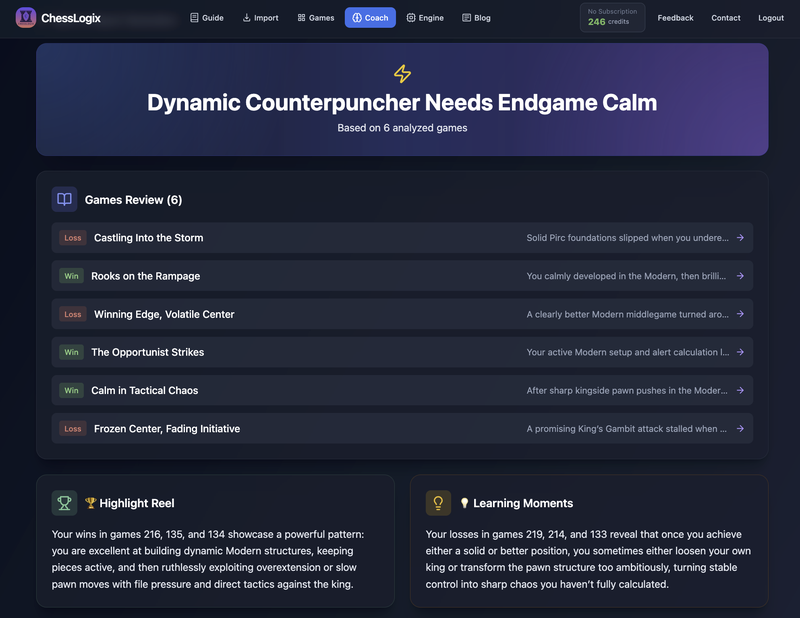
Example of a high-level summary across multiple games, plus “Highlight Reel” vs “Learning Moments.”
The idea is simple: if you keep blowing advantages in the same shape of position, you don’t need more engine lines. You need a diagnosis you can recognize in real time.
Why naming patterns changes everything
There’s a subtle but powerful shift when a mistake is given a name.
“Blunder” is vague.
“Phase Transition Blunder” is specific.
“Bad move” is forgettable.
“Central Push Blindspot” sticks.
Once a pattern has a name, it becomes:
- recognizable during the game
- easier to pause and question
- something you can actively train against
Instead of thinking “Is this move good?”, you start thinking: “Is this one of those moments again?”
That pause alone saves games.
Pattern + lesson
Example: a named failure pattern, a better alternative, and a clear rule to follow.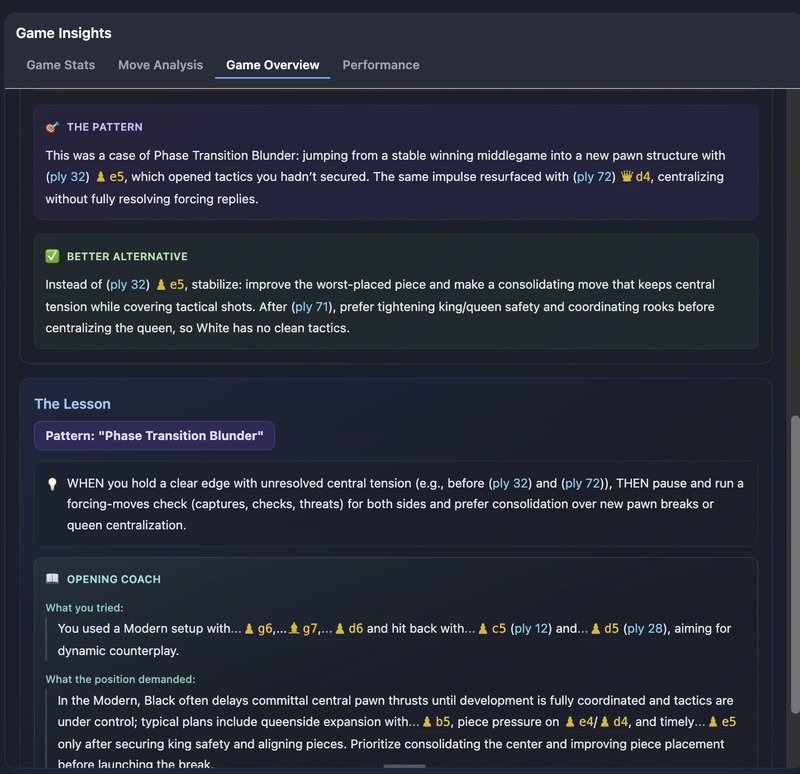
Another example pattern breakdown
Example: turning a swing into a readable story with “how it happened,” not just eval drops.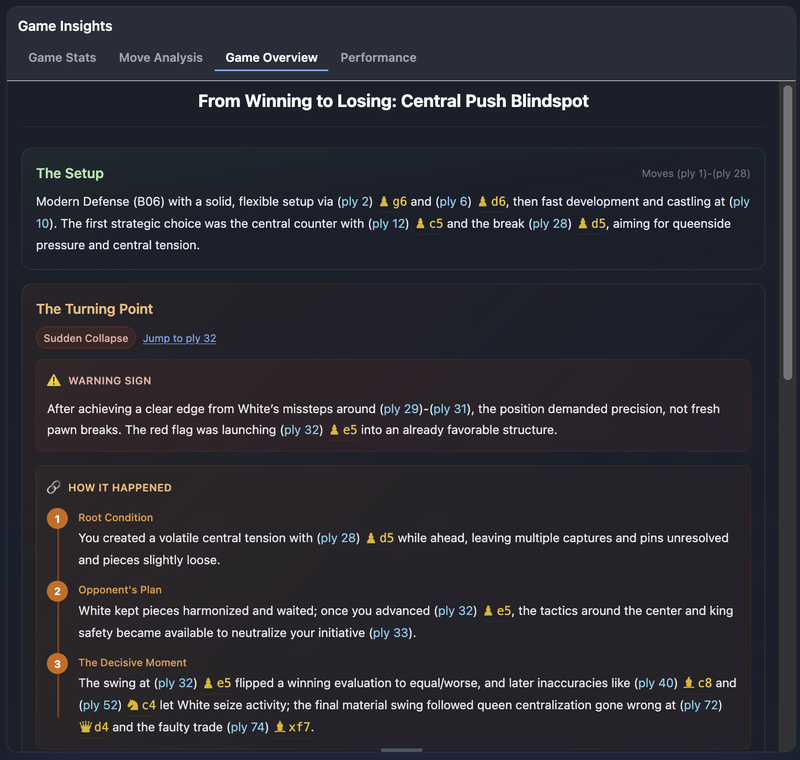
From analysis to coaching (the part most tools don’t do)
Most tools stop at explanation.
What I liked here is that the analysis is turned into constraints and training tasks. Not “play better,” but “do this one concrete thing for the next five games.”
Missions and progress signals
This is the difference between advice and a habit-building constraint.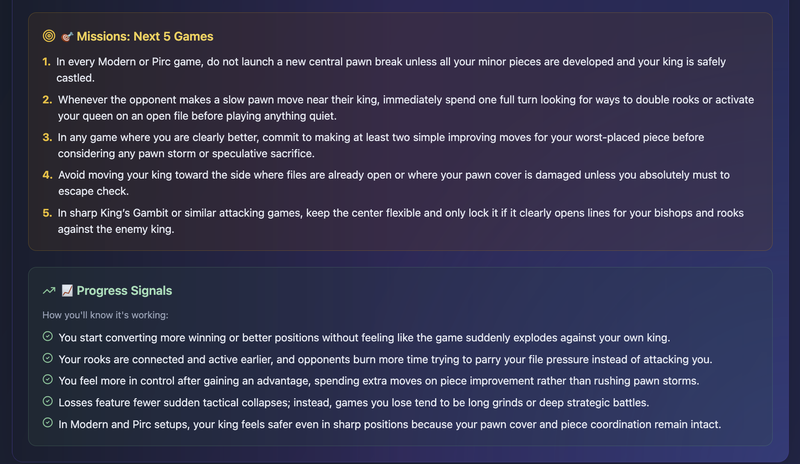
The missions are basically “behavior interrupts.” They’re designed to catch your default impulse before it becomes another repeat loss.
And the progress signals matter more than they look. They’re not “gain 50 rating.” They’re things like:
- fewer sudden tactical collapses
- converting better positions more smoothly
- getting rooks active earlier
- feeling safer in sharp structures
Those are realistic indicators that your decision-making is changing.
Level-up plan drills
Instead of generic advice, you get a simple training loop you can actually run.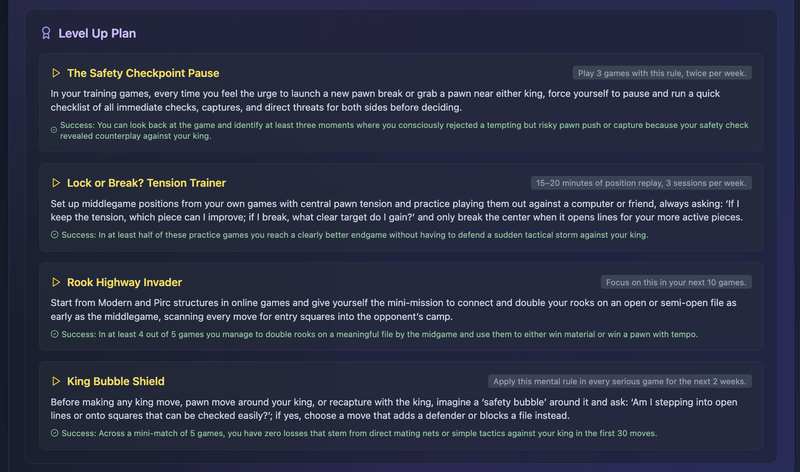
How ChessLogix breaks down a single mistake (and why this is useful)
The other piece that stood out is the “move explanation” flow. It doesn’t just say “mistake.” It tries to reconstruct intent and then show the refutation in human terms.
Move analysis explanation panels
This is the closest thing to “engine analysis that speaks human.”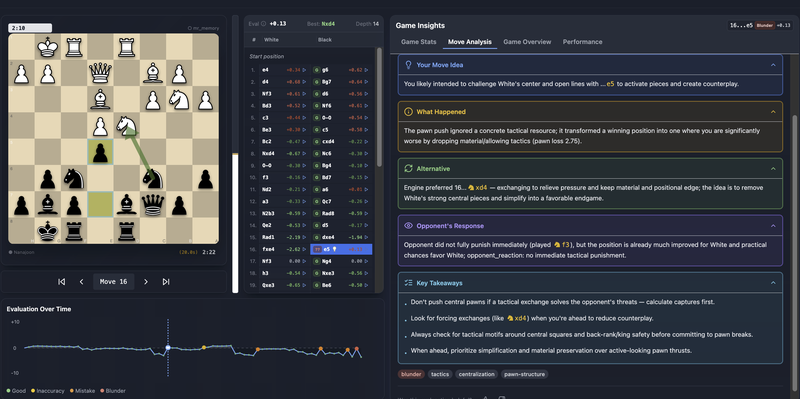
What’s nice about this structure:
- Your Move Idea acknowledges what you were trying to do (important for learning).
- What Happened explains the tactical or strategic reason it failed.
- Alternative gives the engine’s fix, with the point of the fix.
- Key Takeaways turns it into a reusable rule.
Even if you disagree with a recommendation, the “takeaway” is what you can carry into future positions.
Metrics that don’t just feel like flexing accuracy
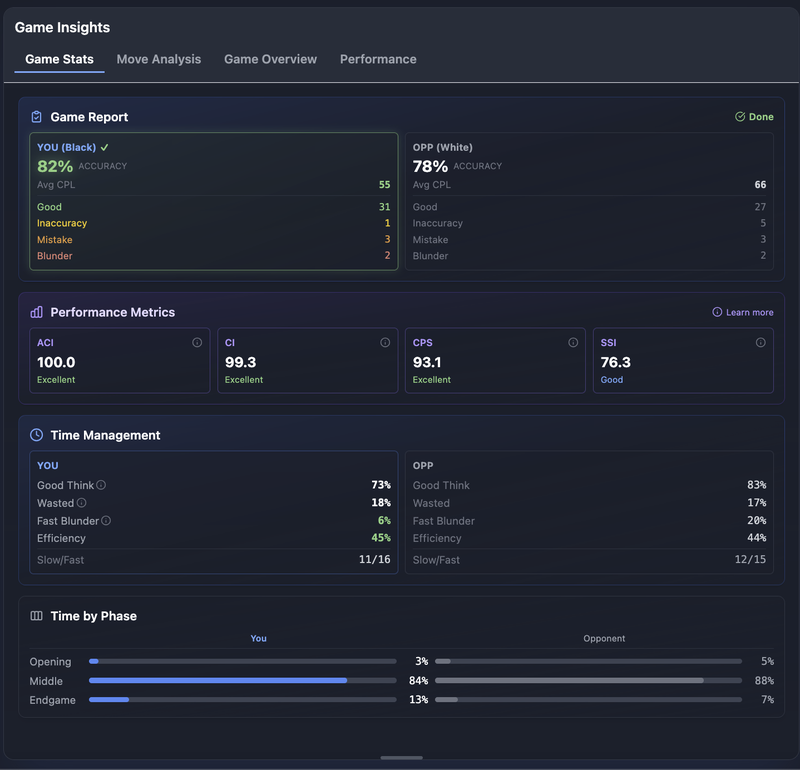
Accuracy can be useful, but it’s also easy to misread. You can play “accurate” in a quiet game and still have the same bad habits.
I liked seeing other views like time usage, phase breakdown, and consistency-style signals.
Game stats and time management
Performance rating estimation
And one more fun (but also humbling) feature is the performance rating estimate for each side, with key moments that drove the estimate.
I’d treat this as “rough feedback,” not a truth machine, but it’s still useful for spotting whether your losses come from one catastrophic moment or death-by-a-thousand-cuts.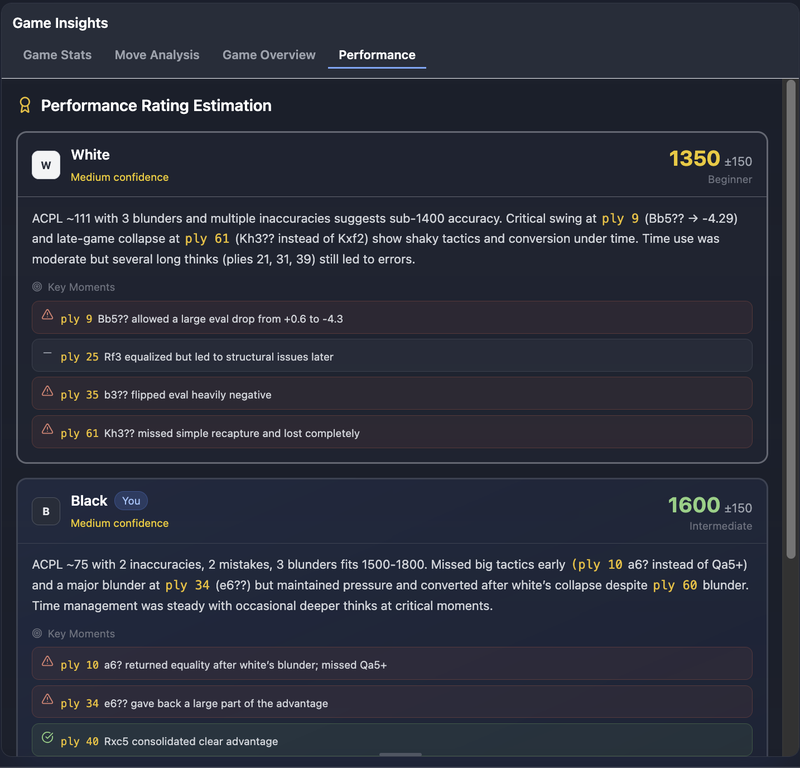
So what is ChessLogix, exactly?
Here’s the simplest way to describe what it’s doing:
- You import games (from Lichess).
- A chess engine analyzes positions and generates evaluations and candidate lines.
- A language model turns those engine outputs into explanations (intent, consequence, alternative, takeaways).
- Across multiple games, it tries to detect repeating behaviors and assigns them names.
- It turns those patterns into a learning loop: missions, drills, and progress signals.
Playstyle profile and trend detection
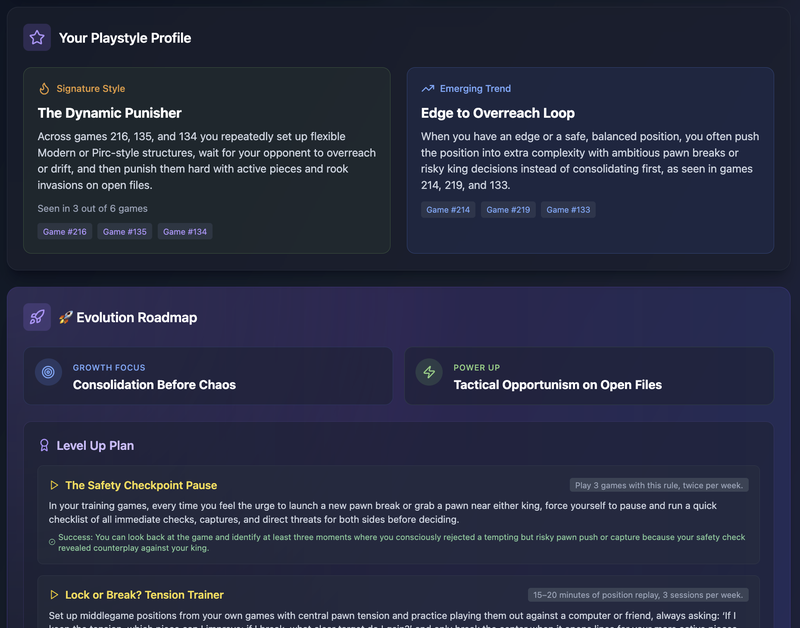
This is the “humans repeat behaviors” part made concrete.
This is the key difference versus standard engine review: the tool is not trying to make you “play like Stockfish.” It’s trying to help you eliminate the few recurring decision mistakes that keep dragging your results back down.
The real goal
The goal isn’t perfect play.
It’s fewer sudden collapses.
More games that reach balanced endgames.
More games where your opponent has to actually outplay you, instead of you self-destructing in the same familiar way.
If you’ve ever felt smarter after analysis but no better over the board, you already understand the problem.
If you want to check the tool out, it’s called ChessLogix. I’d approach it like a complement to Lichess analysis, not a replacement. Use it to extract habits and training constraints, then go play games and test whether those constraints change your decisions. I’m not affiliated with ChessLogix; I just found the approach interesting and useful.
