
From Sicilian to Petroff: My best chess decision
Every chess player needs an answer to 1.e4. For years mine was the Sicilian, but switching to the Petroff changed everything.TL;DR: I switched from the Sicilian to the Petroff after years of feeling uncomfortable and underperforming with 1...c5. The Petroff gave me more control, better practical results (from 40% to 60% win rate against 1.e4), and surprising flexibility without being as drawish as its reputation suggests. It is not a solution for everyone, but if you are struggling with an opening, sometimes the best move can be to try something new.
What to play against e4? “best by test” according to Fischer, and every chess player needs an answer to it.
Most players pick an opening early on and stick with it. For me, that was 1...c5. The Sicilian was fun to play, and I committed to it wholeheartedly. But over time, I realized I was never truly comfortable in its positions, despite studying it a lot and the experience I got. As I climbed the rating ladder, opponents came a bit better prepared, and I often found myself struggling in the sharp, open positions that the Sicilian invites.
The numbers backed up this feeling. Looking at all my games at Lichess, I won just 44% with the Sicilian as Black, slightly below the average for my rating group (48% for 1800–2000). More revealing, in my 150 most recent games, my win rate is 40%, a clear underperformance compared to the average for the Sicillian against 1.e4 (Figure 1 A, Table 1)
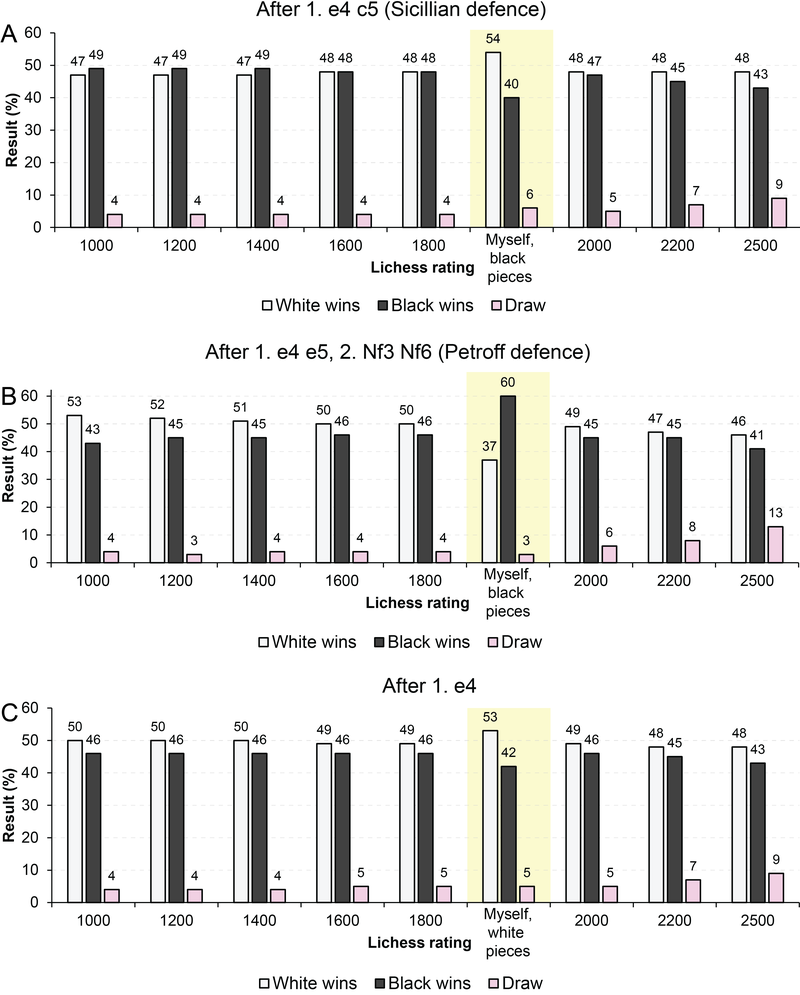
Figure 1. Win, loss, and draw rates in online blitz/rapid games after different opening choices, based on the Lichess database. (A) Results after 1.e4 c5 (Sicilian defence). (B) Results after 1.e4 e5 2.Nf3 Nf6 (Petroff defence). (C) Overall results after 1.e4 (all replies). Bars show the percentage of games won by White (light gray), won by Black (dark gray), and drawn (pink) across rating brackets from 1000 to 2500. Personal performance is highlighted in yellow for comparison with database averages.
At that point I started asking myself: Is the Sicilian really the right fit for me? Maybe a more solid opening would suit me better. Naturally, I looked toward 1...e5. Then I asked another question: Which 1...e5 defense do I personally hate facing the most as White? The answer was easy: the Petroff. It is extremely solid and I never really studied a specific line against it because it is not very often played.
I checked my stats against the Petroff playing 1.e4: against 2...Nf6, I had lost 50% of my games, compared to 46% against 2...Nc6. The Petroff was not only annoying but also effective, yet I hardly ever faced it (just 9% of my 1.e4 games, compared to 74% against 2...Nc6). That made me think: If I hate facing it, why not play it myself?
So I bought a Petroff course and began studying. Despite learning only 186 of 761 variations (24%), less work than for the Classical and Najdorf Sicilians, I felt much more comfortable. Since March/April I have played around 100 games with the Petroff in rapid and blitz and the difference has been remarkable.
First, the positions feel less chaotic than the Sicilian. I have a sense of control, I understand the plans, and I know what to do. Second, the results speak for themselves:
- With the Sicilian (average opponent rating 1816), I scored just 40% wins (Table 1).
- With the Petroff (average opponent rating 1883), I scored 60% wins (Table 1).
That is a massive improvement, and far above database averages (Figure 1B, Table 1).
Table 1. Online blitz/rapid results my last 251 games with the black pieces encountering 1.e4 on Lichess.
| Response to 1. e4 | Win (n, %) | Loss (n, %) | Draw (n, %) | Total |
|---|---|---|---|---|
| 1..c5 (1816 avg. opponent rating) | 60 (40 %) | 81 (54%) | 9 (6%) | 150 |
| 1..e5 (1883 avg. opponent rating) | 61 (60 %) | 37 (37%) | 3 (3%) | 101 |
Interestingly, my Petroff results are now even stronger than my games as White with 1.e4, where I already slightly overperform (53% wins, Figure 1C, Table 2).
Table 2. Online blitz/rapid results my last 241 games with the white pieces pieces on Lichess (n=251)
| First move | Win (n, %) | Loss (n, %) | Draw (n, %) | Total |
|---|---|---|---|---|
| 1. e4 (1862 avg. opponent rating) | 128 (53 %) | 101 (42%) | 12 (5%) | 241 |
Of course, 100 games is not the largest sample size, but it is enough to reveal a clear trend: switching from the Sicilian to a more solid line where I actually understand the positions has been one of the best choices in my chess improvement.
One final point worth addressing is the Petroff’s reputation as “too drawish.” At the very highest level and above 2500 on Lichess this stereotype definitely holds some truth. For example, Figure 1B shows that in the >2500 bracket, the Petroff has a 13% draw rate compared to 9% for the Sicilian. But below that level, the numbers simply do not support the myth. Across rating brackets, the difference in draw rates is at most one percentage point. In fact, in my own games, my draw rate has decreased since switching to the Petroff.
However, the Petroff is not a magic solution, and it is certainly not “the best defence against 1.e4” for everyone. What my experience shows, though, is that if you are consistently underperforming, it may be time to rethink your repertoire. Sometimes the biggest leap forward might not be learning more lines of your current opening, but to trying something new.
In the worst case, experimenting just gives you an extra weapon, or even two, against 1.e4. This is obviously an advantage, especially in OTB where opponents can prepare specifically for you. For example, my OTB games with black against 1.e4 have featured the Sicilian, which makes people prepare for that. It is not that I will never return to the Sicilian, but now I have a second option.
Have you ever made a major change in your repertoire? I would love to hear your experiences. Feel free to share your thoughts :)
You may also like
 Lichess
Should I report this?
Ever encountered a user misbehaving on Lichess? Check out if and how to report them. FM MattyDPerrine
Why Masters Crush Lower-Rated Players (and You Struggle)
Hint: The secret isn’t a high ceiling CM HGabor
How titled players lie to you
This post is a word of warning for the average club player. As the chess world is becoming increasin… WFM fla2021