
The Beauty of chess compositions
What if some of the most beautiful ideas in chess never occur in actual games? If you're also tired of endless discussions about ratings, opening theory, and engine evaluations, step into the fascinating world of chess problems—a branch of chess devoted not to winning, but to creativity, elegance, and ideas
Over-the-board players are often inclined to view chess compositions with a certain degree of skepticism and to dismiss it altogether, they frequently argue that such positions would never arise in a real game and that, in any case, almost every move seems to win. Neither point is inherently wrong, but both miss the essence of chess compositions: its purpose is precisely to demonstrate a mechanism, motif, or idea that does not occur — or occurs only very rarely — in practical play. They are not intended as training material for tournament players (but this is very debatable). Nevertheless, they are absolutely worth studying in greater depth rather than rejecting outright.
What follows is a brief introduction, featuring several challenging examples. At the end, there is a tricky problem for you to solve.
FIRST EXAMPLE AND SOME CONVENTIONS
I would like to begin with a composition by A. Ojanen. White to move and mate in 2.
After the key move 1.Nf2!, White threatens mate in four different ways: with the knight on d3 and g4, and with the queen on e1 and e4.
Black has a choice of four moves, each of which parries all of White's threats. The fact that Black happens to have no more than four legal moves available is irrelevant. What the composer wanted to demonstrate is that the number of White's threats and Black's defenses is identical. Black is nevertheless unfortunate, because every defense weakens the position in some way, allowing White to deliver a new mate.
Several characteristic features of chess problems can be observed here. In directmate problems, White is always to move, and there is exactly one solution. Here, only 1.Nf2 solves the problem; no other move does. Furthermore, the subsequent white moves should also be unique. In particular, the thematic variations should not contain alternative solutions.
Checks and captures on the first move are also extremely rare and are almost never encountered.
This problem also clearly illustrates that practical realism is not the objective. Since the presentation of an idea takes center stage, great emphasis is placed on economy of force. Every inactive piece is removed, and all remaining pieces serve a purpose—even if that purpose is merely to prevent an unintended alternative solution. This is why White often appears to have a significant material advantage.
Finally, one should remember that a chess composition is the result of creative work. Therefore, whenever a problem is published or shared, the composer's name, the original publication, and the year of publication should always be included. Give credit if you want to show a chess composition.
BATTLE BETWEEN BLACK AND WHITE PAWN
The next example shows that not only the solution and the threats can be relevant, but also the tries. A try is a white move for which Black has exactly one successful defense.
A pawn on its starting square can have up to four possible moves: it may advance one square, advance two squares, or capture on either side. It is therefore natural to construct problems around this fact, as in Arthur Christopher Reeves' mate in 2.
White can create four mating threats with the c-pawn. 1.c4 threatens Qd5#, 1.c3 threatens Re5#, 1.cxd3 threatens d4#, and 1.cxb3 threatens b4#.
However, all of these moves are merely tries, because Black has exactly one refutation against each white pawn move.
Black can do with the e-pawn exactly what White can do with the c-pawn! Each of the four possible moves of Black's e-pawn refutes one of White's tries, so every possible move of the black pawn appears in the problem.
The actual solution is 1.Rb4!, threatening 2.Ne4#.
Even though a move with the c-pawn is not the solution, those tries are still an essential part of the content of the problem. A solver may find the key move before discovering the tries and thereby miss the true thematic content. Without the tries, the example would not be particularly interesting.
THE NOVOTNY THEME
Novotny in a Real Game
One motif frequently encountered in problem chess is the Novotny. This is a classic interference theme involving, by its very nature, a rook and a bishop. A rook and a bishop share an intersection square. White occupies this square to destroy the coordination between the defenders. If the rook captures, it blocks the bishop; if the bishop captures, it blocks the rook. Although rare, this motif can occasionally occur in practical play. For example in a rapid game between David Navara and Anna Dergatschova in 2007
The black bishop on b7 prevents Qd5, while the rook on a6 prevents Qe6, which would otherwise be immediate mate. Once these ideas are recognized, the brilliant move Rc6! becomes apparent. Regardless of how Black captures, mate follows with either Qe6 or Qd5. Black has no defense and therefore resigned.
As beautiful as Navara's Rc6 is, problemists naturally seek to explore and develop the motif further. They investigate what is possible. The Novotny theme has been studied since the mid-19th century, and thousands of problems now exist that treat it in one form or another.
Novotny in a Composition
One particularly impressive example, in my opinion, is by Eberhard Schulze, published in Schach Aktiv in 2003. It is a mate in 4 featuring multiple chained Novotnys. To execute the final Novotny, White must first introduce another Novotny. The main plan initially fails because Black possesses a Novotny defense of his own. White therefore employs a preparatory Novotny to enable the principal idea.
White's main idea is 1.Bd4, placing the bishop on the intersection of Black's rook on c4 and bishop on b2. This simultaneously threatens 2.Bxe4# and 2.Rxf6#.
However, White's own pieces also share an intersection square, namely c6. Black can therefore play a Novotny of his own with Rc4-c6. White cannot maintain both mating threats, and Black can delay mate long enough.
The solution is therefore 1.Nc2!, threatening 2.Nd4+ on the next move—another Novotny—followed by timely mate. Black has no choice but to capture the knight with 1...Rxc2 and move the rook across the c3-square. White exploits this with 2.Nc3, threatening 3.Rxf6#. This forces 2...Bxc3.
Now, however, the black bishop blocks the rook, which can no longer reach c6. Finally White's original idea works: 3.Bd4! Black may choose how to be mated, but can no longer postpone the mate on the following move.
GIEGOLD
Many individuals have achieved remarkable success in chess compositions while remaining largely unknown to OTB players. One of my favorite composers is the German Fritz Emil Giegold. Allegedly, he occasionally lost OTB games on tournaments because he searched for a particularly beautiful win instead of the simplest one. He corresponded with Tarrasch, E. Bogoljubow, and K. Richter.
He also had a highly distinctive composing style. Most of his nearly 800 problems are based on zugzwang, yet the key move is often extremely paradoxical — the last move one would calculate in an actual game. For experienced solvers, merely knowing that a composition is by Giegold is often a major clue. The following mate in 3, published in Deutsche Schachblätter in 1952, is an example.
White has many ideas in activating the rook, also Nh3 would be mate without the black queen and bishop defending it. But because there is no useless piece it is clear that White must activate his rook somehow.
At first glance, the rook move 1.Rf6! looks useless. But this move puts Black in a bind because of the sequence 2.Nh3+ and 3.Bxf2#. 1.Bh3 is a good defensive try, but then after 2.Ra6 Black Queen is overloaded.
ALLUMWANDLUNG
Most chess players find pawn promotions particularly appealing. It is therefore unsurprising that promotions are also highly popular in problem chess. Unlike practical play, however, promotion to a queen is not the primary focus. Instead, promotions to a rook, bishop, or knight take center stage.
Especially popular are Allumwandlungen (german term for all-promotion) meaning that all four possible promotion pieces appear in the problem. One of the most famous examples is by Nils Høeg, published in Norges Sjakkforbund II Problemturnering in 1905.
It is said that Høeg spent twelve years discovering the underlying mechanism. The idea is of course that, depending on Black's defense, White must promote to a different piece in order to achieve mate in 3.
BABSON
One of the true highlights of chess compositions is the Babson Task. The astonishing idea is as follows: White plays the key move. Black then promotes a pawn to a queen, knight, rook, or bishop. White must subsequently promote one of his own pawns to exactly the same piece. If Black promotes to a bishop, White's only solution is to promote to a bishop as well. If Black promotes to a knight, White must likewise promote to a knight.
This idea was first proposed by Joseph Babson in 1884, and many composers attempted to realize it. Among them was the French composer Pierre Drumare, who spent many years searching for a satisfactory implementation.
Ninety-nine years after the idea was formulated, the previously unknown Leonid Yarosh became the first person to realize it in a directmate problem. It was published in Shakhmaty v SSSR in March 1983 as a mate in 4.
White's key move is 1.a7. Black may then promote the a-pawn to any piece. On White's second move, the b-pawn must promote to exactly the same piece in order to achieve the objective.
It is interesting to examine why White cannot simply promote to a queen regardless of Black's choice.
For example, if Black promotes to a rook and White promotes to a queen, Black could not play 3...Kxc4; instead, Black would be stalemated.
Likewise, after Black promotes to a bishop, Black would be stalemated on move three because the bishop on e4 would be pinned.
Finally, if Black promotes to a knight, White must also promote to a knight and then play 3.Qc1, depriving the black king of c3 so that 4.Nc6 with mate becomes possible.
Other black first moves, including 1...Qxd8+, do not save Black either.
BEYOND DIRECTMATES
In addition to directmate problems, many other genres exist in problem chess. There are helpmates, in which both sides cooperate to mate the black king; selfmates, in which White forces Black to mate the white king; and retrograde problems, in which one must determine the last moves played.
Fairy pieces, such as the Nightrider (a line-moving knight), and modified rules are also highly popular.
Chess composition is a field with endlessly fascinating possibilities.
PROBLEM TO SOLVE
To conclude, here is a problem by Herbert Grasemann, published in Schach-Expreß in 1949.
Mate in four. Enjoy the solving and - more important - the solution!
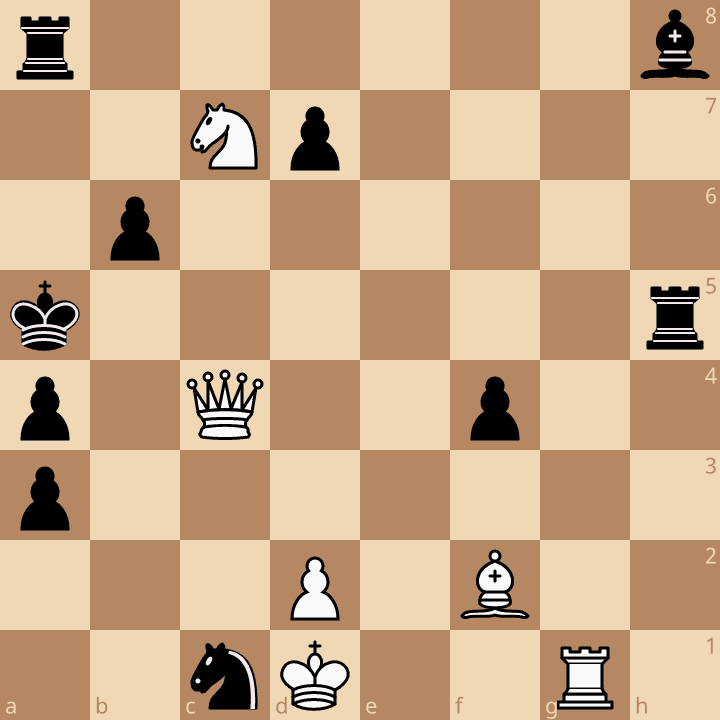
if you want to analyze it with Stockfish, here is the FEN code for copy & paste:
r6b/2Np4/1p6/k6r/p1Q2p2/p7/3P1B2/2nK2R1 w - - 0 1
You may also like
 ChessMonitor_Stats
Where do Grandmasters play Chess? - Lichess vs. Chess.com
This is the first large-scale analysis of Grandmaster activity across Chess.com and Lichess from 200… DeepHuman_95
The Beauty of interference
In this article I show you more motifs from the world of chess combinations, in particular intersect… NM ZugAddict
Are you rated 1600? Good.
It's good to be 1600 and I will explain why thibault
How I started building Lichess
I get this question sometimes. How did you decide to make a chess server? The truth is, I didn't. CM HGabor
How titled players lie to you
This post is a word of warning for the average club player. As the chess world is becoming increasin… GM Avetik_ChessMood